Rowett Institute of Nutrition and Health, University of Aberdeen, Aberdeen, AB25 2ZD, UK.
Aberdeen Biomedical Imaging Centre, University of Aberdeen, Aberdeen, AB25 2ZD, UK.
Sci Rep. 2021 Jan 13;11(1):943. doi: 10.1038/s41598-020-78062-2.
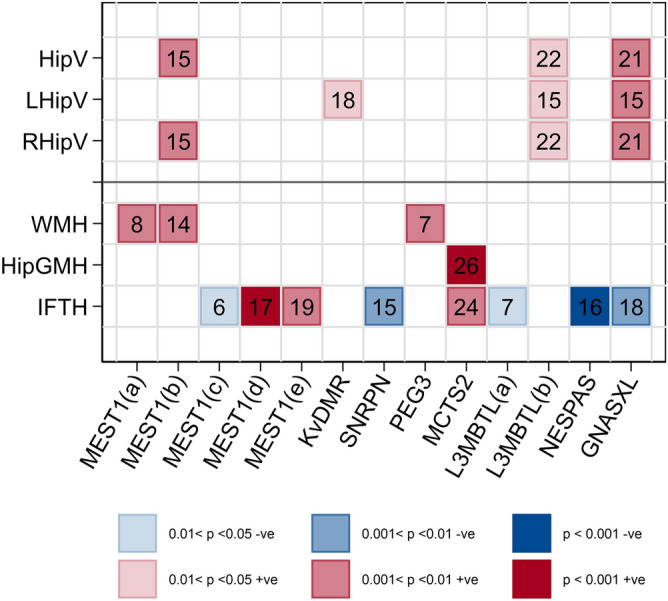
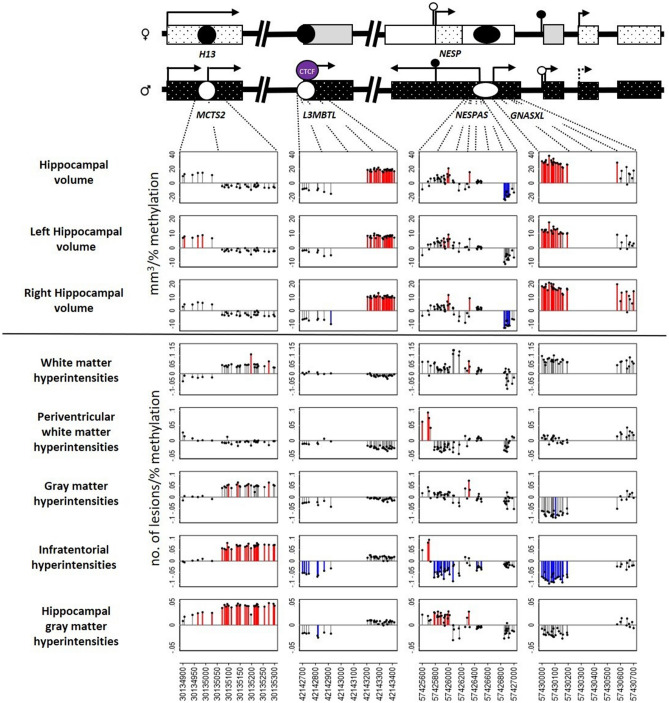
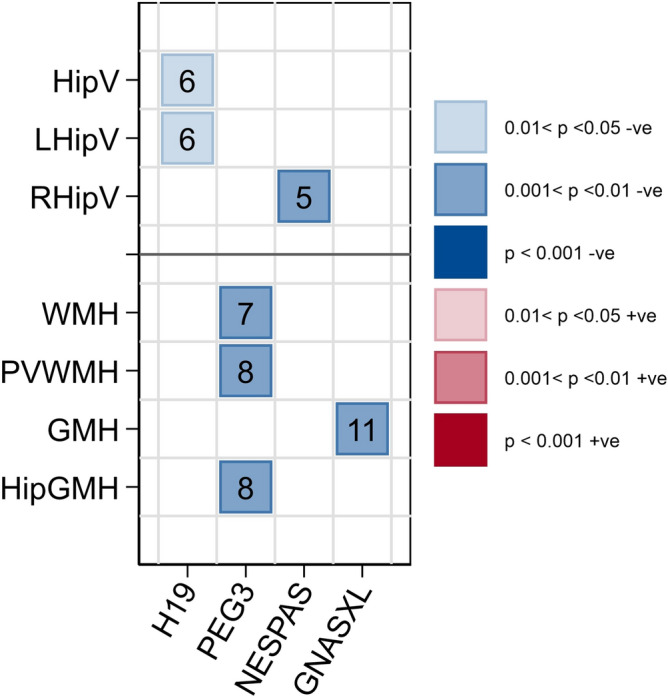
Epigenetic imprinting is important for neurogenesis and brain function. Hippocampal volumes and brain hyperintensities in late life have been associated with early life circumstances. Epigenetic imprinting may underpin these associations. Methylation was measured at 982 sites in 13 imprinted locations in blood samples from a longitudinal cohort by bisulphite amplicon sequencing. Hippocampal volumes and hyperintensities were determined at age 64y and 72y using MRI. Hyperintensities were determined in white matter, grey matter and infratentorial regions. Permutation methods were used to adjust for multiple testing. At 64y, H19/IGF2 and NESPAS methylation predicted hippocampal volumes. PEG3 predicted hyperintensities in hippocampal grey matter, and white matter. GNASXL predicted grey matter hyperintensities. Changes with age were predicted for hippocampal volume (MEST1, KvDMR, L3MBTL, GNASXL), white matter (MEST1, PEG3) and hippocampal grey matter hyperintensities (MCTS2, GNASXL, NESPAS, L3MBTL, MCTS2, SNRPN, MEST1). Including childhood cognitive ability, years in education, or socioeconomic status as additional explanatory variables in regression analyses did not change the overall findings. Imprinting methylation in multiple genes predicts brain structures, and their change over time. These findings are potentially relevant to the development of novel tests of brain structure and function across the life-course, strategies to improve cognitive outcomes, and our understanding of early influences on brain development and function.
表观遗传印迹对于神经发生和大脑功能很重要。晚年的海马体体积和脑高信号与早年的生活环境有关。表观遗传印迹可能是这些关联的基础。通过亚硫酸盐扩增测序,在纵向队列的血液样本中,在 13 个印迹位置的 982 个位点测量了甲基化。在 64 岁和 72 岁时使用 MRI 确定海马体体积和高信号。在白质、灰质和小脑下区确定高信号。通过置换方法进行多次测试调整。在 64 岁时,H19/IGF2 和 NESPAS 甲基化预测海马体体积。PEG3 预测海马体灰质和白质中的高信号。GNASXL 预测灰质高信号。与年龄相关的变化预测了海马体体积(MEST1、KvDMR、L3MBTL、GNASXL)、白质(MEST1、PEG3)和海马体灰质高信号(MCTS2、GNASXL、NESPAS、L3MBTL、MCTS2、SNRPN、MEST1)。在回归分析中,将儿童认知能力、受教育年限或社会经济地位作为额外的解释变量,并没有改变总体发现。多个基因的印迹甲基化预测了大脑结构及其随时间的变化。这些发现可能与开发整个生命周期的大脑结构和功能的新测试、改善认知结果的策略以及我们对早期影响大脑发育和功能的理解有关。