• 文献检索
  • 文档翻译
  • 深度研究
  • 学术资讯
  • Suppr Zotero 插件Zotero 插件
  • 邀请有礼
  • 套餐&价格
  • 历史记录
应用&插件
Suppr Zotero 插件Zotero 插件浏览器插件Mac 客户端Windows 客户端微信小程序
定价
高级版会员购买积分包购买API积分包
服务
文献检索文档翻译深度研究API 文档MCP 服务
关于我们
关于 Suppr公司介绍联系我们用户协议隐私条款
关注我们

Suppr 超能文献

核心技术专利:CN118964589B侵权必究
粤ICP备2023148730 号-1Suppr @ 2026

文献检索

告别复杂PubMed语法,用中文像聊天一样搜索,搜遍4000万医学文献。AI智能推荐,让科研检索更轻松。

立即免费搜索

文件翻译

保留排版,准确专业,支持PDF/Word/PPT等文件格式,支持 12+语言互译。

免费翻译文档

深度研究

AI帮你快速写综述,25分钟生成高质量综述,智能提取关键信息,辅助科研写作。

立即免费体验

开发一种机器学习模型,用于预测重症监护病房入院早期的儿科死亡率。

Development of a machine learning model for predicting pediatric mortality in the early stages of intensive care unit admission.

机构信息

Department of Emergency Medicine, Seoul National University Hospital, Seoul, Korea.

Department of Biomedical Engineering, Seoul National University College of Medicine, Seoul, Korea.

出版信息

Sci Rep. 2021 Jan 13;11(1):1263. doi: 10.1038/s41598-020-80474-z.

DOI:10.1038/s41598-020-80474-z
PMID:33441845
原文链接:https://pmc.ncbi.nlm.nih.gov/articles/PMC7806776/
Abstract

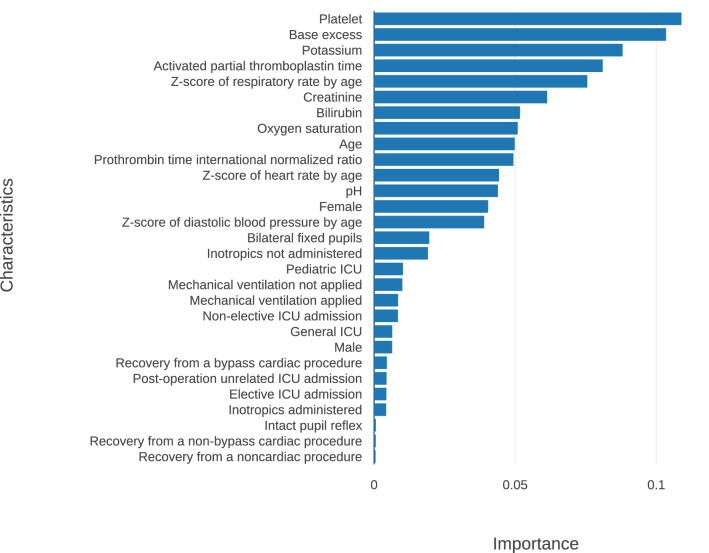
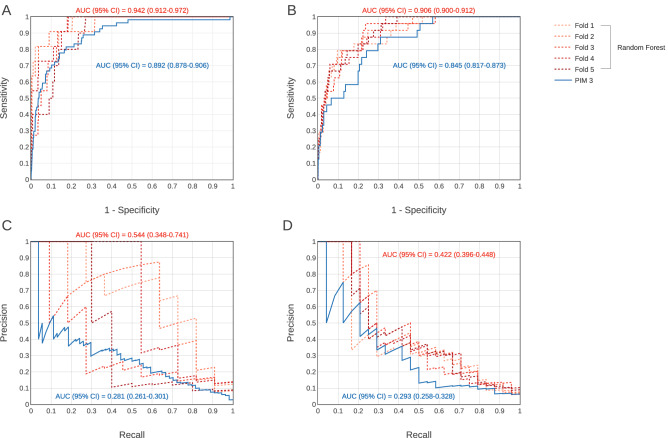
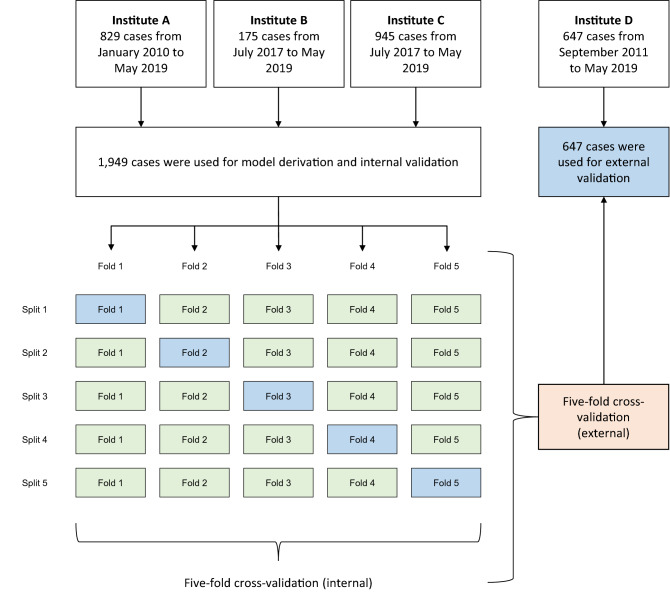
The aim of this study was to develop a predictive model of pediatric mortality in the early stages of intensive care unit (ICU) admission using machine learning. Patients less than 18 years old who were admitted to ICUs at four tertiary referral hospitals were enrolled. Three hospitals were designated as the derivation cohort for machine learning model development and internal validation, and the other hospital was designated as the validation cohort for external validation. We developed a random forest (RF) model that predicts pediatric mortality within 72 h of ICU admission, evaluated its performance, and compared it with the Pediatric Index of Mortality 3 (PIM 3). The area under the receiver operating characteristic curve (AUROC) of RF model was 0.942 (95% confidence interval [CI] = 0.912-0.972) in the derivation cohort and 0.906 (95% CI = 0.900-0.912) in the validation cohort. In contrast, the AUROC of PIM 3 was 0.892 (95% CI = 0.878-0.906) in the derivation cohort and 0.845 (95% CI = 0.817-0.873) in the validation cohort. The RF model in our study showed improved predictive performance in terms of both internal and external validation and was superior even when compared to PIM 3.

摘要

本研究旨在使用机器学习开发一种在重症监护病房(ICU)入院早期预测儿科死亡率的预测模型。我们招募了年龄小于 18 岁且在四家三级转诊医院 ICU 入院的患者。其中三家医院被指定为机器学习模型开发和内部验证的推导队列,另一家医院被指定为外部验证的验证队列。我们开发了一种预测 ICU 入院后 72 小时内儿科死亡率的随机森林(RF)模型,评估了其性能,并将其与儿科死亡率 3 指数(PIM 3)进行了比较。在推导队列中,RF 模型的受试者工作特征曲线下面积(AUROC)为 0.942(95%置信区间 [CI]:0.912-0.972),在验证队列中为 0.906(95%CI:0.900-0.912)。相比之下,在推导队列中,PIM 3 的 AUROC 为 0.892(95%CI:0.878-0.906),在验证队列中为 0.845(95%CI:0.817-0.873)。我们研究中的 RF 模型在内部和外部验证方面均显示出了改进的预测性能,甚至优于 PIM 3。
https://cdn.ncbi.nlm.nih.gov/pmc/blobs/0dc5/7806776/c929689e8eca/41598_2020_80474_Fig3_HTML.jpg
https://cdn.ncbi.nlm.nih.gov/pmc/blobs/0dc5/7806776/8f749a9347ef/41598_2020_80474_Fig1_HTML.jpg
https://cdn.ncbi.nlm.nih.gov/pmc/blobs/0dc5/7806776/1545decb9561/41598_2020_80474_Fig2_HTML.jpg
https://cdn.ncbi.nlm.nih.gov/pmc/blobs/0dc5/7806776/c929689e8eca/41598_2020_80474_Fig3_HTML.jpg
https://cdn.ncbi.nlm.nih.gov/pmc/blobs/0dc5/7806776/8f749a9347ef/41598_2020_80474_Fig1_HTML.jpg
https://cdn.ncbi.nlm.nih.gov/pmc/blobs/0dc5/7806776/1545decb9561/41598_2020_80474_Fig2_HTML.jpg
https://cdn.ncbi.nlm.nih.gov/pmc/blobs/0dc5/7806776/c929689e8eca/41598_2020_80474_Fig3_HTML.jpg

相似文献

1
Development of a machine learning model for predicting pediatric mortality in the early stages of intensive care unit admission.开发一种机器学习模型,用于预测重症监护病房入院早期的儿科死亡率。
Sci Rep. 2021 Jan 13;11(1):1263. doi: 10.1038/s41598-020-80474-z.
2
Dynamic and explainable machine learning prediction of mortality in patients in the intensive care unit: a retrospective study of high-frequency data in electronic patient records.动态可解释机器学习预测 ICU 患者死亡率:电子患者记录中高频数据的回顾性研究。
Lancet Digit Health. 2020 Apr;2(4):e179-e191. doi: 10.1016/S2589-7500(20)30018-2. Epub 2020 Mar 12.
3
Application of artificial neural networks to establish a predictive mortality risk model in children admitted to a paediatric intensive care unit.应用人工神经网络建立儿科重症监护病房收治儿童的死亡风险预测模型。
Singapore Med J. 2006 Nov;47(11):928-34.
4
Early hospital mortality prediction of intensive care unit patients using an ensemble learning approach.基于集成学习方法的重症监护病房患者早期住院病死率预测。
Int J Med Inform. 2017 Dec;108:185-195. doi: 10.1016/j.ijmedinf.2017.10.002. Epub 2017 Oct 5.
5
Machine learning models to evaluate mortality in pediatric patients with pneumonia in the intensive care unit.机器学习模型评估重症监护病房中肺炎患儿的死亡率。
Pediatr Pulmonol. 2024 May;59(5):1256-1265. doi: 10.1002/ppul.26897. Epub 2024 Feb 14.
6
Development of machine learning models predicting mortality using routinely collected observational health data from 0-59 months old children admitted to an intensive care unit in Bangladesh: critical role of biochemistry and haematology data.利用孟加拉国重症监护病房 0-59 个月大儿童的常规观察性健康数据开发预测死亡率的机器学习模型:生物化学和血液学数据的关键作用。
BMJ Paediatr Open. 2024 Jul 22;8(1):e002365. doi: 10.1136/bmjpo-2023-002365.
7
Development and Validation of Unplanned Extubation Prediction Models Using Intensive Care Unit Data: Retrospective, Comparative, Machine Learning Study.基于 ICU 数据的非计划性拔管预测模型的开发和验证:回顾性、对比、机器学习研究。
J Med Internet Res. 2021 Aug 11;23(8):e23508. doi: 10.2196/23508.
8
Can generic paediatric mortality scores calculated 4 hours after admission be used as inclusion criteria for clinical trials?入院4小时后计算出的通用儿科死亡率评分能否用作临床试验的纳入标准?
Crit Care. 2004 Aug;8(4):R185-93. doi: 10.1186/cc2869. Epub 2004 May 21.
9
Predicting in-hospital mortality of patients with acute kidney injury in the ICU using random forest model.应用随机森林模型预测 ICU 中急性肾损伤患者的院内死亡率。
Int J Med Inform. 2019 May;125:55-61. doi: 10.1016/j.ijmedinf.2019.02.002. Epub 2019 Feb 12.
10
Validation of the Pediatric Index of Mortality 3 in a Single Pediatric Intensive Care Unit in Korea.韩国一家儿科重症监护病房中儿童死亡率指数3的验证
J Korean Med Sci. 2017 Feb;32(2):365-370. doi: 10.3346/jkms.2017.32.2.365.

引用本文的文献

1
Prediction cardiovascular deterioration in a paediatric intensive care unit (PicEWS): a machine learning modelling study of routinely collected health-care data.儿科重症监护病房心血管恶化的预测(PicEWS):一项基于常规收集的医疗数据的机器学习建模研究
EClinicalMedicine. 2025 Jun 18;85:103255. doi: 10.1016/j.eclinm.2025.103255. eCollection 2025 Jul.
2
Machine Learning for Predicting Critical Events Among Hospitalized Children.用于预测住院儿童危急事件的机器学习
JAMA Netw Open. 2025 May 1;8(5):e2513149. doi: 10.1001/jamanetworkopen.2025.13149.
3
Dynamic mortality prediction in critically Ill children during interhospital transports to PICUs using explainable AI.

本文引用的文献

1
Distribution of Pediatric Vital Signs in the Emergency Department: A Nationwide Study.急诊科儿童生命体征分布:一项全国性研究。
Children (Basel). 2020 Aug 5;7(8):89. doi: 10.3390/children7080089.
2
Validation of Pediatric Index of Mortality 3 for Predicting Mortality among Patients Admitted to a Pediatric Intensive Care Unit.用于预测儿科重症监护病房收治患者死亡率的儿童死亡率指数3的验证
Acute Crit Care. 2018 Aug;33(3):170-177. doi: 10.4266/acc.2018.00150. Epub 2018 Aug 31.
3
Artificial neural networks improve and simplify intensive care mortality prognostication: a national cohort study of 217,289 first-time intensive care unit admissions.
使用可解释人工智能对危重症儿童在转诊至儿科重症监护病房期间的动态死亡率进行预测。
NPJ Digit Med. 2025 Feb 17;8(1):108. doi: 10.1038/s41746-025-01465-w.
4
Artificial Intelligence in Pediatric Emergency Medicine: Applications, Challenges, and Future Perspectives.人工智能在儿科急诊医学中的应用、挑战及未来展望
Biomedicines. 2024 May 30;12(6):1220. doi: 10.3390/biomedicines12061220.
5
Development of a deep learning model for predicting critical events in a pediatric intensive care unit.用于预测儿科重症监护病房危急事件的深度学习模型的开发。
Acute Crit Care. 2024 Feb;39(1):186-191. doi: 10.4266/acc.2023.01424. Epub 2024 Feb 20.
6
Artificial intelligence-based clinical decision support in pediatrics.基于人工智能的儿科临床决策支持。
Pediatr Res. 2023 Jan;93(2):334-341. doi: 10.1038/s41390-022-02226-1. Epub 2022 Jul 29.
7
Machine Learning-Based Systems for the Anticipation of Adverse Events After Pediatric Cardiac Surgery.基于机器学习的小儿心脏手术后不良事件预测系统。
Front Pediatr. 2022 Jun 27;10:930913. doi: 10.3389/fped.2022.930913. eCollection 2022.
8
Ignorance Isn't Bliss: We Must Close the Machine Learning Knowledge Gap in Pediatric Critical Care.无知并非幸福:我们必须弥合儿科重症监护中机器学习的知识差距。
Front Pediatr. 2022 May 10;10:864755. doi: 10.3389/fped.2022.864755. eCollection 2022.
9
An Artificial Neural Network Model for Pediatric Mortality Prediction in Two Tertiary Pediatric Intensive Care Units in South Africa. A Development Study.南非两家三级儿科重症监护病房中用于儿科死亡率预测的人工神经网络模型。一项开发研究。
Front Pediatr. 2022 Feb 25;10:797080. doi: 10.3389/fped.2022.797080. eCollection 2022.
10
Predicting Hemodynamic Failure Development in PICU Using Machine Learning Techniques.使用机器学习技术预测儿科重症监护病房血流动力学衰竭的发展
Diagnostics (Basel). 2021 Jul 20;11(7):1299. doi: 10.3390/diagnostics11071299.
人工神经网络改善并简化重症监护死亡率预测:一项针对217,289例首次入住重症监护病房患者的全国队列研究。
J Intensive Care. 2019 Aug 16;7:44. doi: 10.1186/s40560-019-0393-1. eCollection 2019.
4
A deep learning model for real-time mortality prediction in critically ill children.深度学习模型实时预测危重症儿童死亡率。
Crit Care. 2019 Aug 14;23(1):279. doi: 10.1186/s13054-019-2561-z.
5
Comparison of Outcomes using Pediatric Index of Mortality (PIM) -3 and PIM-2 Models in a Pediatric Intensive Care Unit.在儿科重症监护病房中使用儿童死亡率指数(PIM)-3和PIM-2模型的结果比较
Indian Pediatr. 2018 Nov 15;55(11):972-974.
6
Optimal intensive care outcome prediction over time using machine learning.利用机器学习预测随时间变化的最佳重症监护结果。
PLoS One. 2018 Nov 14;13(11):e0206862. doi: 10.1371/journal.pone.0206862. eCollection 2018.
7
Performance of the Pediatric Index of Mortality 3 Score in PICUs in Argentina: A Prospective, National Multicenter Study.儿科死亡率 3 评分在阿根廷 PICUs 中的表现:一项前瞻性、全国多中心研究。
Pediatr Crit Care Med. 2018 Dec;19(12):e653-e661. doi: 10.1097/PCC.0000000000001741.
8
Development and Evaluation of an Automated Machine Learning Algorithm for In-Hospital Mortality Risk Adjustment Among Critical Care Patients.开发和评估一种自动化机器学习算法,用于重症监护患者住院死亡率的风险调整。
Crit Care Med. 2018 Jun;46(6):e481-e488. doi: 10.1097/CCM.0000000000003011.
9
Validation of the Pediatric Index of Mortality 3 in a Single Pediatric Intensive Care Unit in Korea.韩国一家儿科重症监护病房中儿童死亡率指数3的验证
J Korean Med Sci. 2017 Feb;32(2):365-370. doi: 10.3346/jkms.2017.32.2.365.
10
Paediatric index of mortality 3: an updated model for predicting mortality in pediatric intensive care*.儿科死亡率 3 指数:一种预测儿科重症监护死亡率的更新模型*。
Pediatr Crit Care Med. 2013 Sep;14(7):673-81. doi: 10.1097/PCC.0b013e31829760cf.