• 文献检索
  • 文档翻译
  • 深度研究
  • 学术资讯
  • Suppr Zotero 插件Zotero 插件
  • 邀请有礼
  • 套餐&价格
  • 历史记录
应用&插件
Suppr Zotero 插件Zotero 插件浏览器插件Mac 客户端Windows 客户端微信小程序
定价
高级版会员购买积分包购买API积分包
服务
文献检索文档翻译深度研究API 文档MCP 服务
关于我们
关于 Suppr公司介绍联系我们用户协议隐私条款
关注我们

Suppr 超能文献

核心技术专利:CN118964589B侵权必究
粤ICP备2023148730 号-1Suppr @ 2026

文献检索

告别复杂PubMed语法,用中文像聊天一样搜索,搜遍4000万医学文献。AI智能推荐,让科研检索更轻松。

立即免费搜索

文件翻译

保留排版,准确专业,支持PDF/Word/PPT等文件格式,支持 12+语言互译。

免费翻译文档

深度研究

AI帮你快速写综述,25分钟生成高质量综述,智能提取关键信息,辅助科研写作。

立即免费体验

南非两家三级儿科重症监护病房中用于儿科死亡率预测的人工神经网络模型。一项开发研究。

An Artificial Neural Network Model for Pediatric Mortality Prediction in Two Tertiary Pediatric Intensive Care Units in South Africa. A Development Study.

作者信息

Pienaar Michael A, Sempa Joseph B, Luwes Nicolaas, Solomon Lincoln J

机构信息

Paediatric Critical Care Unit, Department of Paediatrics and Child Health, University of the Free State, Bloemfontein, South Africa.

Department of Biostatistics, Faculty of Health Sciences, University of the Free State, Bloemfontein, South Africa.

出版信息

Front Pediatr. 2022 Feb 25;10:797080. doi: 10.3389/fped.2022.797080. eCollection 2022.

DOI:10.3389/fped.2022.797080
PMID:35281234
原文链接:https://pmc.ncbi.nlm.nih.gov/articles/PMC8916561/
Abstract

OBJECTIVES

The performance of mortality prediction models remain a challenge in lower- and middle-income countries. We developed an artificial neural network (ANN) model for the prediction of mortality in two tertiary pediatric intensive care units (PICUs) in South Africa using free to download and use software and commercially available computers. These models were compared to a logistic regression model and a recalibrated version of the Pediatric Index of Mortality 3.

DESIGN

This study used data from a retrospective cohort study to develop an artificial neural model and logistic regression model for mortality prediction. The outcome evaluated was death in PICU.

SETTING

Two tertiary PICUs in South Africa.

PATIENTS

2,089 patients up to the age of 13 completed years were included in the study.

INTERVENTIONS

None.

MEASUREMENTS AND MAIN RESULTS

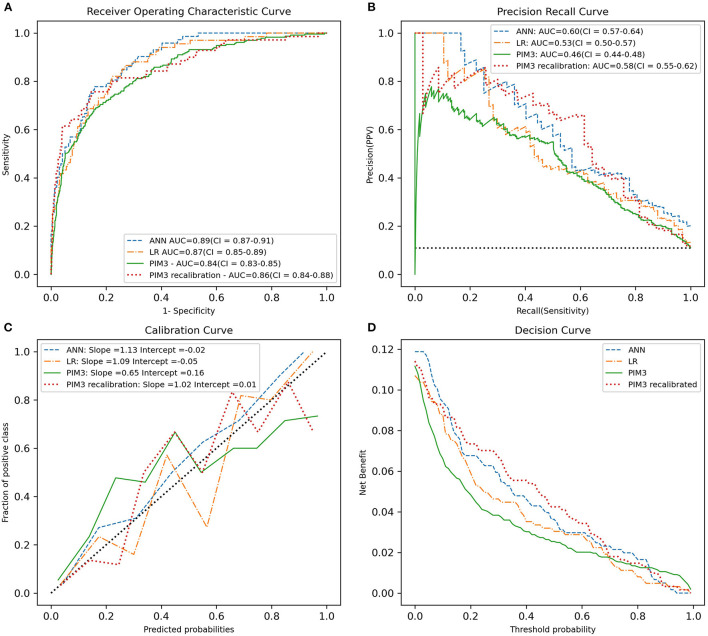
The AUROC was higher for the ANN (0.89) than for the logistic regression model (LR) (0.87) and the recalibrated PIM3 model (0.86). The precision recall curve however favors the ANN over logistic regression and recalibrated PIM3 (AUPRC = 0.6 vs. 0.53 and 0.58, respectively. The slope of the calibration curve was 1.12 for the ANN model (intercept 0.01), 1.09 for the logistic regression model (intercept 0.05) and 1.02 (intercept 0.01) for the recalibrated version of PIM3. The calibration curve was however closer to the diagonal for the ANN model.

CONCLUSIONS

Artificial neural network models are a feasible method for mortality prediction in lower- and middle-income countries but significant challenges exist. There is a need to conduct research directed toward the acquisition of large, complex data sets, the integration of documented clinical care into clinical research and the promotion of the development of electronic health record systems in lower and middle income settings.

摘要

目的

在低收入和中等收入国家,死亡率预测模型的性能仍是一项挑战。我们使用可免费下载和使用的软件以及市售计算机,开发了一种人工神经网络(ANN)模型,用于预测南非两家三级儿科重症监护病房(PICU)的死亡率。将这些模型与逻辑回归模型以及重新校准的儿科死亡率指数3进行比较。

设计

本研究使用回顾性队列研究的数据来开发用于死亡率预测的人工神经模型和逻辑回归模型。评估的结局是PICU中的死亡情况。

设置

南非的两家三级PICU。

患者

纳入研究的是2089名年龄在13岁及以下的患者。

干预措施

无。

测量和主要结果

ANN的曲线下面积(AUROC)(0.89)高于逻辑回归模型(LR)(0.87)和重新校准的PIM3模型(0.86)。然而,精确召回率曲线显示ANN优于逻辑回归和重新校准的PIM3(AUPRC分别为0.6、0.53和0.58)。ANN模型校准曲线的斜率为1.12(截距0.01),逻辑回归模型为1.09(截距0.05),重新校准的PIM3为1.02(截距0.01)。然而,ANN模型的校准曲线更接近对角线。

结论

人工神经网络模型是低收入和中等收入国家死亡率预测的一种可行方法,但仍存在重大挑战。有必要开展研究,以获取大型复杂数据集,将记录的临床护理整合到临床研究中,并促进低收入和中等收入地区电子健康记录系统的发展。
https://cdn.ncbi.nlm.nih.gov/pmc/blobs/f37d/8916561/6560279090cb/fped-10-797080-g0001.jpg

相似文献

1
An Artificial Neural Network Model for Pediatric Mortality Prediction in Two Tertiary Pediatric Intensive Care Units in South Africa. A Development Study.南非两家三级儿科重症监护病房中用于儿科死亡率预测的人工神经网络模型。一项开发研究。
Front Pediatr. 2022 Feb 25;10:797080. doi: 10.3389/fped.2022.797080. eCollection 2022.
2
An Artificial Neural Network-Based Pediatric Mortality Risk Score: Development and Performance Evaluation Using Data From a Large North American Registry.基于人工神经网络的儿科死亡率风险评分:使用来自北美大型登记处的数据进行开发和性能评估
JMIR Med Inform. 2021 Aug 31;9(8):e24079. doi: 10.2196/24079.
3
Application of artificial neural networks to establish a predictive mortality risk model in children admitted to a paediatric intensive care unit.应用人工神经网络建立儿科重症监护病房收治儿童的死亡风险预测模型。
Singapore Med J. 2006 Nov;47(11):928-34.
4
Development and Validation of Unplanned Extubation Prediction Models Using Intensive Care Unit Data: Retrospective, Comparative, Machine Learning Study.基于 ICU 数据的非计划性拔管预测模型的开发和验证:回顾性、对比、机器学习研究。
J Med Internet Res. 2021 Aug 11;23(8):e23508. doi: 10.2196/23508.
5
Development and Performance of Electronic Pediatric Risk of Mortality and Pediatric Logistic Organ Dysfunction-2 Automated Acuity Scores.电子儿童死亡风险和儿科逻辑器官功能障碍-2 自动评估分数的制定和性能。
Pediatr Crit Care Med. 2019 Aug;20(8):e372-e379. doi: 10.1097/PCC.0000000000001998.
6
Pediatric Simplified Acute Physiology Score II: Establishment of a New, Repeatable Pediatric Mortality Risk Assessment Score.小儿简化急性生理学评分II:一种新的、可重复的小儿死亡风险评估评分的建立。
Front Pediatr. 2021 Oct 28;9:757822. doi: 10.3389/fped.2021.757822. eCollection 2021.
7
Development of a model for prediction of survival in pediatric trauma patients: comparison of artificial neural networks and logistic regression.小儿创伤患者生存预测模型的开发:人工神经网络与逻辑回归的比较
J Pediatr Surg. 2002 Jul;37(7):1098-104; discussion 1098-104. doi: 10.1053/jpsu.2002.33885.
8
Development of artificial neural network models for paediatric critical illness in South Africa.南非小儿危重症人工神经网络模型的开发
Front Pediatr. 2022 Nov 15;10:1008840. doi: 10.3389/fped.2022.1008840. eCollection 2022.
9
Performance of Pediatric Mortality Prediction Scores for PICU Mortality and 90-Day Mortality.儿科死亡率预测评分对 PICU 死亡率和 90 天死亡率的预测性能。
Pediatr Crit Care Med. 2019 Feb;20(2):113-119. doi: 10.1097/PCC.0000000000001764.
10
Comparing an Artificial Neural Network to Logistic Regression for Predicting ED Visit Risk Among Patients With Cancer: A Population-Based Cohort Study.比较人工神经网络与逻辑回归预测癌症患者 ED 就诊风险:一项基于人群的队列研究。
J Pain Symptom Manage. 2020 Jul;60(1):1-9. doi: 10.1016/j.jpainsymman.2020.02.010. Epub 2020 Feb 21.

引用本文的文献

1
Use of artificial intelligence in healthcare in South Africa: A scoping review.人工智能在南非医疗保健中的应用:一项范围综述。
Health SA. 2025 Jul 14;30:2977. doi: 10.4102/hsag.v30i0.2977. eCollection 2025.
2
Machine learning algorithms to predict the risk of admission to intensive care units in HIV-infected individuals: a single-centre study.预测HIV感染者入住重症监护病房风险的机器学习算法:一项单中心研究。
Virol J. 2025 Aug 5;22(1):267. doi: 10.1186/s12985-025-02900-w.
3
A validation of machine learning models for the identification of critically ill children presenting to the paediatric emergency room of a tertiary hospital in South Africa: A proof of concept.

本文引用的文献

1
Continuous Prediction of Mortality in the PICU: A Recurrent Neural Network Model in a Single-Center Dataset.重症监护病房死亡率的连续预测:单中心数据集的递归神经网络模型。
Pediatr Crit Care Med. 2021 Jun 1;22(6):519-529. doi: 10.1097/PCC.0000000000002682.
2
Pediatric Index of Mortality 3-An Evaluation of Function Among ICUs In South Africa.儿科死亡率 3 指数-南非 ICU 功能评估。
Pediatr Crit Care Med. 2021 Sep 1;22(9):813-821. doi: 10.1097/PCC.0000000000002693.
3
Development of a machine learning model for predicting pediatric mortality in the early stages of intensive care unit admission.
用于识别前往南非一家三级医院儿科急诊室的危重症儿童的机器学习模型验证:概念验证
South Afr J Crit Care. 2024 Nov 25;40(3):e1398. doi: 10.7196/SAJCC.2024.v40i3.1398. eCollection 2024.
4
Detecting depression severity using weighted random forest and oxidative stress biomarkers.使用加权随机森林和氧化应激生物标志物检测抑郁严重程度。
Sci Rep. 2024 Jul 15;14(1):16328. doi: 10.1038/s41598-024-67251-y.
5
Development of artificial neural network models for paediatric critical illness in South Africa.南非小儿危重症人工神经网络模型的开发
Front Pediatr. 2022 Nov 15;10:1008840. doi: 10.3389/fped.2022.1008840. eCollection 2022.
6
Mortality risk prediction models: Methods of assessing discrimination and calibration and what they mean.死亡率风险预测模型:评估区分度和校准度的方法及其意义。
South Afr J Crit Care. 2022 May 6;38(1). doi: 10.7196/SAJCC.2022.v38i1.548. eCollection 2022.
开发一种机器学习模型,用于预测重症监护病房入院早期的儿科死亡率。
Sci Rep. 2021 Jan 13;11(1):1263. doi: 10.1038/s41598-020-80474-z.
4
Array programming with NumPy.使用 NumPy 进行数组编程。
Nature. 2020 Sep;585(7825):357-362. doi: 10.1038/s41586-020-2649-2. Epub 2020 Sep 16.
5
Machine Learning and Artificial Intelligence in Pediatric Research: Current State, Future Prospects, and Examples in Perioperative and Critical Care.机器学习与人工智能在儿科研究中的应用:现状、未来展望及围手术期与重症监护领域的实例
J Pediatr. 2020 Jun;221S:S3-S10. doi: 10.1016/j.jpeds.2020.02.039.
6
Calibration: the Achilles heel of predictive analytics.校准:预测分析的阿喀琉斯之踵。
BMC Med. 2019 Dec 16;17(1):230. doi: 10.1186/s12916-019-1466-7.
7
A deep learning model for real-time mortality prediction in critically ill children.深度学习模型实时预测危重症儿童死亡率。
Crit Care. 2019 Aug 14;23(1):279. doi: 10.1186/s13054-019-2561-z.
8
The REDCap consortium: Building an international community of software platform partners.REDCap 联盟:构建软件平台合作伙伴的国际社区。
J Biomed Inform. 2019 Jul;95:103208. doi: 10.1016/j.jbi.2019.103208. Epub 2019 May 9.
9
Sample Size Guidelines for Logistic Regression from Observational Studies with Large Population: Emphasis on the Accuracy Between Statistics and Parameters Based on Real Life Clinical Data.基于大样本人群观察性研究的逻辑回归样本量指南:基于真实临床数据强调统计量与参数之间的准确性
Malays J Med Sci. 2018 Jul;25(4):122-130. doi: 10.21315/mjms2018.25.4.12. Epub 2018 Aug 30.
10
A comparison between raw and predicted mortality in a paediatric intensive care unit in South Africa.南非一家儿科重症监护病房中原始死亡率与预测死亡率的比较。
BMC Res Notes. 2018 Nov 26;11(1):829. doi: 10.1186/s13104-018-3946-9.