The Research and Development Department, euglena Co., Ltd., Tokyo, 108-0014, Japan.
Graduate School of Science, Technology, and Innovation, Kobe University, Kobe, Hyogo, 657-8501, Japan.
Sci Rep. 2021 Jan 13;11(1):1074. doi: 10.1038/s41598-020-80306-0.
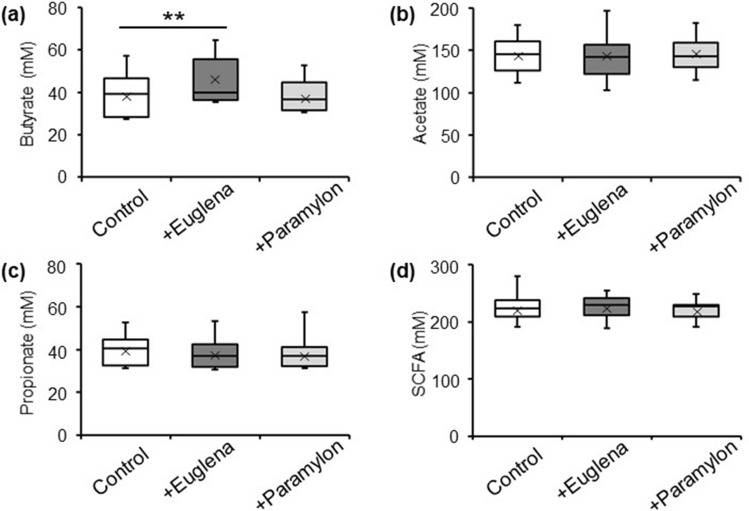
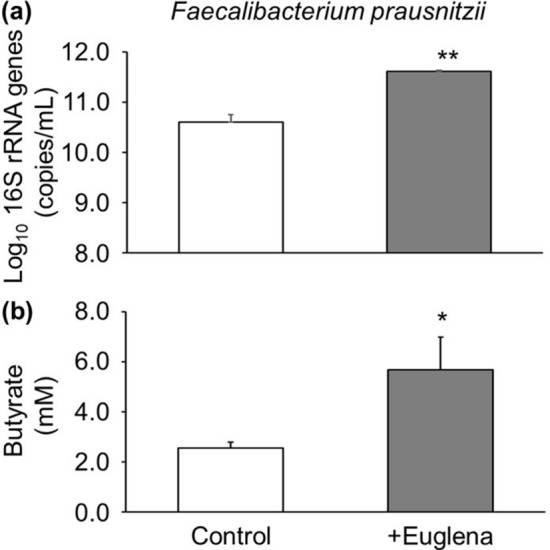
The alga Euglena gracilis (E. gracilis) has recently gained attention as a health food, but its effects on human gut microbiota remain unknown. This study aimed to determine the effect of E. gracilis on gut microbiota and defecation due to modulation of microbiota composition in vitro and in vivo. The in vitro model simulating human colonic microbiota revealed that E. gracilis addition stimulated the growth of commensal Faecalibacterium. Further, E. gracilis addition enhanced butyrate production by Faecalibacterium prausnitzii. Paramylon, an insoluble dietary fibre that accumulates in E. gracilis and is the main component of E. gracilis, did not stimulate Faecalibacterium growth in vitro. Daily ingestion of 2 g of E. gracilis for 30 days increased bowel movement frequency as well as stool volume in 28 human participants. Collectively, these findings indicate that E. gracilis components other than paramylon, stimulate the growth of Faecalibacterium to improve digestive health as well as promote defecation by increasing butyrate production.
绿眼虫(Euglena gracilis)最近作为一种健康食品引起了人们的关注,但它对人类肠道微生物群的影响尚不清楚。本研究旨在通过体外和体内调节微生物组成来确定绿眼虫对肠道微生物群和排便的影响。模拟人类结肠微生物群的体外模型表明,添加绿眼虫刺激共生拟杆菌的生长。此外,添加绿眼虫增强了普拉梭菌(Faecalibacterium prausnitzii)的丁酸生成。拟南芥,一种不溶性膳食纤维,在绿眼虫中积累,是绿眼虫的主要成分,在体外并没有刺激拟杆菌的生长。28 名人类参与者每天摄入 2 克绿眼虫 30 天,增加了肠道运动的频率和粪便量。总的来说,这些发现表明,除了拟南芥之外的绿眼虫成分刺激拟杆菌的生长,通过增加丁酸生成来改善消化健康并促进排便。