Department of Basic Medicine, Quanzhou Medical College, Quanzhou, China.
Department of Infectious Diseases, The First Hospital of Quanzhou Affiliated to Fujian Medical University, No. 250 East Street, Licheng District, Quanzhou, 362000, Fujian, China.
Sci Rep. 2021 Jan 13;11(1):1233. doi: 10.1038/s41598-021-81010-3.
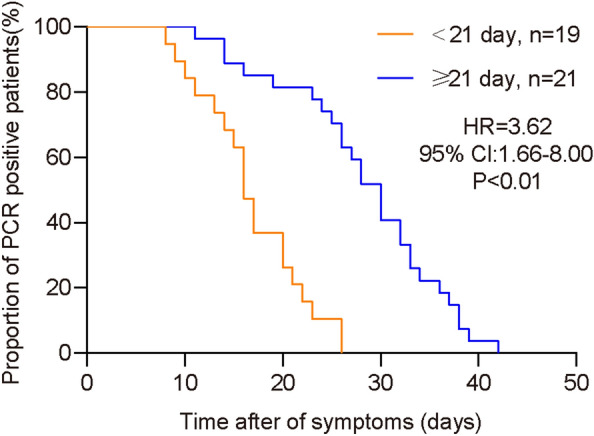
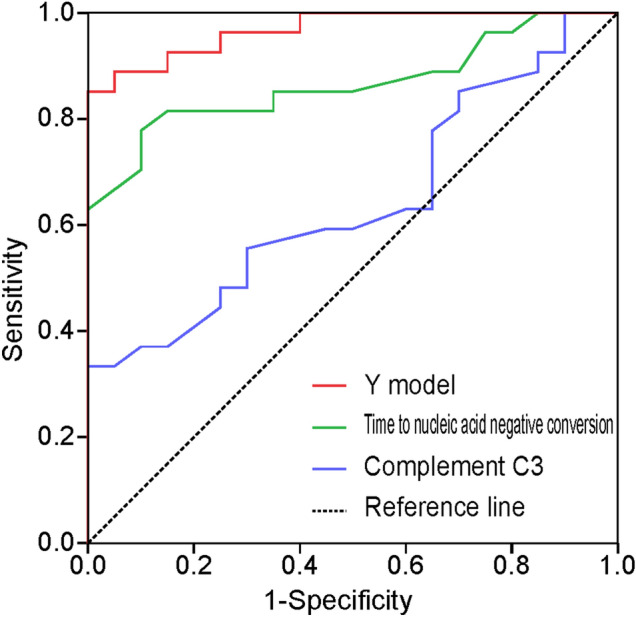
To determine factors associated with delayed discharge of hospitalized patients with coronavirus disease (COVID-19). This retrospective cohort study included 47 patients with COVID-19 admitted to three hospitals in Quanzhou City, Fujian Province, China, between January 21, 2020 and March 6, 2020. Univariate and multivariate logistic regression analyses were conducted to identify factors associated with delayed discharge. The median length of hospital stay was 22 days. Patients in the delayed discharge group (length of hospital stay ≥ 21 days, n = 27) were more likely to have diarrhea, anorexia, decreased white blood cell counts, increased complement C3 and C-reactive protein levels, air bronchograms, undergo thymalfasin treatment, and take significantly longer to convert to a severe acute respiratory syndrome coronavirus (SARS-CoV-2) RNA-negative status than those in the control group (length of hospital stay, < 21 days; n = 20). In multivariate logistic regression analysis, the time to SARS-CoV-2 RNA-negative conversion (odds ratio [OR]: 1.48, 95% confidence interval [CI] 1.09-2.04, P = 0.01) and complement C3 levels (OR 1.14 95% CI 1.02-1.27, P = 0.03) were the only risk factors independently associated with delayed discharge from the hospital. Dynamic monitoring of complement C3 and SARS-CoV-2 RNA levels is useful for predicting delayed discharge of patients.
确定与新型冠状病毒肺炎(COVID-19)住院患者延迟出院相关的因素。
这是一项回顾性队列研究,纳入了 2020 年 1 月 21 日至 3 月 6 日期间在中国福建省泉州市的 3 家医院收治的 47 例 COVID-19 患者。采用单因素和多因素 logistic 回归分析确定与延迟出院相关的因素。
中位住院时间为 22 天。延迟出院组(住院时间≥21 天,n=27)较对照组(住院时间<21 天,n=20)更易发生腹泻、厌食、白细胞计数降低、补体 C3 和 C 反应蛋白水平升高、空气支气管征、胸腺法新治疗以及转为 SARS-CoV-2 核酸阴性的时间显著延长。多因素 logistic 回归分析显示,SARS-CoV-2 核酸阴转时间(比值比[OR]:1.48,95%置信区间[CI]:1.09-2.04,P=0.01)和补体 C3 水平(OR 1.14,95%CI 1.02-1.27,P=0.03)是与延迟出院独立相关的唯一危险因素。
动态监测补体 C3 和 SARS-CoV-2 核酸水平有助于预测患者的延迟出院。