Department of Microbiology and Immunology, University of California, San Francisco, San Francisco, CA 94403, USA.
Department of Microbiology and Immunology, University of California, San Francisco, San Francisco, CA 94403, USA; Quantitative Biosciences Institute, University of California, San Francisco, San Francisco, CA 94403, USA; Innovative Genomics Institute, Berkeley, CA, USA.
Cell Host Microbe. 2021 May 12;29(5):704-714. doi: 10.1016/j.chom.2020.12.007. Epub 2021 Jan 13.
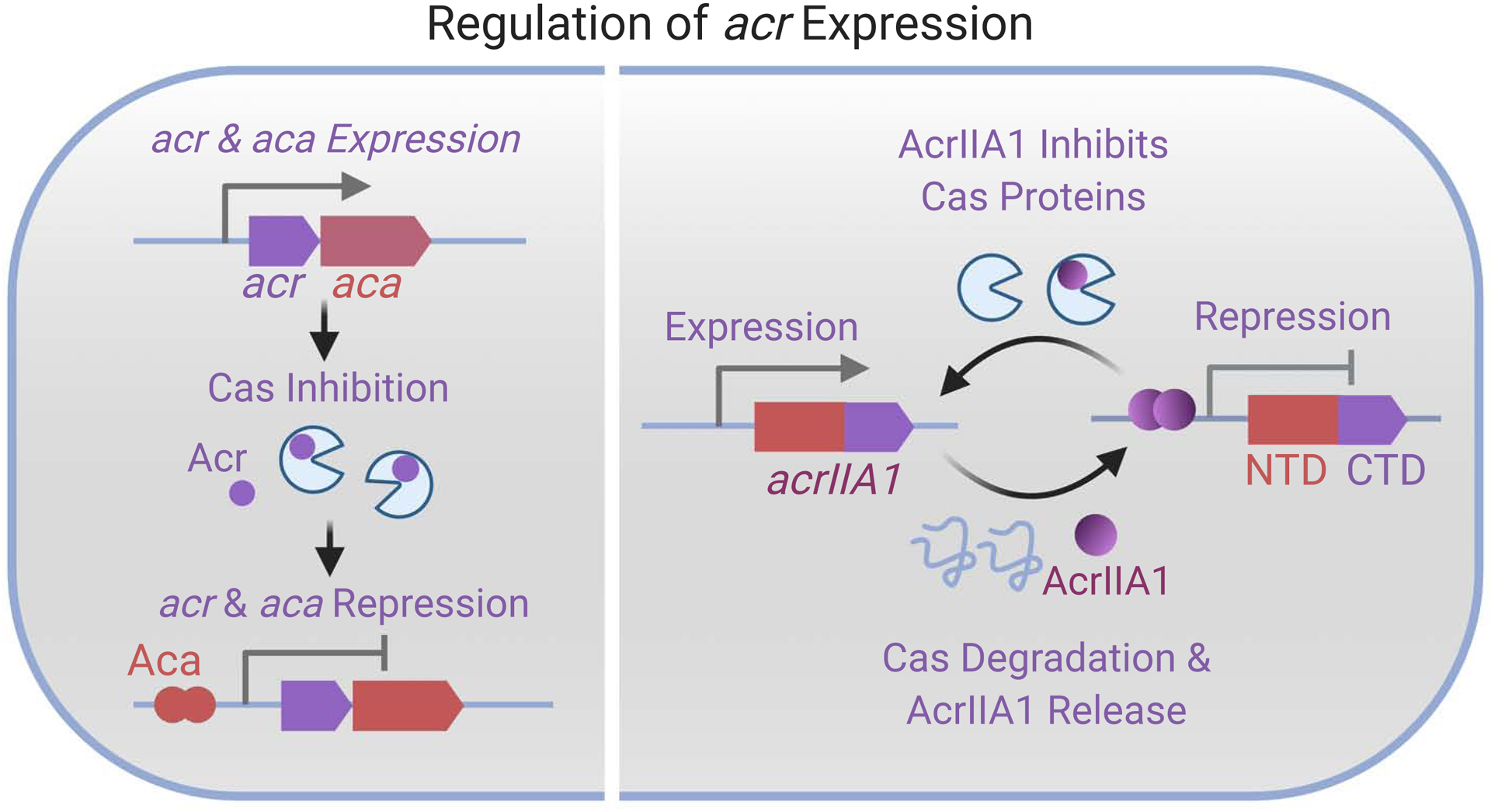
Bacteriophages encode diverse anti-CRISPR (Acr) proteins that inhibit CRISPR-Cas immunity during infection of their bacterial hosts. Although detailed mechanisms have been characterized for multiple Acr proteins, an understanding of their role in phage infection biology is just emerging. Here, we review recent work in this area and propose a framework of "phage autonomy" to evaluate CRISPR-immune evasion strategies. During phage infection, Acr proteins are deployed by a tightly regulated "fast on-fast off" transcriptional burst, which is necessary, but insufficient, for CRISPR-Cas inactivation. Instead of a single phage shutting down CRISPR-Cas immunity, a community of acr-carrying phages cooperate to suppress bacterial immunity, displaying low phage autonomy. Enzymatic Acr proteins with novel mechanisms have been recently revealed and are predicted to enhance phage autonomy, while phage DNA protective measures offer the highest phage autonomy observed. These varied Acr mechanisms and strengths also have unexpected impacts on the bacterial populations and competing phages.
噬菌体编码多种抗 CRISPR(Acr)蛋白,在感染其细菌宿主时抑制 CRISPR-Cas 免疫。尽管已经对多种 Acr 蛋白的详细机制进行了描述,但人们对它们在噬菌体感染生物学中的作用的理解才刚刚开始。在这里,我们回顾了该领域的最新工作,并提出了一个“噬菌体自主性”框架来评估 CRISPR 免疫逃逸策略。在噬菌体感染过程中,Acr 蛋白通过严格调控的“快速开启-快速关闭”转录爆发进行部署,这对于 CRISPR-Cas 的失活是必要的,但还不够。不是单个噬菌体关闭 CRISPR-Cas 免疫,而是一群携带 acr 的噬菌体合作抑制细菌免疫,表现出低噬菌体自主性。最近发现了具有新颖机制的酶促 Acr 蛋白,预计它们将增强噬菌体自主性,而噬菌体 DNA 保护措施则提供了迄今为止观察到的最高噬菌体自主性。这些不同的 Acr 机制和强度也对细菌种群和竞争噬菌体产生了意想不到的影响。