Univ. Grenoble Alpes, CNRS, CEA, INSERM, IRIG, Biomics, 38000, Grenoble, France.
Univ. Grenoble Alpes, CEA, INSERM, IRIG, Biomics, 38000, Grenoble, France.
Sci Rep. 2021 Jan 14;11(1):1290. doi: 10.1038/s41598-020-79661-9.
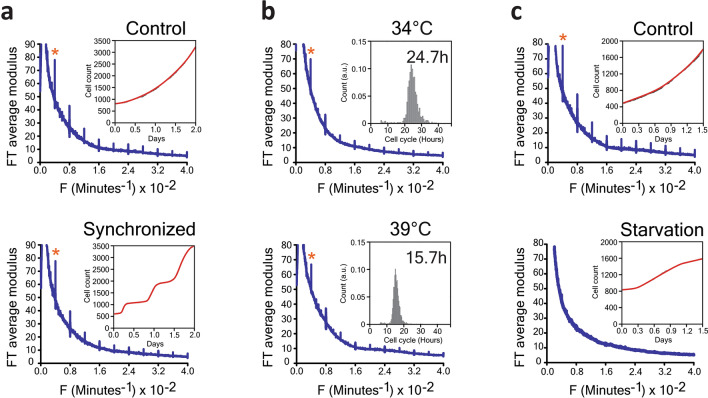
We have discovered a new 4 h ultradian rhythm that occurs during the interphase of the cell cycle in a wide range of individual mammalian cells, including both primary and transformed cells. The rhythm was detected by holographic lens-free microscopy that follows the histories of the dry mass of thousands of single live cells simultaneously, each at a resolution of five minutes. It was vital that the rhythm was observed in inherently heterogeneous cell populations, thus eliminating synchronization and labeling bias. The rhythm is independent of circadian rhythm, and is temperature-compensated. We show that the amplitude of the fundamental frequency provides a way to quantify the effects of, chemical reagents on cells, thus shedding light on its mechanism. The rhythm is suppressed by proteostasis disruptors and is detected only in proliferating cells, suggesting that it represents a massive degradation and re-synthesis of protein every 4 h in growing cells.
我们发现了一种新的 4h 超昼夜节律,它发生在广泛的个体哺乳动物细胞的细胞周期的间期,包括原代细胞和转化细胞。该节律是通过全息无透镜显微镜检测到的,该显微镜同时跟踪数千个单个活细胞的干质量历史,每个细胞的分辨率为五分钟。至关重要的是,该节律是在固有异质细胞群体中观察到的,从而消除了同步化和标记偏倚。该节律独立于昼夜节律,并且具有温度补偿性。我们表明,基本频率的幅度提供了一种量化化学试剂对细胞的影响的方法,从而揭示了其机制。该节律被蛋白质稳态破坏剂抑制,并且仅在增殖细胞中检测到,这表明它代表了在生长细胞中每 4h 进行的大规模蛋白质降解和再合成。