Univ. Grenoble Alpes, CEA, List, F-38000, Grenoble, France.
Univ. Grenoble Alpes, CNRS, Grenoble-INP, GIPSA-Lab, 38000, Grenoble, France.
Sci Rep. 2024 Mar 25;14(1):7053. doi: 10.1038/s41598-024-57684-w.
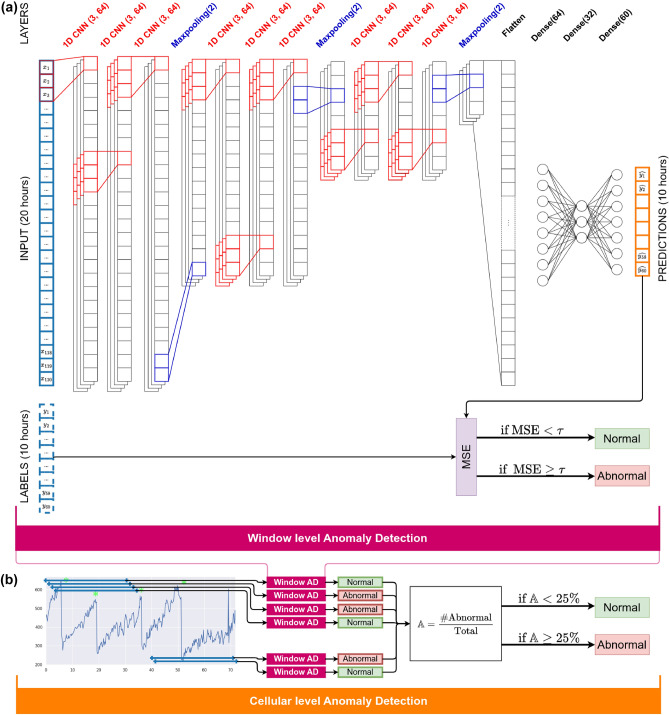
The prediction of pathological changes on single cell behaviour is a challenging task for deep learning models. Indeed, in self-supervised learning methods, no prior labels are used for the training and all of the information for event predictions are extracted from the data themselves. We present here a novel self-supervised learning model for the detection of anomalies in a given cell population, StArDusTS. Cells are monitored over time, and analysed to extract time-series of dry mass values. We assessed its performances on different cell lines, showing a precision of 96% in the automatic detection of anomalies. Additionally, anomaly detection was also associated with cell measurement errors inherent to the acquisition or analysis pipelines, leading to an improvement of the upstream methods for feature extraction. Our results pave the way to novel architectures for the continuous monitoring of cell cultures in applied research or bioproduction applications, and for the prediction of pathological cellular changes.
单细胞行为的病理变化预测对深度学习模型来说是一项具有挑战性的任务。事实上,在自监督学习方法中,训练过程中不使用先验标签,所有的事件预测信息都从数据本身中提取。我们在这里提出了一种新的自监督学习模型,用于检测给定细胞群体中的异常,即 StArDusTS。细胞随时间被监测,并进行分析以提取干物质值的时间序列。我们在不同的细胞系上评估了它的性能,在自动检测异常方面的准确率达到了 96%。此外,异常检测还与获取或分析管道固有的细胞测量误差相关,从而提高了上游的特征提取方法的性能。我们的研究结果为应用研究或生物生产应用中细胞培养的连续监测以及病理性细胞变化的预测开辟了新的途径。