School of Natural Resources and Environment, University of Florida, Gainesville, FL, 32611, USA.
Facultad de Ciencias Veterinarias, Instituto de Medicina Preventiva Veterinaria, Universidad Austral de Chile, Edificio Federico Saelzer, 5º Piso, Campus Isla Teja S/N, Valdivia, Chile.
Ecohealth. 2020 Dec;17(4):498-511. doi: 10.1007/s10393-020-01508-6. Epub 2021 Jan 14.
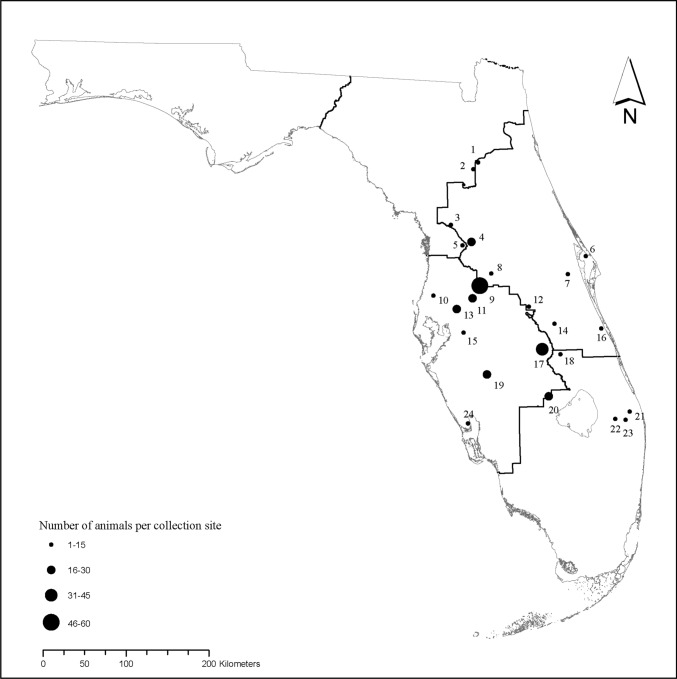
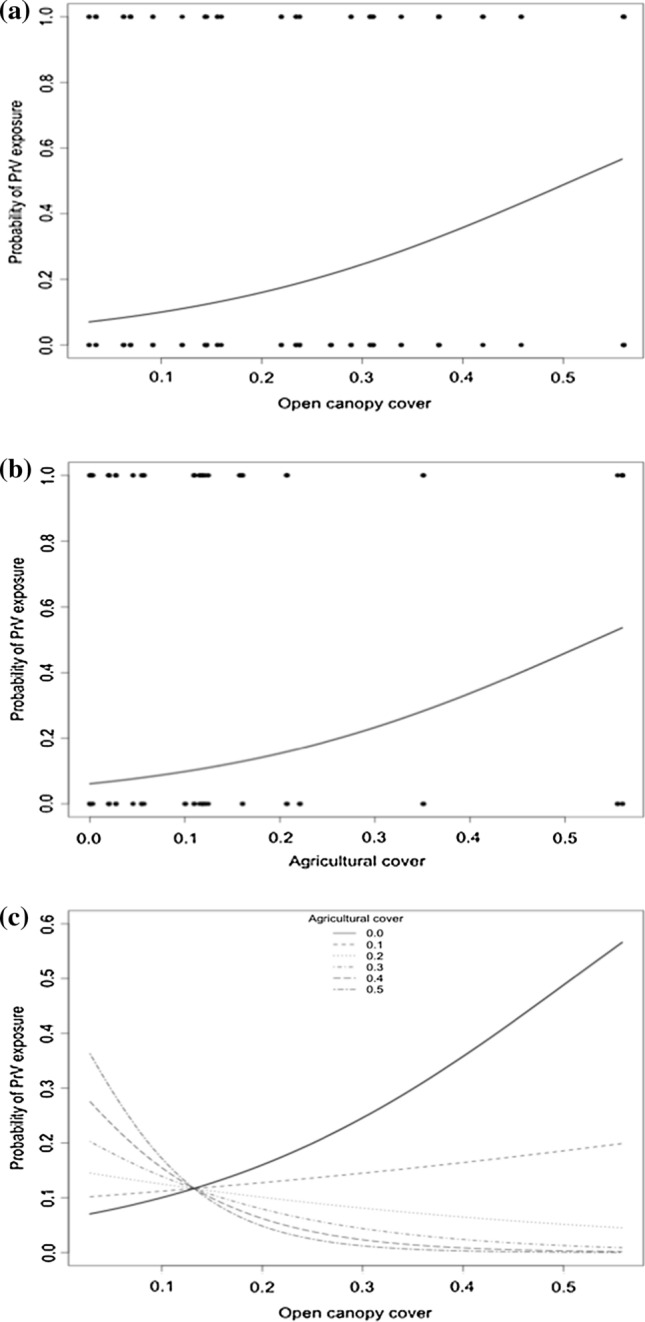
We investigated the landscape epidemiology of a globally distributed mammal, the wild pig (Sus scrofa), in Florida (U.S.), where it is considered an invasive species and reservoir to pathogens that impact the health of people, domestic animals, and wildlife. Specifically, we tested the hypothesis that two commonly cited factors in disease transmission, connectivity among populations and abundant resources, would increase the likelihood of exposure to both pseudorabies virus (PrV) and Brucella spp. (bacterial agent of brucellosis) in wild pigs across the Kissimmee Valley of Florida. Using DNA from 348 wild pigs and sera from 320 individuals at 24 sites, we employed population genetic techniques to infer individual dispersal, and an Akaike information criterion framework to compare candidate logistic regression models that incorporated both dispersal and land cover composition. Our findings suggested that recent dispersal conferred higher odds of exposure to PrV, but not Brucella spp., among wild pigs throughout the Kissimmee Valley region. Odds of exposure also increased in association with agriculture and open canopy pine, prairie, and scrub habitats, likely because of highly localized resources within those land cover types. Because the effect of open canopy on PrV exposure reversed when agricultural cover was available, we suggest that small-scale resource distribution may be more important than overall resource abundance. Our results underscore the importance of studying and managing disease dynamics through multiple processes and spatial scales, particularly for non-native pathogens that threaten wildlife conservation, economy, and public health.
我们调查了一种在全球范围内分布的哺乳动物——野猪(Sus scrofa)的景观流行病学,在佛罗里达州(美国),野猪被认为是一种入侵物种,也是影响人类、家畜和野生动物健康的病原体的宿主。具体来说,我们检验了这样一个假设,即在疾病传播的两个常见因素——种群间的连通性和丰富的资源——会增加佛罗里达州基西米谷的野猪接触伪狂犬病病毒(PrV)和布鲁氏菌属(布鲁氏菌病的细菌病原体)的可能性。我们从 348 头野猪的 DNA 和 24 个地点的 320 个人的血清中,利用种群遗传技术推断个体的扩散,并采用 Akaike 信息准则框架来比较纳入扩散和土地覆盖组成的候选逻辑回归模型。我们的研究结果表明,在基西米谷地区,近期的扩散使野猪接触 PrV 的几率更高,但接触布鲁氏菌属的几率并没有增加。与农业和开阔林冠、草原和灌丛栖息地相关的接触几率也有所增加,这可能是由于这些土地覆盖类型中存在高度局部化的资源。由于当农业用地可用时,开阔林冠对 PrV 暴露的影响发生了逆转,因此我们认为,小尺度资源分布可能比总体资源丰度更为重要。我们的研究结果强调了通过多个过程和空间尺度研究和管理疾病动态的重要性,特别是对于威胁野生动物保护、经济和公共卫生的非本地病原体。