Armitage Jessica M, Wang R Adele H, Davis Oliver S P, Bowes Lucy, Haworth Claire M A
School of Psychological Science, University of Bristol, Bristol, BS8 1TU, UK.
MRC Integrative Epidemiology Unit, University of Bristol, Bristol, BS8 2BN, UK.
BMC Public Health. 2021 Jan 15;21(1):148. doi: 10.1186/s12889-021-10198-w.
Peer victimisation is a common occurrence and has well-established links with a range of psychiatric problems in adulthood. Significantly less is known however, about how victimisation influences positive aspects of mental health such as wellbeing. The purpose of this study was therefore to assess for the first time, whether peer victimisation in adolescence is associated with adult wellbeing. We aimed to understand whether individuals who avoid a diagnosis of depression after victimisation, maintain good wellbeing in later life, and therefore display resilience.
Longitudinal data was taken from the Avon Longitudinal Study of Parents and Children, a prospective cohort study based in the UK. Peer victimisation was assessed at 13 years using a modified version of the bullying and friendship interview schedule, and wellbeing at age 23 using the Warwick-Edinburgh Mental Well-Being Scale. The presence or absence of depression was diagnosed using the Clinical Interview Schedule-Revised at 18 years. A series of logistic and linear regression analyses were used to explore relationships between peer victimisation, depression, and wellbeing, adjusting for potentially confounding individual and family factors.
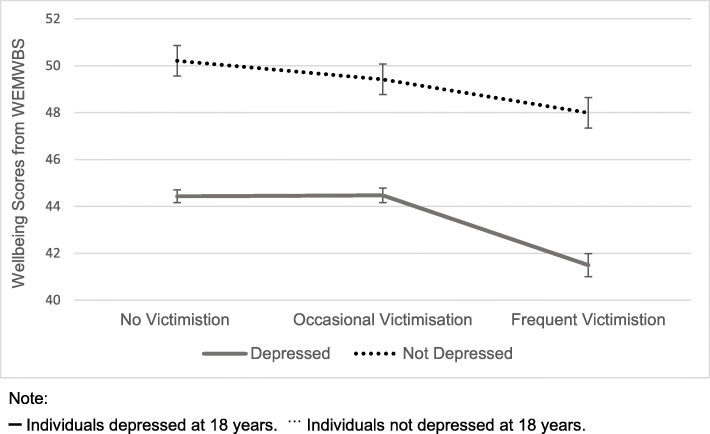
Just over 15% of victims of frequent bullying had a diagnosis of depression at age 18. Victimisation also had a significant impact on wellbeing, with a one-point increase in frequent victimisation associated with a 2.71-point (SE = 0.46, p < 0.001) decrease in wellbeing scores aged 23. This finding remained after adjustment for the mediating and moderating effects of depression, suggesting that the burden of victimisation extends beyond depression to impact wellbeing. Results therefore show that individuals who remain partially resilient by avoiding a diagnosis of depression after victimisation have significantly poorer wellbeing than their non-victimised counterparts.
Overall, our study demonstrates for the first time that victimisation during adolescence is a significant risk factor for not only the onset of depression, but also poor wellbeing in adulthood. Such findings highlight the importance of investigating both dimensions of mental health to understand the true burden of victimisation and subsequent resilience. In addition to the need for interventions that reduce the likelihood of depression following adolescent victimisation, efforts should also be made to promote good wellbeing.
同伴间的欺侮行为很常见,且与成年后的一系列精神问题有着既定的联系。然而,对于欺侮行为如何影响心理健康的积极方面,如幸福感,人们所知甚少。因此,本研究的目的是首次评估青少年时期的同伴欺侮行为是否与成年后的幸福感相关。我们旨在了解那些在遭受欺侮后未被诊断出患有抑郁症的个体,在晚年是否能保持良好的幸福感,从而表现出恢复力。
纵向数据取自英国的一项前瞻性队列研究——阿冯父母与儿童纵向研究。在13岁时,使用欺凌与友谊访谈时间表的修订版评估同伴欺侮行为;在23岁时,使用沃里克 - 爱丁堡心理健康量表评估幸福感。在18岁时,使用修订后的临床访谈时间表诊断是否患有抑郁症。一系列逻辑回归和线性回归分析被用于探索同伴欺侮行为、抑郁症和幸福感之间的关系,并对可能产生混淆的个体和家庭因素进行调整。
超过15%的频繁受欺凌受害者在18岁时被诊断出患有抑郁症。欺侮行为对幸福感也有显著影响,频繁受欺侮程度增加一分,与23岁时幸福感得分降低2.71分(标准误 = 0.46,p < 0.001)相关。在对抑郁症的中介和调节作用进行调整后,这一发现仍然成立,表明欺侮行为的负担不仅限于抑郁症,还会影响幸福感。因此,结果表明,那些在遭受欺侮后通过避免被诊断出患有抑郁症而保持部分恢复力的个体,其幸福感明显低于未受欺侮的同龄人。
总体而言,我们的研究首次表明,青少年时期的欺侮行为不仅是抑郁症发病的重要危险因素,也是成年后幸福感低下的重要危险因素。这些发现凸显了调查心理健康的两个维度以了解欺侮行为的真正负担和后续恢复力的重要性。除了需要采取干预措施降低青少年受欺侮后患抑郁症的可能性外,还应努力促进良好的幸福感。