School of Psychological Science, University of Bristol, Bristol, BS8 1TU, UK.
MRC Integrative Epidemiology Unit, University of Bristol, Bristol, BS8 2BN, UK.
Behav Genet. 2022 Jan;52(1):1-12. doi: 10.1007/s10519-021-10085-5. Epub 2021 Oct 11.
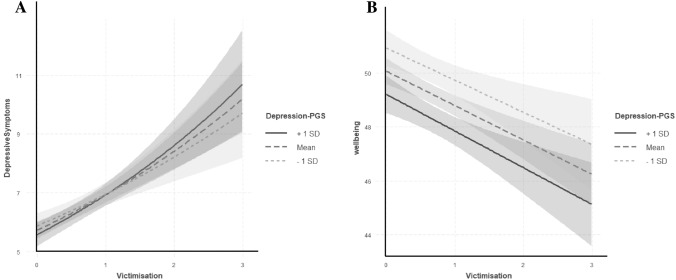
Previous studies suggest an individual's risk of depression following adversity may be moderated by their genetic liability. No study, however, has examined peer victimisation, an experience repeatedly associated with mental illness. We explore whether the negative mental health outcomes following victimisation can be partly attributed to genetic factors using polygenic scores for depression and wellbeing. Among participants from the Avon Longitudinal Study of Parents and Children (ALSPAC), we show that polygenic scores and peer victimisation are significant independent predictors of depressive symptoms (n=2268) and wellbeing (n=2299) in early adulthood. When testing for interaction effects, our results lead us to conclude that low mental health and wellbeing following peer victimisation is unlikely to be explained by a moderating effect of genetic factors, as indexed by current polygenic scores. Genetic profiling is therefore unlikely to be effective in identifying those more vulnerable to the effects of victimisation at present. The reasons why some go on to experience mental health problems following victimisation, while others remain resilient, requires further exploration, but our results rule out a major influence of current polygenic scores.
先前的研究表明,个体在逆境后抑郁的风险可能受到其遗传易感性的调节。然而,尚无研究探讨同伴欺凌这一与精神疾病反复相关的经历。我们利用抑郁和幸福感的多基因评分,来探究同伴欺凌后的负面心理健康结果是否部分归因于遗传因素。在阿冯纵向研究父母和孩子(ALSPAC)的参与者中,我们表明多基因评分和同伴欺凌是成年早期抑郁症状(n=2268)和幸福感(n=2299)的显著独立预测因素。在检验交互作用效应时,我们的结果表明,同伴欺凌后心理健康和幸福感水平较低不太可能是由当前多基因评分所代表的遗传因素调节作用所解释。因此,基因分析不太可能有效地识别那些目前更容易受到欺凌影响的人。为什么有些人在遭受欺凌后会继续出现心理健康问题,而有些人则保持韧性,这需要进一步探讨,但我们的结果排除了当前多基因评分的主要影响。