Universität Göttingen, Institut für Physikalische Chemie, Theoretische Chemie, Tammannstraße 6, 37077, Göttingen, Germany.
Department of Physics, Universität Basel, Klingelbergstrasse 82, 4056, Basel, Switzerland.
Nat Commun. 2021 Jan 15;12(1):398. doi: 10.1038/s41467-020-20427-2.
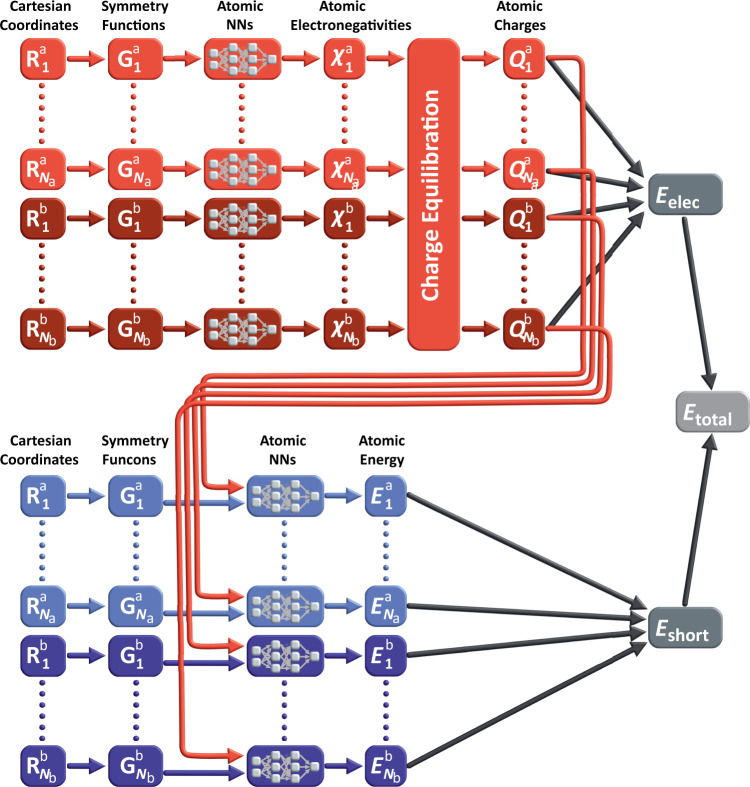
Machine learning potentials have become an important tool for atomistic simulations in many fields, from chemistry via molecular biology to materials science. Most of the established methods, however, rely on local properties and are thus unable to take global changes in the electronic structure into account, which result from long-range charge transfer or different charge states. In this work we overcome this limitation by introducing a fourth-generation high-dimensional neural network potential that combines a charge equilibration scheme employing environment-dependent atomic electronegativities with accurate atomic energies. The method, which is able to correctly describe global charge distributions in arbitrary systems, yields much improved energies and substantially extends the applicability of modern machine learning potentials. This is demonstrated for a series of systems representing typical scenarios in chemistry and materials science that are incorrectly described by current methods, while the fourth-generation neural network potential is in excellent agreement with electronic structure calculations.
机器学习潜力已经成为许多领域原子模拟的重要工具,从化学到分子生物学再到材料科学。然而,大多数已建立的方法依赖于局部性质,因此无法考虑电子结构的全局变化,这些变化是由长程电荷转移或不同的电荷态引起的。在这项工作中,我们通过引入第四代高维神经网络势来克服这一限制,该势结合了环境相关原子电负性的电荷平衡方案和准确的原子能量。该方法能够正确描述任意系统中的全局电荷分布,从而显著提高能量,并大大扩展了现代机器学习势的适用性。这在一系列代表化学和材料科学中典型情况的系统中得到了证明,这些系统当前的方法无法正确描述,而第四代神经网络势与电子结构计算非常吻合。