Department of Internal Medicine, Kangnam Sacred Heart Hospital, Hallym University Medical Center, Hallym University College of Medicine, Seoul, 07441, Republic of Korea.
Department of Pediatrics, Sanggye Paik Hospital, Inje University College of Medicine, 1342, Dongilro, Nowon-gu, Seoul, 01757, Korea.
Sci Rep. 2021 Jan 15;11(1):1603. doi: 10.1038/s41598-021-80980-8.
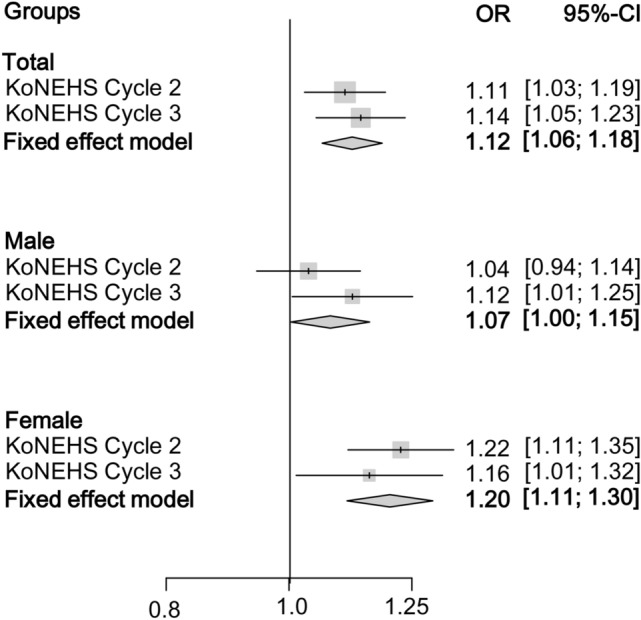
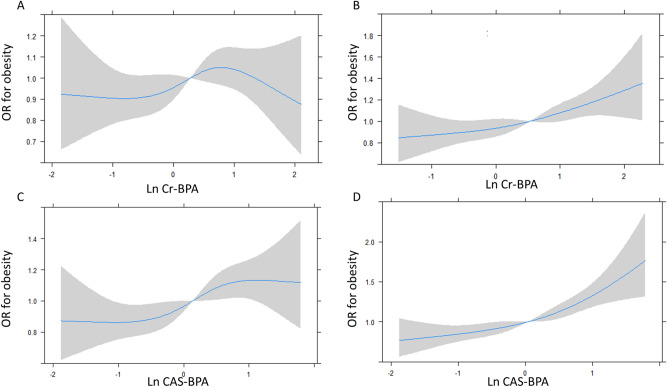
This study was aimed to evaluate the association between urinary bisphenol A (BPA) levels and risk of obesity in Korean adults. We analyzed data from the Korean National Environmental Health Survey (KoNEHS) Cycle 2 (2012-2014) and Cycle 3 (2015-2017). A total of 10,021 participants aged ≥ 19 years were included. Urine dilution was corrected by the covariate-adjusted standardization (CAS) method. We performed meta-analysis, logistic regression analysis by matching all covariates with a 1:1 propensity score, and a 4-knot restricted cubic spline plot model to calculate the odds ratios (ORs) for obesity according to natural log-transformed BPA levels. Mean urinary BPA concentration was 1.12 µg/L in KoNEHS Cycle 2 and 1.32 µg/L in Cycle 3. BPA levels were significantly higher among obese adults than among non-obese adults in both KoNEHS Cycles 2 and 3. In pooled data of KoNEHS Cycles 2 and 3, BPA showed significant positive associations with ORs for obesity in both sexes, which were more prominent in females (linear) than in males (non-linear). These associations were confirmed in spline analyses. CAS-applied BPA concentrations were positively associated with obesity in nationwide representative samples of Korean adults. Further studies are warranted to confirm and elucidate the underlying mechanism.
本研究旨在评估韩国成年人尿液双酚 A(BPA)水平与肥胖风险之间的关联。我们分析了来自韩国国家环境健康调查(KoNEHS)第 2 周期(2012-2014 年)和第 3 周期(2015-2017 年)的数据。共有 10021 名年龄≥19 岁的参与者被纳入研究。尿液稀释度通过协变量调整的标准化(CAS)方法进行校正。我们进行了荟萃分析、通过匹配所有协变量的 1:1 倾向评分进行逻辑回归分析,以及 4 结限制立方样条图模型,以根据自然对数转换的 BPA 水平计算肥胖的比值比(OR)。在 KoNEHS 第 2 周期和第 3 周期中,尿液 BPA 的平均浓度分别为 1.12μg/L 和 1.32μg/L。在这两个周期中,肥胖成年人的 BPA 水平均显著高于非肥胖成年人。在 KoNEHS 第 2 周期和第 3 周期的数据汇总中,BPA 与肥胖的比值比呈显著正相关,在女性中更为明显(线性),而在男性中则不明显(非线性)。这些关联在样条分析中得到了证实。在全国代表性的韩国成年人样本中,应用 CAS 的 BPA 浓度与肥胖呈正相关。需要进一步的研究来证实和阐明潜在的机制。