Institute of Neurobiology, University of Lübeck, Lübeck, Germany.
Endocrinology. 2021 Mar 1;162(3). doi: 10.1210/endocr/bqab009.
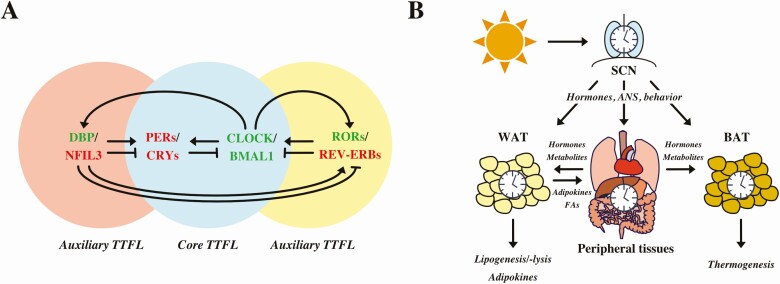
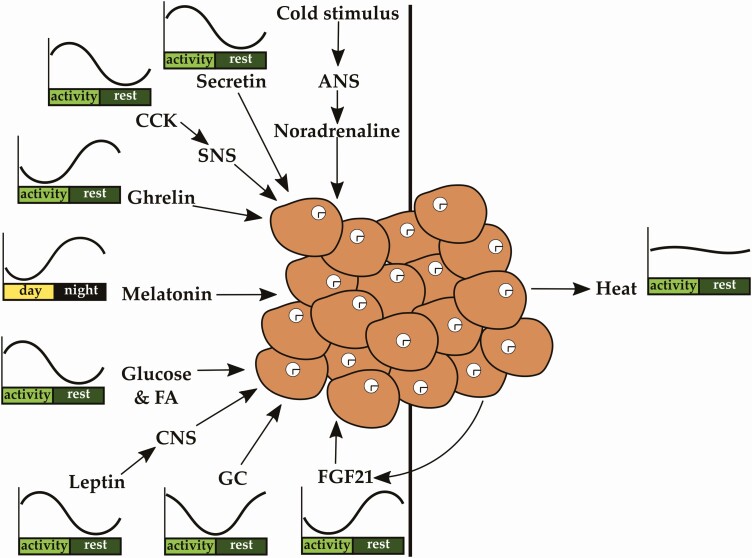
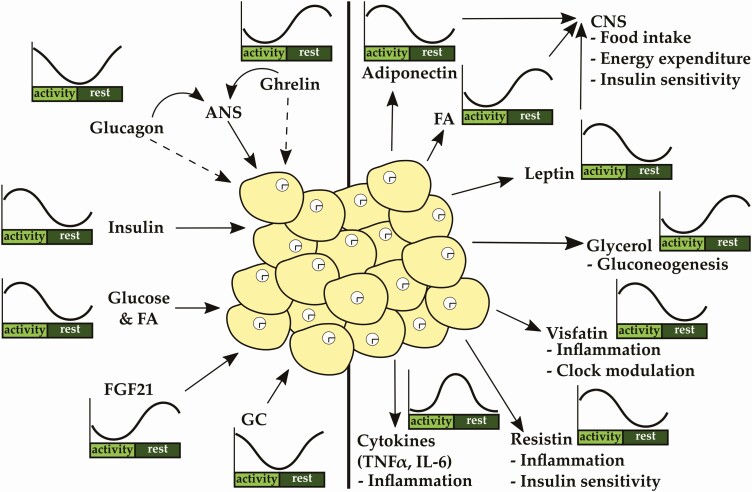
The term energy metabolism comprises the entirety of chemical processes associated with uptake, conversion, storage, and breakdown of nutrients. All these must be tightly regulated in time and space to ensure metabolic homeostasis in an environment characterized by cycles such as the succession of day and night. Most organisms evolved endogenous circadian clocks to achieve this goal. In mammals, a ubiquitous network of cellular clocks is coordinated by a pacemaker residing in the hypothalamic suprachiasmatic nucleus. Adipocytes harbor their own circadian clocks, and large aspects of adipose physiology are regulated in a circadian manner through transcriptional regulation of clock-controlled genes. White adipose tissue (WAT) stores energy in the form of triglycerides at times of high energy levels that then serve as fuel in times of need. It also functions as an endocrine organ, releasing factors in a circadian manner to regulate food intake and energy turnover in other tissues. Brown adipose tissue (BAT) produces heat through nonshivering thermogenesis, a process also controlled by the circadian clock. We here review how WAT and BAT contribute to the circadian regulation of energy metabolism. We describe how adipose rhythms are regulated by the interplay of systemic signals and local clocks and summarize how adipose-originating circadian factors feed-back on metabolic homeostasis. The role of adipose tissue in the circadian control of metabolism becomes increasingly clear as circadian disruption leads to alterations in adipose tissue regulation, promoting obesity and its sequelae. Stabilizing adipose tissue rhythms, in turn, may help to combat disrupted energy homeostasis and obesity.
能量代谢一词包括与营养物质的摄取、转化、储存和分解相关的所有化学过程。为了确保在以昼夜循环为特征的环境中保持代谢稳态,所有这些过程都必须在时间和空间上进行严格的调节。大多数生物体进化出内源性的生物钟来实现这一目标。在哺乳动物中,一个普遍存在的细胞时钟网络由位于下丘脑视交叉上核的起搏器协调。脂肪细胞拥有自己的生物钟,并且脂肪生理学的大部分方面通过时钟控制基因的转录调节以昼夜节律的方式进行调节。白色脂肪组织(WAT)以甘油三酯的形式在能量水平高的时候储存能量,然后在需要的时候作为燃料。它还作为一个内分泌器官,以昼夜节律的方式释放因子,调节其他组织的食物摄入和能量周转。棕色脂肪组织(BAT)通过非颤抖产热产生热量,这个过程也受生物钟的控制。我们在这里回顾了 WAT 和 BAT 如何为能量代谢的昼夜节律调节做出贡献。我们描述了全身信号和局部时钟的相互作用如何调节脂肪节律,并总结了脂肪起源的昼夜节律因子如何反馈代谢稳态。随着昼夜节律紊乱导致脂肪组织调节改变,促进肥胖及其后果,脂肪组织在代谢昼夜节律控制中的作用变得越来越明显。反过来,稳定脂肪组织节律可能有助于对抗紊乱的能量稳态和肥胖。