Engineering Research Center of Intelligent Control for Underground Space, Ministry of Education, China University of Mining and Technology, Xuzhou, 221116, China; School of Information and Control Engineering, China University of Mining and Technology, Xuzhou 221116, China.
Engineering Research Center of Intelligent Control for Underground Space, Ministry of Education, China University of Mining and Technology, Xuzhou, 221116, China; School of Information and Control Engineering, China University of Mining and Technology, Xuzhou 221116, China.
Comput Methods Programs Biomed. 2021 Mar;200:105934. doi: 10.1016/j.cmpb.2021.105934. Epub 2021 Jan 8.
With the increasing problem of coronavirus disease 2019 (COVID-19) in the world, improving the image resolution of COVID-19 computed tomography (CT) becomes a very important task. At present, single-image super-resolution (SISR) models based on convolutional neural networks (CNN) generally have problems such as the loss of high-frequency information and the large size of the model due to the deep network structure.
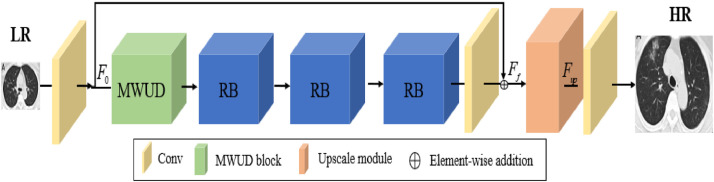
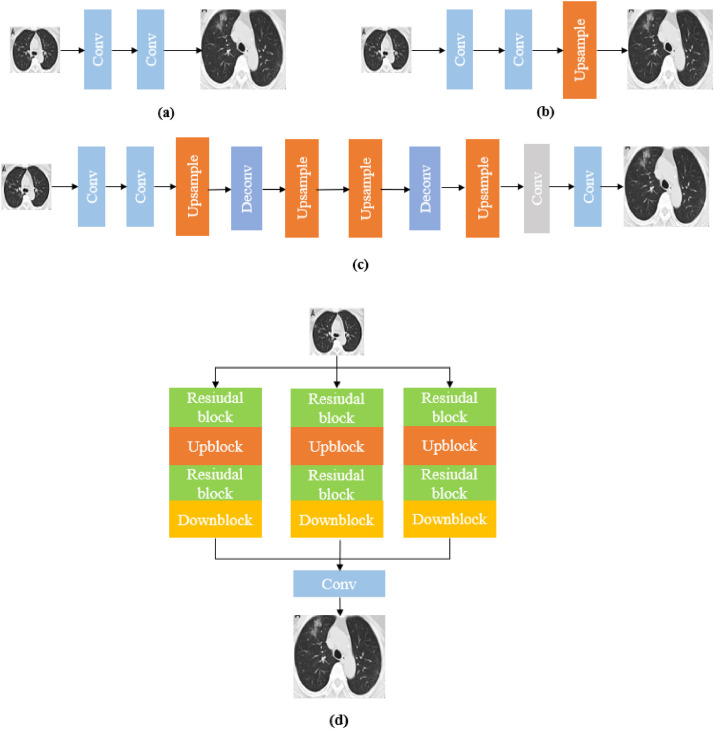
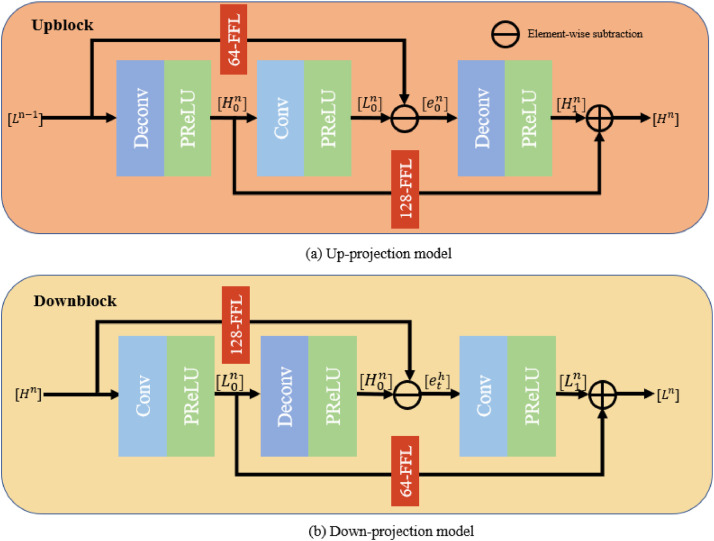
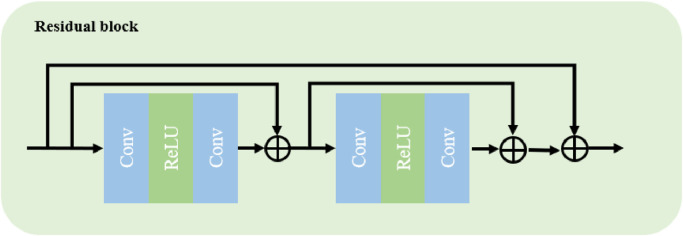
In this work, we propose an optimization model based on multi-window back-projection residual network (MWSR), which outperforms most of the state-of-the-art methods. Firstly, we use multi-window to refine the same feature map at the same time to obtain richer high/low frequency information, and fuse and filter out the features needed by the deep network. Then, we develop a back-projection network based on the dilated convolution, using up-projection and down-projection modules to extract image features. Finally, we merge several repeated and continuous residual modules with global features, merge the information flow through the network, and input them to the reconstruction module.
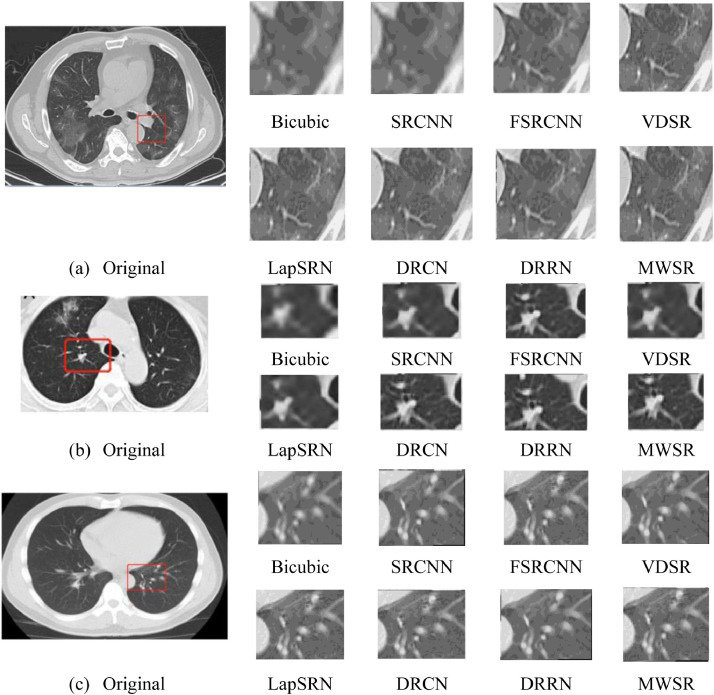
The proposed method shows the superiority over the state-of-the-art methods on the benchmark dataset, and generates clear COVID-19 CT super-resolution images.
Both subjective visual effects and objective evaluation indicators are improved, and the model specifications are optimized. Therefore, the MWSR method can improve the clarity of CT images of COVID-19 and effectively assist the diagnosis and quantitative assessment of COVID-19.
随着世界范围内 2019 年冠状病毒病(COVID-19)问题的日益严重,提高 COVID-19 计算机断层扫描(CT)的图像分辨率成为一项非常重要的任务。目前,基于卷积神经网络(CNN)的单图像超分辨率(SISR)模型由于网络结构较深,普遍存在高频信息损失和模型尺寸较大的问题。
在这项工作中,我们提出了一种基于多窗口反向投影残差网络(MWSR)的优化模型,该模型优于大多数最先进的方法。首先,我们使用多窗口同时细化相同的特征图,以获得更丰富的高/低频率信息,并融合和过滤出深层网络所需的特征。然后,我们开发了一个基于扩张卷积的反向投影网络,使用上投影和下投影模块提取图像特征。最后,我们将几个重复和连续的残差模块与全局特征合并,通过网络合并信息流,并将其输入到重建模块中。
所提出的方法在基准数据集上优于最先进的方法,生成了清晰的 COVID-19 CT 超分辨率图像。
主观视觉效果和客观评价指标均得到提高,模型规格得到优化。因此,MWSR 方法可以提高 COVID-19 的 CT 图像清晰度,并有效辅助 COVID-19 的诊断和定量评估。