Vazquez Carmelo, Valiente Carmen, García Felipe E, Contreras Alba, Peinado Vanesa, Trucharte Almudena, Bentall Richard P
Department of Personality, Assessment and Clinical Psychology, Complutense University of Madrid, Madrid, Spain.
Facultad de Ciencias Sociales y Comunicaciones, Universidad Santo Tomás, Santiago, Chile.
J Happiness Stud. 2021;22(7):2915-2935. doi: 10.1007/s10902-020-00352-3. Epub 2021 Jan 11.
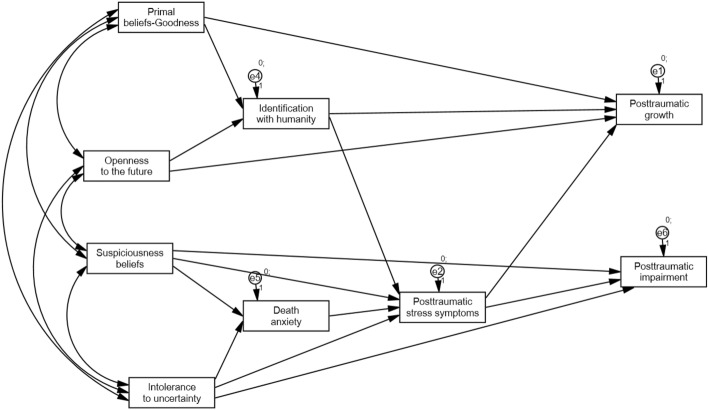
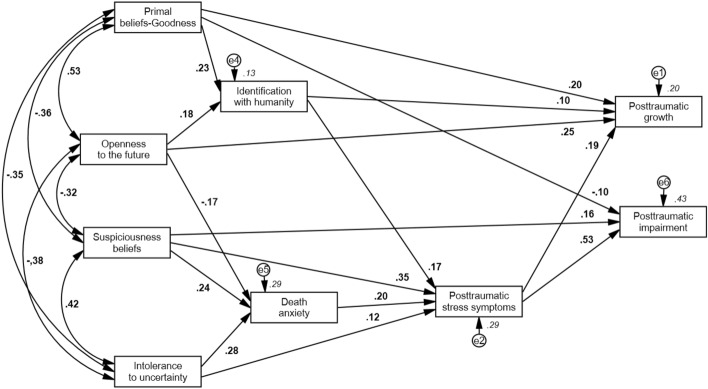
Given the need to understand both the negative and positive psychological consequences of the current global COVID-19 pandemic (Brewin et al. in Perspectives in Public Health 10.1177/1757913920957365 2020), the aim of this study was to test a cognitive model of post-traumatic symptoms (PTS) and post-traumatic growth (PTG) during confinement caused by the SARS-COV-2 epidemic. In line with cognitive models of trauma elaboration (Park in Psychological Bulletin 10.1037/a0018301), we included in our model some beliefs associated to the world (e.g., primal beliefs about a good world), to the self (e.g., death anxiety or orientation toward the future) and to others (e.g., suspiciousness or identification with humanity). To evaluate the explanatory model, a national representative sample of adults between the ages of 18 and 75 (N = 1951) was surveyed between 7th and 13th April, 2020, in the middle of a strict 7-week national confinement. Structural equation modelling yielded a very similar model to the one initially specified. The results highlight the role of both negative and positive core beliefs, which are pertinent to the current pandemic threat, in the appearance of PTS and PTG, respectively. In short, primal beliefs about a good world, openness to the future and identification with humanity were associated with PTG; while suspiciousness, intolerance of uncertainty, anxiety about death and also identification with humanity were associated with PTS and consequent impairment. This is an innovative study of different pathways to traumatic responses and growth during a pandemic. Future research is needed to replicate its findings.
鉴于有必要了解当前全球新冠疫情的负面和正面心理影响(布鲁因等人,《公共卫生视角》,2020年,10.1177/1757913920957365),本研究旨在检验严重急性呼吸综合征冠状病毒2(SARS-CoV-2)疫情导致隔离期间创伤后症状(PTS)和创伤后成长(PTG)的认知模型。根据创伤阐述的认知模型(帕克,《心理公报》,10.1037/a0018301),我们在模型中纳入了一些与世界相关的信念(例如,关于美好世界的原始信念)、与自我相关的信念(例如,死亡焦虑或对未来的取向)以及与他人相关的信念(例如,怀疑或对人性的认同)。为了评估该解释模型,2020年4月7日至13日,在为期7周的严格全国隔离期间,对18至75岁的全国代表性成年样本(N = 1951)进行了调查。结构方程建模得出了一个与最初指定的模型非常相似的模型。结果突出了分别与当前疫情威胁相关的负面和正面核心信念在PTS和PTG出现过程中的作用。简而言之,关于美好世界的原始信念、对未来的开放性和对人性的认同与PTG相关;而怀疑、对不确定性的不耐受、死亡焦虑以及对人性的认同与PTS及随之而来的损害相关。这是一项关于疫情期间创伤反应和成长不同途径的创新性研究。需要未来的研究来复制其研究结果。