Adjeiwaah Mary, Garpebring Anders, Nyholm Tufve
Department of Radiation Sciences, Umeå University, Umeå, Sweden.
Phys Imaging Radiat Oncol. 2020 Mar 13;13:21-27. doi: 10.1016/j.phro.2020.03.001. eCollection 2020 Jan.
There are currently no standard quality assurance (QA) methods for magnetic resonance imaging (MRI) in radiotherapy (RT). This work was aimed at evaluating the ability of two QA protocols to detect common events that affect quality of MR images under RT settings.
The American College of Radiology (ACR) MRI QA phantom was repeatedly scanned using a flexible coil and action limits for key image quality parameters were derived. Using an exploratory survey, issues that reduce MR image quality were identified. The most commonly occurring events were introduced as provocations to produce MR images with degraded quality. From these images, detection sensitivities of the ACR MRI QA protocol and a commercial geometric accuracy phantom were determined.
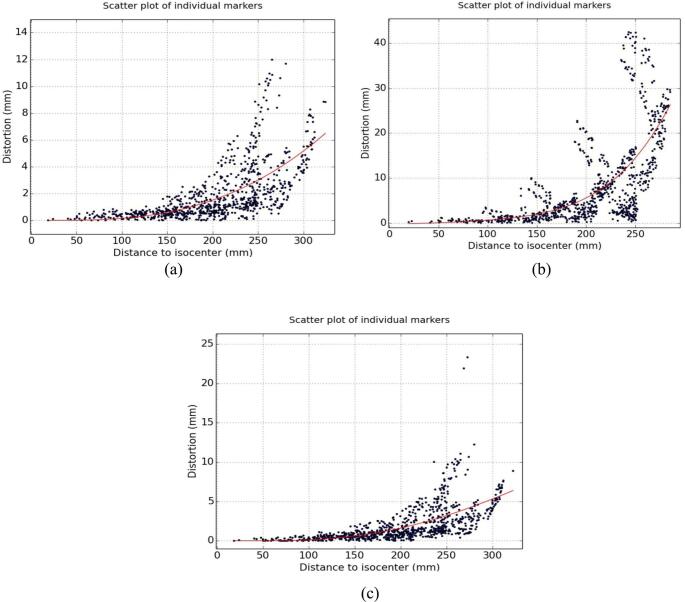
Machine-specific action limits for key image quality parameters set at were comparable with the ACR acceptable values. For the geometric accuracy phantom, provocations from uncorrected gradient nonlinearity effects and a piece of metal in the bore of the scanner resulted in worst distortions of 22.2 mm and 3.4 mm, respectively. The ACR phantom was sensitive to uncorrected signal variations, electric interference and a piece of metal in the bore of the scanner but could not adequately detect individual coil element failures.
The ACR MRI QA phantom combined with the large field-of-view commercial geometric accuracy phantom were generally sensitive in identifying some common MR image quality issues. The two protocols when combined may provide a tool to monitor the performance of MRI systems in the radiotherapy environment.
目前在放射治疗(RT)中,磁共振成像(MRI)尚无标准的质量保证(QA)方法。本研究旨在评估两种QA方案检测放疗环境下影响MR图像质量常见问题的能力。
使用柔性线圈对美国放射学会(ACR)MRI QA体模进行反复扫描,并得出关键图像质量参数的行动限值。通过探索性调查,确定降低MR图像质量的问题。将最常出现的问题作为诱发因素,以生成质量下降的MR图像。根据这些图像,确定ACR MRI QA方案和商业几何精度体模的检测灵敏度。
设置为 的关键图像质量参数的特定机器行动限值与ACR可接受值相当。对于几何精度体模,未校正的梯度非线性效应和扫描孔内的一块金属分别导致最大变形为22.2毫米和3.4毫米。ACR体模对未校正的信号变化、电干扰和扫描孔内的一块金属敏感,但无法充分检测单个线圈元件故障。
ACR MRI QA体模与大视野商业几何精度体模相结合,在识别一些常见的MR图像质量问题方面通常较为敏感。这两种方案结合使用可能为监测放疗环境中MRI系统的性能提供一种工具。