Department of Genetics, Harvard Medical School, Boston, Massachusetts, USA.
Department of Pathology, Brigham and Women's Hospital, Boston, Massachusetts, USA.
Dev Growth Differ. 2021 Feb;63(2):140-153. doi: 10.1111/dgd.12710. Epub 2021 Mar 9.
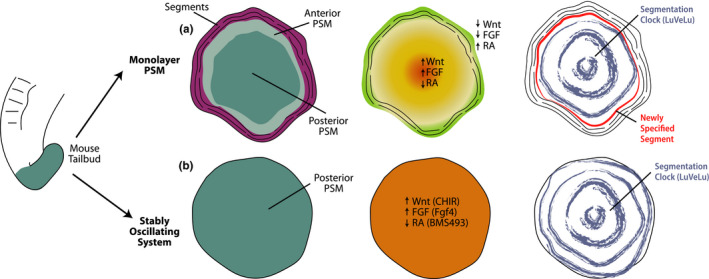
Segmental organization of the vertebrate body plan is established by the segmentation clock, a molecular oscillator that controls the periodicity of somite formation. Given the dynamic nature of the segmentation clock, in vivo studies in vertebrate embryos pose technical challenges. As an alternative, simpler models of the segmentation clock based on primary explants and pluripotent stem cells have recently been developed. These ex vivo and in vitro systems enable more quantitative analysis of oscillatory properties and expand the experimental repertoire applicable to the segmentation clock. Crucially, by eliminating the need for model organisms, in vitro models allow us to study the segmentation clock in new species, including our own. The human oscillator was recently recapitulated using induced pluripotent stem cells, providing a window into human development. Certainly, a combination of in vivo and in vitro work holds the most promising potential to unravel the mechanisms behind vertebrate segmentation.
脊椎动物体节模式的分段组织由分段时钟建立,这是一种分子振荡器,控制着体节形成的周期性。鉴于分段时钟的动态性质,在脊椎动物胚胎中的体内研究带来了技术挑战。作为替代方法,基于原代外植体和多能干细胞的分段时钟的更简单模型最近已被开发出来。这些离体和体外系统能够更定量地分析振荡特性,并扩展适用于分段时钟的实验方案。至关重要的是,通过消除对模式生物的需求,体外模型使我们能够在新物种中研究分段时钟,包括我们自己的物种。最近使用诱导多能干细胞重现了人类振荡器,为人类发育提供了一个窗口。当然,体内和体外工作的结合具有最有前途的潜力,可以揭示脊椎动物分段背后的机制。