Hernández-García Marta, Sánchez-López Javier, Martínez-García Laura, Becerra-Aparicio Federico, Morosini María Isabel, Ruiz-Garbajosa Patricia, Cantón Rafael
Servicio de Microbiología, Hospital Universitario Ramón y Cajal and Instituto Ramón y Cajal de Investigación Sanitaria (IRYCIS), 28034 Madrid, Spain.
Red Española de Investigación en Patología Infecciosa (REIPI), 28029 Madrid, Spain.
Pathogens. 2021 Jan 14;10(1):67. doi: 10.3390/pathogens10010067.
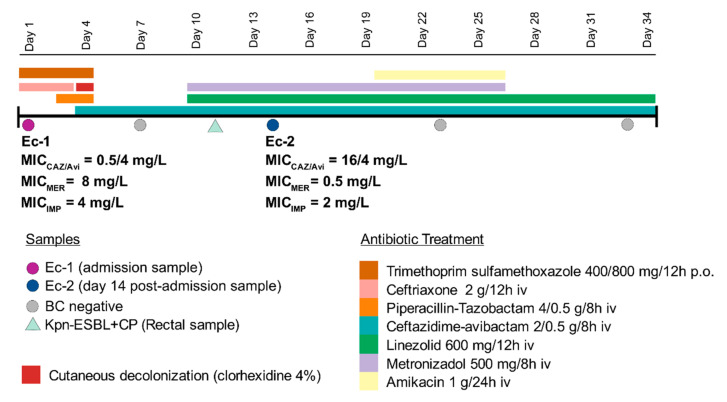
We report the emergence of an isolate belonging to the sequence type (ST)131- high-risk clone with ceftazidime-avibactam resistance recovered from a patient with bacteremia in 2019. Antimicrobial susceptibility was determined and whole genome sequencing (Illumina-NovaSeq6000) and cloning experiments were performed to investigate its resistance phenotype. A KPC-3-producing isolate susceptible to ceftazidime-avibactam (MIC = 0.5/4 mg/L) and with non-wild type MIC of meropenem (8 mg/L) was detected in a blood culture performed at hospital admission. Following 10-days of standard ceftazidime-avibactam dose treatment, a second KPC-producing isolate with a phenotype resembling an extended-spectrum β-lactamase (ESBL) producer (meropenem 0.5 mg/L, piperacillin-tazobactam 16/8 mg/L) but resistant to ceftazidime-avibactam (16/4 mg/L) was recovered. Both isolates belonged to ST131, serotype O25:H4 and sublineage H30R1. Genomics analysis showed a genome of 5,203,887 base pair with an evolutionary distance of 6 single nucleotide polymorphisms. A high content of resistance and virulence genes was detected in both isolates. The novel KPC-49 variant, an Arg-163-Ser mutant of , was detected in the isolate with resistance to ceftazidime-avibactam. Cloning experiments revealed that gene increases ceftazidime-avibactam MIC and decreases carbapenem MICs when using a porin deficient strain as a host. Both and genes were located on the transposon Tna as a part of an IncF [F1:A2:B20] plasmid. The emergence of novel genes conferring decreased susceptibility to ceftazidime-avibactam and resembling ESBL production in the epidemic ST131-H30R1- high-risk clone presents a new challenge in clinical practice.
我们报告了2019年从一名菌血症患者中分离出的一株属于序列型(ST)131高风险克隆且对头孢他啶-阿维巴坦耐药的菌株。测定了其药敏性,并进行了全基因组测序(Illumina-NovaSeq6000)和克隆实验以研究其耐药表型。在入院时进行的血培养中检测到一株产KPC-3且对头孢他啶-阿维巴坦敏感(MIC = 0.5/4 mg/L)、美罗培南MIC为非野生型(8 mg/L)的菌株。在标准剂量的头孢他啶-阿维巴坦治疗10天后,又分离出一株产KPC的菌株,其表型类似于超广谱β-内酰胺酶(ESBL)产生菌(美罗培南0.5 mg/L,哌拉西林-他唑巴坦16/8 mg/L),但对头孢他啶-阿维巴坦耐药(16/4 mg/L)。两株菌株均属于ST131、血清型O25:H4和亚谱系H30R1。基因组分析显示基因组大小为5,203,887碱基对,进化距离为6个单核苷酸多态性。在两株菌株中均检测到高含量的耐药和毒力基因。在对头孢他啶-阿维巴坦耐药的菌株中检测到新型KPC-49变体,即KPC的Arg-163-Ser突变体。克隆实验表明,当以孔蛋白缺陷菌株作为宿主时,KPC基因会增加头孢他啶-阿维巴坦的MIC并降低碳青霉烯类抗生素的MIC。KPC和TEM基因均位于转座子Tna上,作为IncF [F1:A2:B20]质粒的一部分。在流行的ST131-H30R1高风险克隆中出现赋予对头孢他啶-阿维巴坦敏感性降低且类似于ESBL产生的新型KPC基因,给临床实践带来了新的挑战。