Unità Operativa Complessa Cardiologia con UTIC ed Emodinamica-Dipartimento Emergenza Accettazione, Azienda Ospedaliera "Antonio Cardarelli", 80131 Napoli, Italy.
Dipartimento di Scienze Biomediche Avanzate, Università Federico II, 80131 Napoli, Italy.
Int J Mol Sci. 2021 Jan 14;22(2):775. doi: 10.3390/ijms22020775.
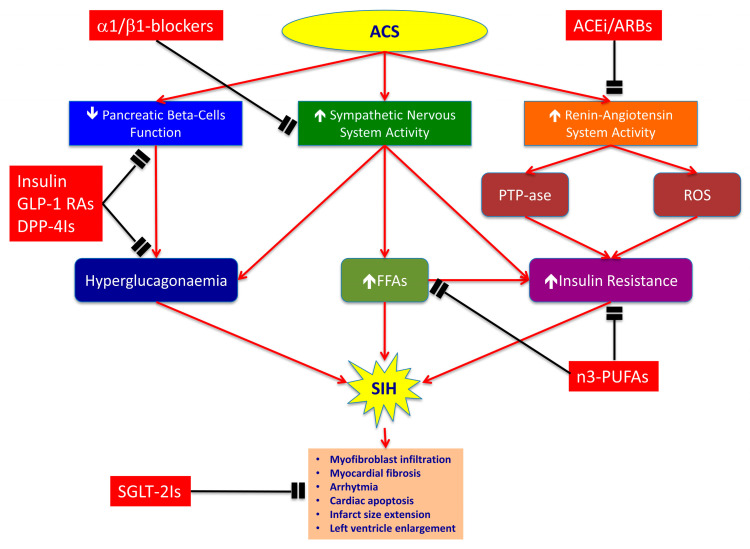
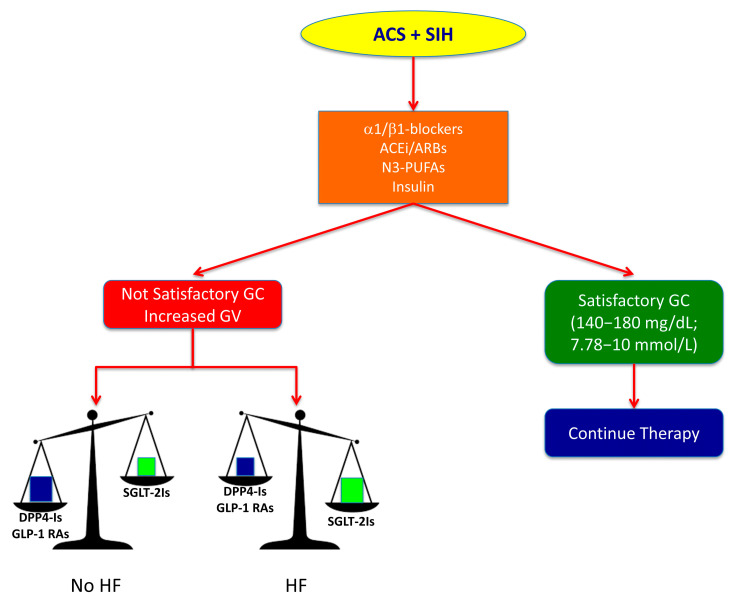
Stress-induced hyperglycaemia (SIH) at hospital admission for acute coronary syndrome is associated with poor outcome, especially in patients without known diabetes. Nevertheless, insulin treatment in these subjects was not correlated with the reduction of mortality. This is likely due to the fact that SIH in the context of an acute coronary syndrome, compared to that in known diabetes, represents an epiphenomenon of other pathological conditions, such as adrenergic and renin-angiotensin system over-activity, hyperglucagonaemia, increase of circulating free fatty acids and pancreatic beta-cell dysfunction, which are not completely reversed by insulin therapy and so worsen the prognosis. Thus, SIH may be considered not only as a biomarker of organ damage, but also as an indicator of a more complex therapeutic strategy in these subjects. The aim of this review is to analyse the molecular mechanisms by which SIH may favour a worse prognosis in non-diabetic patients with acute coronary syndrome and identify new therapeutic strategies, in addition to insulin therapy, for a more appropriate treatment and improved outcomes.
入院时急性冠状动脉综合征导致的应激性高血糖(SIH)与不良预后相关,尤其是在无已知糖尿病的患者中。然而,这些患者的胰岛素治疗与死亡率降低无关。这可能是因为与已知糖尿病相比,急性冠状动脉综合征背景下的 SIH 是其他病理状况(如肾上腺素能和肾素-血管紧张素系统过度活跃、高胰高血糖素血症、循环游离脂肪酸增加和胰岛β细胞功能障碍)的继发现象,这些状况不能通过胰岛素治疗完全逆转,从而使预后恶化。因此,SIH 不仅可以作为器官损伤的生物标志物,还可以作为这些患者更复杂治疗策略的指标。本综述的目的是分析 SIH 如何促进急性冠状动脉综合征非糖尿病患者预后恶化的分子机制,并确定除胰岛素治疗以外的新的治疗策略,以实现更恰当的治疗和改善结局。