Huang Xinbo, Zhou Qun, Wang Mingxia, Cao Congcong, Ma Qian, Ye Jing, Gui Yaoting
Guangdong and Shenzhen Key Laboratory of Male Reproductive Medicine and Genetics, Institute of Urology, Peking University Shenzhen Hospital, Shenzhen-Peking University-The Hong Kong University of Science and Technology Medical Center, Shenzhen, China.
Department of Urology, The Affiliated Nanhua Hospital of University of South China, Hengyang, China.
Front Mol Biosci. 2021 Jan 5;7:627848. doi: 10.3389/fmolb.2020.627848. eCollection 2020.
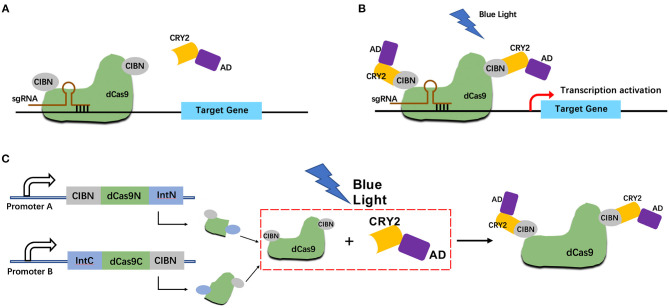
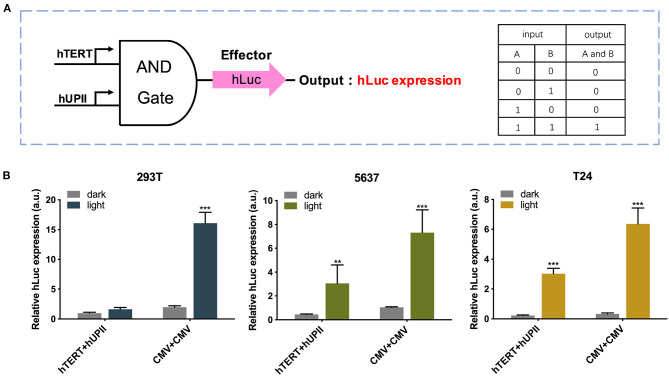
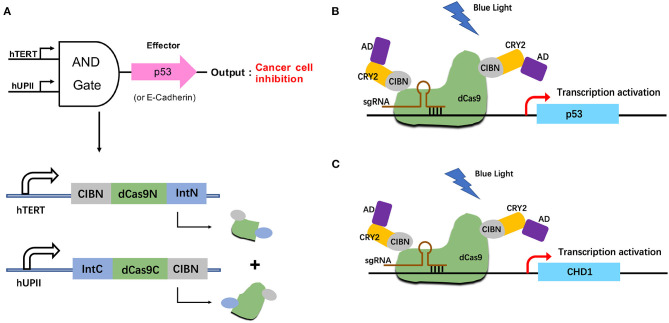
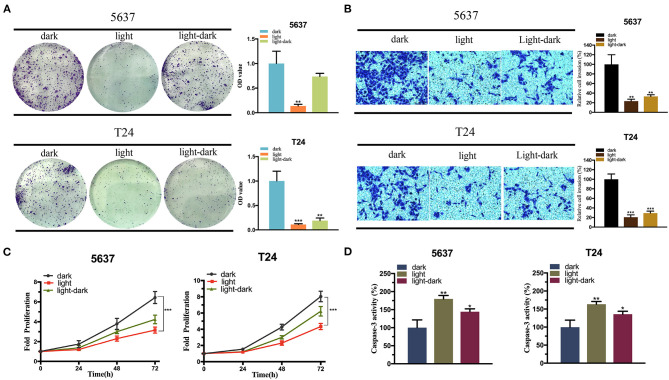
Optogenetic systems have been increasingly investigated in the field of biomedicine. Previous studies had found the inhibitory effect of the light-inducible genetic circuits on cancer cell growth. In our study, we applied an AND logic gates to the light-inducible genetic circuits to inhibit the cancer cells more specifically. The circuit would only be activated in the presence of both the human telomerase reverse transcriptase (hTERT) and the human uroplakin II (hUPII) promoter. The activated logic gate led to the expression of the p53 or E-cadherin protein, which could inhibit the biological function of tumor cells. In addition, we split the dCas9 protein to reduce the size of the synthetic circuit compared to the full-length dCas9. This light-inducible system provides a potential therapeutic strategy for future bladder cancer.
光遗传学系统在生物医学领域受到越来越多的研究。先前的研究发现光诱导遗传回路对癌细胞生长具有抑制作用。在我们的研究中,我们将与门应用于光诱导遗传回路,以更特异性地抑制癌细胞。该回路仅在人端粒酶逆转录酶(hTERT)和人尿路上皮蛋白II(hUPII)启动子同时存在时才会被激活。激活的逻辑门导致p53或E-钙粘蛋白的表达,这可以抑制肿瘤细胞的生物学功能。此外,与全长dCas9相比,我们拆分了dCas9蛋白以减小合成回路的大小。这种光诱导系统为未来的膀胱癌提供了一种潜在的治疗策略。