Filby Samantha, van der Zee Kirsten, van Walbeek Corné
Research Unit on the Economics of Excisable Products, University of Cape Town School of Economics, Rondebosch, South Africa
Research Unit on the Economics of Excisable Products, University of Cape Town School of Economics, Rondebosch, South Africa.
Tob Control. 2022 Nov;31(6):694-700. doi: 10.1136/tobaccocontrol-2020-056209. Epub 2021 Jan 20.
The endgame literature recommends that, for a tobacco sales ban to be successful, several demand-side preconditions (eg, low prevalence and effective cessation support) should be in place. The South African Government imposed a ban on the sale of all tobacco and vaping products between 27 March and 17 August 2020, as part of the COVID-19 lockdown.
To assess how cigarette smokers responded to the sales ban, to evaluate how the ban impacted the cigarette market in South Africa and to use the South African experience to inform endgame planning.
Regular preban cigarette smokers completed an online questionnaire from 4 to 19 June 2020 (n=23 631), in which they reported on their prelockdown cigarette smoking patterns, quitting behaviour (if relevant) and smoking behaviour during the ban.
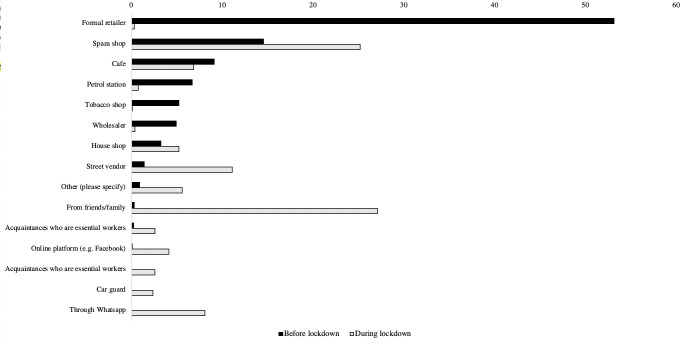
About 9% of prelockdown smokers in the sample successfully quit smoking. 93% of continuing smokers purchased cigarettes despite the sales ban. The average price of cigarettes increased by 250% relative to prelockdown prices. Most respondents purchased cigarettes through informal channels.
The demand-side preconditions for an effective sales ban were not in place in South Africa, making a sales ban inappropriate. The South African experience suggests that supply-side factors are also important in ensuring the success of a sales ban. These are: (1) the illicit market must be under control before implementing a sales ban; and (2) an effective sales ban needs to be synchronised with a ban on the manufacture, transport and distribution of cigarettes.
控烟终局阶段的文献表明,要使烟草销售禁令取得成功,应具备若干需求侧前提条件(例如低流行率和有效的戒烟支持)。作为新冠疫情封锁措施的一部分,南非政府在2020年3月27日至8月17日期间禁止销售所有烟草和电子烟产品。
评估吸烟者对销售禁令的反应,评估该禁令对南非卷烟市场的影响,并利用南非的经验为控烟终局规划提供参考。
在2020年6月4日至19日,定期吸烟的吸烟者(禁令实施前)完成了一份在线调查问卷(n = 23631),他们报告了封锁前的吸烟模式、戒烟行为(如相关)以及禁令期间的吸烟行为。
样本中约9%的封锁前吸烟者成功戒烟。尽管实施了销售禁令,但93%的继续吸烟者仍购买了香烟。香烟平均价格相对于封锁前价格上涨了250%。大多数受访者通过非正式渠道购买香烟。
南非并未具备有效销售禁令的需求侧前提条件,因此实施销售禁令并不合适。南非的经验表明,供应侧因素对于确保销售禁令的成功也很重要。这些因素包括:(1)在实施销售禁令之前,非法市场必须得到控制;(2)有效的销售禁令需要与香烟制造、运输和分销禁令同步实施。