Amer Sara Adel, Abushady Hala Mohamed, Refay Rasha Mohamed, Mailam Mahmoud Ahmed
Agricultural Research Centre (ARC), Food Technology Research Institute (FTRI), Giza, Egypt.
Faculty of Science, Department of Microbiology, Ain Shams University, Cairo, Egypt.
J Genet Eng Biotechnol. 2021 Jan 20;19(1):13. doi: 10.1186/s43141-020-00093-z.
Bacteriocins are proteinaceous compounds produced from lactic acid bacteria. Bacteriocins are well-known for their antibacterial potential and safety for application in food. However, the commercial availability of bacteriocin is facing several limitations; among them is the low yield and short stability period. That calls for a new strategy for overcoming these hurdles. Among these approaches is incorporating bacteriocin in nanoparticles. So, the aim of this study was to enhance the plantaricin produced from isolated Lactobacillus plantarum strain using nanotechnology.
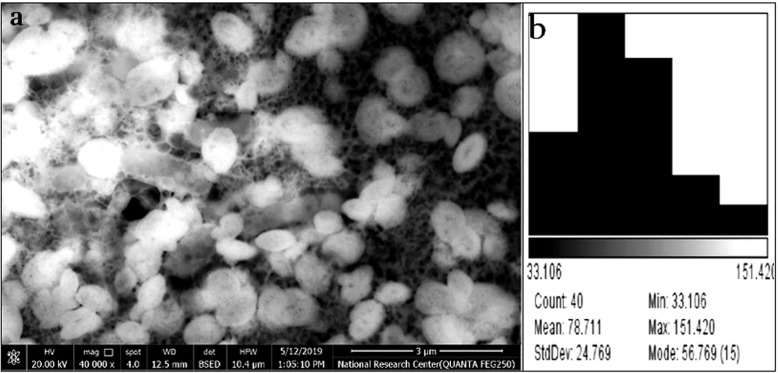
In this study, the plnEF genes encoding plantaricin EF have been identified and sequenced (accession number of MN172264.1). The extracted bacteriocin (EX-PL) was obtained by the ammonium sulfate method. Then, it was used for biosynthesizing plantaricin-incorporated silver nanoparticles (PL-SNPs). The synthesized nanoparticles were confirmed by SEM-EDAX analysis. The antibacterial activity of both combined (PL-SNPs) and extracted plantaricin (EX-PL) were tested against some strains of foodborne pathogenic bacteria. The results revealed that the antibacterial activities were increased by 99.2% on the combination of bacteriocin with the silver nanoparticle. The MIC of EX-PL (7.6 mg/mL) has been lowered after incorporating into silver nanoparticles and reached 0.004 mg/mL for PL-SNPs. Despite that extracted plantaricin showed no inhibitory activity towards Listeria monocytogenes, plantaricin-incorporated silver nanoparticles displayed inhibitory activity against this strain. Furthermore, the stability period at 4 °C was increased from 5 days to 60 days for EX-PL and PL-SNPs, respectively.
Plantaricin-incorporated silver nanoparticles possess higher antibacterial activity and more stability than the free one, which makes it more fitting for combating foodborne pathogens and open more fields for applications in both food and pharmaceutical industries.
细菌素是由乳酸菌产生的蛋白质类化合物。细菌素因其抗菌潜力和在食品中应用的安全性而闻名。然而,细菌素的商业可用性面临着几个限制;其中包括产量低和保质期短。这就需要一种新的策略来克服这些障碍。这些方法之一是将细菌素掺入纳米颗粒中。因此,本研究的目的是利用纳米技术提高从分离的植物乳杆菌菌株中产生的植物乳杆菌素。
在本研究中,已鉴定并测序了编码植物乳杆菌素EF的plnEF基因(登录号为MN172264.1)。通过硫酸铵法获得提取的细菌素(EX-PL)。然后,将其用于生物合成掺入植物乳杆菌素的银纳米颗粒(PL-SNPs)。通过扫描电子显微镜-能量色散X射线分析(SEM-EDAX)确认了合成的纳米颗粒。测试了组合的(PL-SNPs)和提取的植物乳杆菌素(EX-PL)对一些食源性病原体菌株的抗菌活性。结果表明,细菌素与银纳米颗粒组合后抗菌活性提高了99.2%。EX-PL的最低抑菌浓度(MIC)(7.6mg/mL)在掺入银纳米颗粒后降低,PL-SNPs的MIC达到0.004mg/mL。尽管提取的植物乳杆菌素对单核细胞增生李斯特菌没有抑制活性,但掺入植物乳杆菌素的银纳米颗粒对该菌株具有抑制活性。此外,EX-PL和PL-SNPs在4℃下的保质期分别从5天增加到60天。
掺入植物乳杆菌素的银纳米颗粒比游离的具有更高的抗菌活性和更高的稳定性,这使其更适合对抗食源性病原体,并为食品和制药行业的应用开辟了更多领域。