School of Psychology, University of Nottingham, UK.
Institute of Cognitive & Evolutionary Anthropology, University of Oxford, UK.
Br J Psychol. 2021 Aug;112(3):763-780. doi: 10.1111/bjop.12491. Epub 2021 Jan 20.
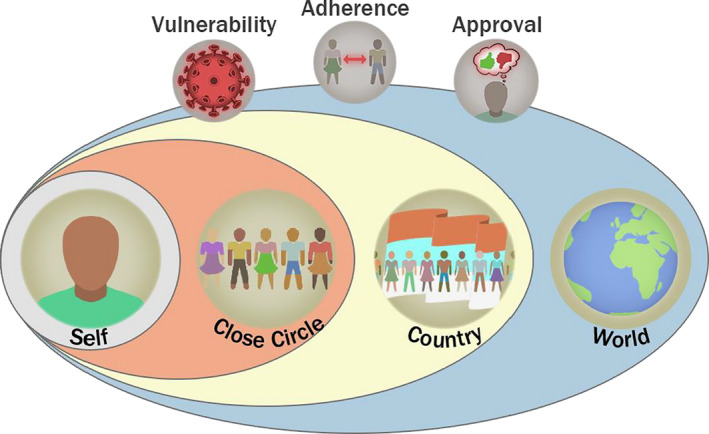
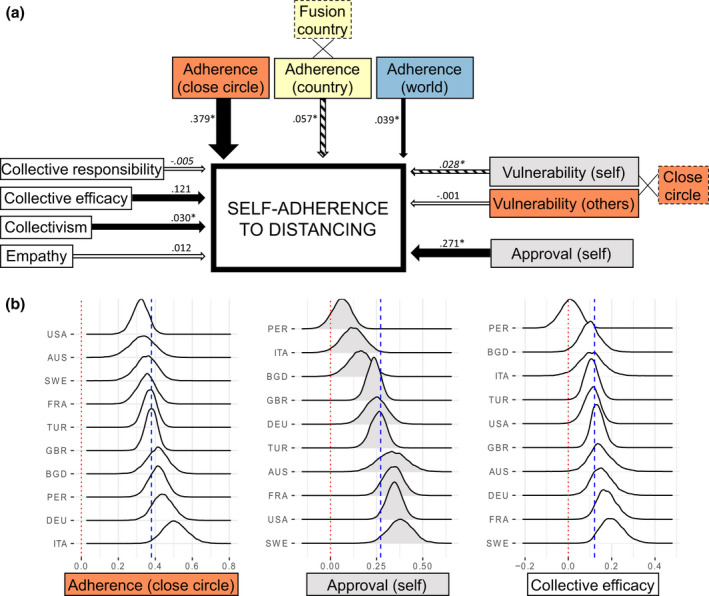
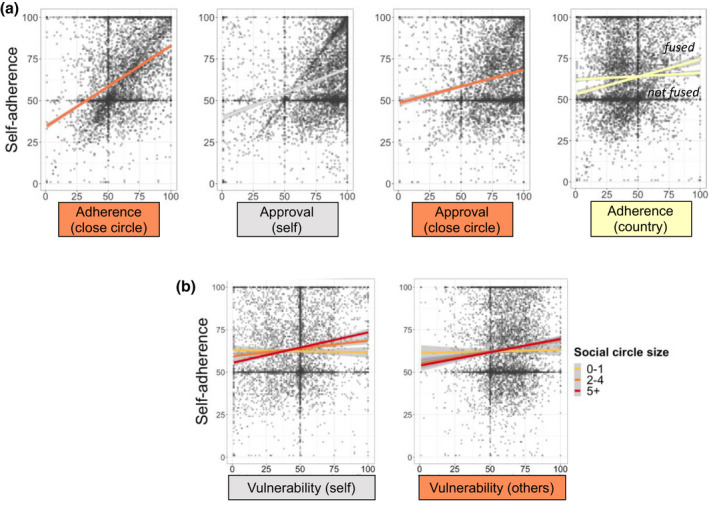
Why do we adopt new rules, such as social distancing? Although human sciences research stresses the key role of social influence in behaviour change, most COVID-19 campaigns emphasize the disease's medical threat. In a global data set (n = 6,675), we investigated how social influences predict people's adherence to distancing rules during the pandemic. Bayesian regression analyses controlling for stringency of local measures showed that people distanced most when they thought their close social circle did. Such social influence mattered more than people thinking distancing was the right thing to do. People's adherence also aligned with their fellow citizens, but only if they felt deeply bonded with their country. Self-vulnerability to the disease predicted distancing more for people with larger social circles. Collective efficacy and collectivism also significantly predicted distancing. To achieve behavioural change during crises, policymakers must emphasize shared values and harness the social influence of close friends and family.
为什么我们要采用新的规则,例如社交距离?尽管人类科学研究强调社会影响在行为改变中的关键作用,但大多数 COVID-19 运动都强调了该疾病的医学威胁。在一个全球数据集(n=6675)中,我们调查了社会影响如何预测人们在大流行期间对隔离规则的遵守程度。控制当地措施严格程度的贝叶斯回归分析表明,当人们认为自己的亲密社交圈在做什么时,他们的社交距离就最大。这种社会影响比人们认为保持社交距离是正确的事情更为重要。人们的遵守程度也与他们的同胞一致,但前提是他们与自己的国家有着深厚的联系。对于社交圈子较大的人来说,对疾病的自我脆弱性更能预测社交距离。集体效能和集体主义也显著预测了社交距离。为了在危机期间实现行为改变,政策制定者必须强调共同价值观,并利用亲密朋友和家人的社会影响。