Bali Prerna, Coker Joanna, Lozano-Pope Ivonne, Zengler Karsten, Obonyo Marygorret
Department of Medicine, School of Medicine, University of California, San Diego, La Jolla, CA 92093, USA.
Department of Pediatrics, University of California, San Diego, La Jolla, CA 92093, USA.
Microorganisms. 2021 Jan 17;9(1):189. doi: 10.3390/microorganisms9010189.
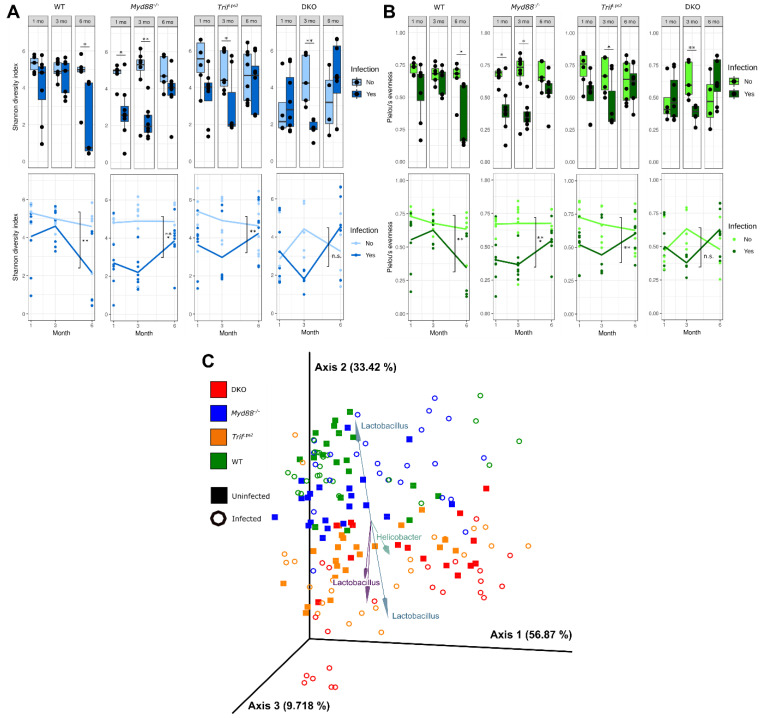
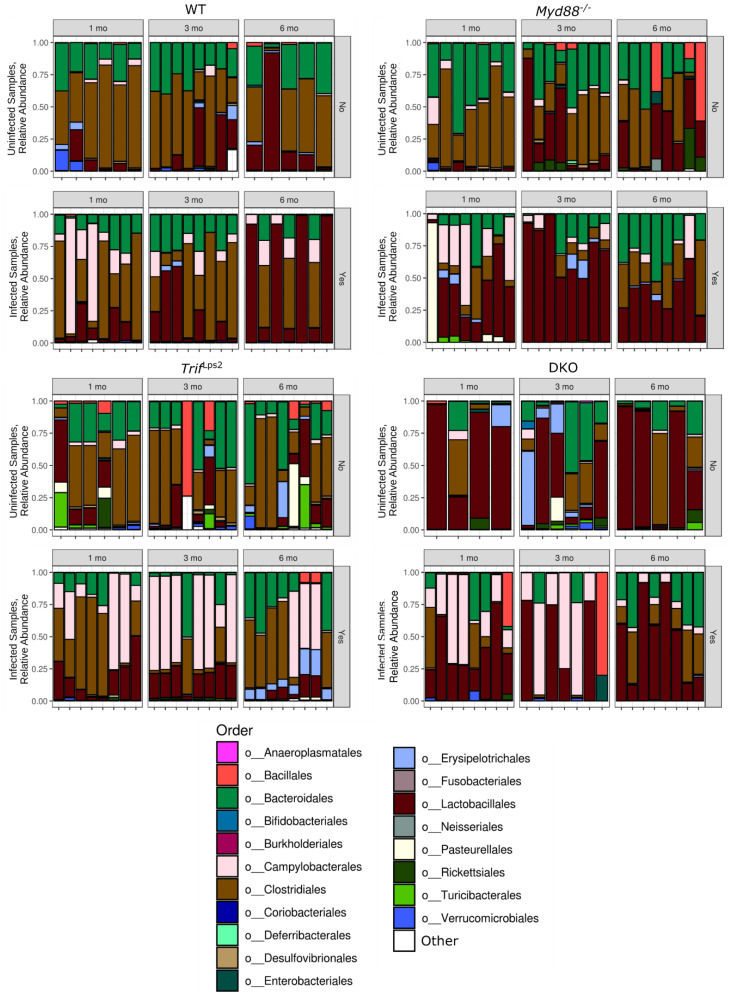
Gastric cancer is the third most common cause of death from cancer in the world and infection with () is the main cause of gastric cancer. In addition to infection, the overall stomach microbiota has recently emerged as a potential factor in gastric cancer progression. Previously we had established that mice deficient in myeloid differentiation primary response gene 88 (MyD88, ) rapidly progressed to neoplasia when infected with . Thus, in order to assess the role of the microbiota in this fast-progressing gastric cancer model we investigated changes of the gastric microbiome in mice with different genotypic backgrounds: wild type (WT), MyD88-deficient (), mice deficient in the Toll/interleukin-1 receptor (TIR) domain-containing adaptor-inducing interferon-β (TRIF, ), and MyD88- and TRIF-deficient (/ , double knockout (DKO)) mice. We compared changes in alpha diversity, beta diversity, relative abundance, and log-fold differential of relative abundance ratios in uninfected and infected mice and studied their correlations with disease progression to gastric cancer . We observed an overall reduction in microbial diversity post-infection with across all genotypes. Campylobacterales were observed in all infected mice, with marked reduction in abundance at 3 and 6 months in mice. A sharp increase in Lactobacillales in infected and DKO mice at 3 and 6 months was observed as compared to and WT mice, hinting at a possible role of these bacteria in gastric cancer progression. This was further reinforced upon comparison of Lactobacillales log-fold differentials with histological data, indicating that Lactobacillales are closely associated with infection and gastric cancer progression. Our study suggests that differences in genotypes could influence the stomach microbiome and make it more susceptible to the development of gastric cancer upon infection. Additionally, increase in Lactobacillales could contribute to faster development of gastric cancer and might serve as a potential biomarker for the fast progressing form of gastric cancer.
胃癌是全球第三大常见癌症死因,感染(此处括号内容缺失,无法准确翻译)是胃癌的主要病因。除感染外,胃内整体微生物群最近已成为胃癌进展的一个潜在因素。此前我们已证实,髓样分化初级反应基因88(MyD88,此处括号内容缺失,无法准确翻译)缺陷的小鼠在感染(此处括号内容缺失,无法准确翻译)后会迅速发展为肿瘤。因此,为了评估微生物群在这种快速进展的胃癌模型中的作用,我们研究了不同基因背景小鼠(野生型(WT)、MyD88缺陷型(此处括号内容缺失,无法准确翻译)、Toll/白细胞介素-1受体(TIR)结构域含接头诱导干扰素-β(TRIF,此处括号内容缺失,无法准确翻译)缺陷的小鼠以及MyD88和TRIF双缺陷(/ ,双敲除(DKO))小鼠)胃微生物组的变化。我们比较了未感染和感染(此处括号内容缺失,无法准确翻译)小鼠的α多样性、β多样性、相对丰度以及相对丰度比的对数倍差异,并研究了它们与胃癌疾病进展的相关性。我们观察到所有基因型小鼠在感染(此处括号内容缺失,无法准确翻译)后微生物多样性总体下降。在所有感染小鼠中均观察到弯曲杆菌目,在(此处括号内容缺失,无法准确翻译)小鼠中,其丰度在3个月和6个月时显著降低。与(此处括号内容缺失,无法准确翻译)和WT小鼠相比,在感染的(此处括号内容缺失二处)和DKO小鼠中,乳杆菌目在3个月和6个月时急剧增加,这暗示这些细菌在胃癌进展中可能发挥作用。将乳杆菌目的对数倍差异与组织学数据进行比较后,这一点得到了进一步证实,表明乳杆菌目与(此处括号内容缺失,无法准确翻译)感染和胃癌进展密切相关。我们的研究表明,基因型差异可能会影响胃微生物组,并使其在感染(此处括号内容缺失,无法准确翻译)后更容易发生胃癌。此外,乳杆菌目的增加可能会导致胃癌更快发展,并可能作为快速进展型胃癌的潜在生物标志物。