MED-Mediterranean Institute for Agriculture, Environment and Development, Instituto de Investigação e Formação Avançada, Universidade de Évora, Pólo da Mitra, Ap. 94, 7006-554 Évora, Portugal.
MED-Mediterranean Institute for Agriculture, Environment and Development & Departamento de Fitotecnia, Escola de Ciências e Tecnologia, Universidade de Évora, Pólo da Mitra, Ap. 94, 7006-554 Évora, Portugal.
Viruses. 2021 Jan 19;13(1):141. doi: 10.3390/v13010141.
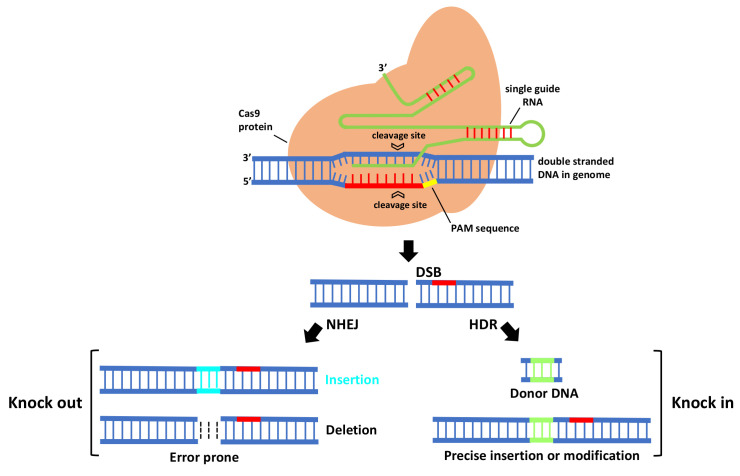
Plant viruses cause devastating diseases in many agriculture systems, being a serious threat for the provision of adequate nourishment to a continuous growing population. At the present, there are no chemical products that directly target the viruses, and their control rely mainly on preventive sanitary measures to reduce viral infections that, although important, have proved to be far from enough. The current most effective and sustainable solution is the use of virus-resistant varieties, but which require too much work and time to obtain. In the recent years, the versatile gene editing technology known as CRISPR/Cas has simplified the engineering of crops and has successfully been used for the development of viral resistant plants. CRISPR stands for 'clustered regularly interspaced short palindromic repeats' and CRISPR-associated (Cas) proteins, and is based on a natural adaptive immune system that most archaeal and some bacterial species present to defend themselves against invading bacteriophages. Plant viral resistance using CRISPR/Cas technology can been achieved either through manipulation of plant genome (plant-mediated resistance), by mutating host factors required for viral infection; or through manipulation of virus genome (virus-mediated resistance), for which CRISPR/Cas systems must specifically target and cleave viral DNA or RNA. Viruses present an efficient machinery and comprehensive genome structure and, in a different, beneficial perspective, they have been used as biotechnological tools in several areas such as medicine, materials industry, and agriculture with several purposes. Due to all this potential, it is not surprising that viruses have also been used as vectors for CRISPR technology; namely, to deliver CRISPR components into plants, a crucial step for the success of CRISPR technology. Here we discuss the basic principles of CRISPR/Cas technology, with a special focus on the advances of CRISPR/Cas to engineer plant resistance against DNA and RNA viruses. We also describe several strategies for the delivery of these systems into plant cells, focusing on the advantages and disadvantages of the use of plant viruses as vectors. We conclude by discussing some of the constrains faced by the application of CRISPR/Cas technology in agriculture and future prospects.
植物病毒会导致许多农业系统中出现毁灭性疾病,对为不断增长的人口提供充足营养构成严重威胁。目前,尚无直接针对病毒的化学产品,其防治主要依赖于减少病毒感染的预防性卫生措施,尽管这些措施很重要,但事实证明还远远不够。目前最有效和可持续的解决方案是使用抗病毒品种,但这需要太多的工作和时间来获得。近年来,一种被称为 CRISPR/Cas 的多功能基因编辑技术简化了作物工程,并且已经成功地用于开发抗病毒植物。CRISPR 代表“成簇的、规律间隔的短回文重复序列”和 CRISPR 相关(Cas)蛋白,它基于大多数古菌和一些细菌为抵御入侵噬菌体而呈现的一种自然适应性免疫机制。利用 CRISPR/Cas 技术实现植物抗病毒可以通过对植物基因组的操作(植物介导的抗性)来实现,通过突变病毒感染所需的宿主因子来实现;或者通过病毒基因组的操作(病毒介导的抗性)来实现,为此 CRISPR/Cas 系统必须专门靶向并切割病毒 DNA 或 RNA。病毒具有高效的机制和全面的基因组结构,从不同的、有益的角度来看,它们已被用于医学、材料工业和农业等多个领域的生物技术工具,具有多种用途。由于具有所有这些潜力,病毒也被用作 CRISPR 技术的载体也就不足为奇了;也就是说,将 CRISPR 组件递送到植物中,这是 CRISPR 技术成功的关键步骤。在这里,我们讨论了 CRISPR/Cas 技术的基本原则,特别关注 CRISPR/Cas 技术在工程植物抗 DNA 和 RNA 病毒方面的进展。我们还描述了几种将这些系统递送到植物细胞的策略,重点介绍了使用植物病毒作为载体的优缺点。最后,我们讨论了 CRISPR/Cas 技术在农业中的应用所面临的一些限制以及未来的前景。