Feeney Megan P, Xu Yaqian, Surface Matthew, Shah Hiral, Vanegas-Arroyave Nora, Chan Amanda K, Delaney Elizabeth, Przedborski Serge, Beck James C, Alcalay Roy N
Parkinson's Foundation, New York, NY, USA.
Department of Psychiatry, Columbia University Irving Medical Center, New York, NY, USA.
NPJ Parkinsons Dis. 2021 Jan 21;7(1):10. doi: 10.1038/s41531-020-00153-8.
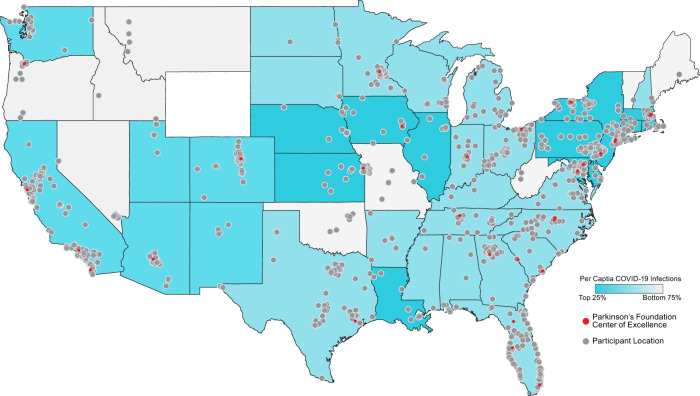
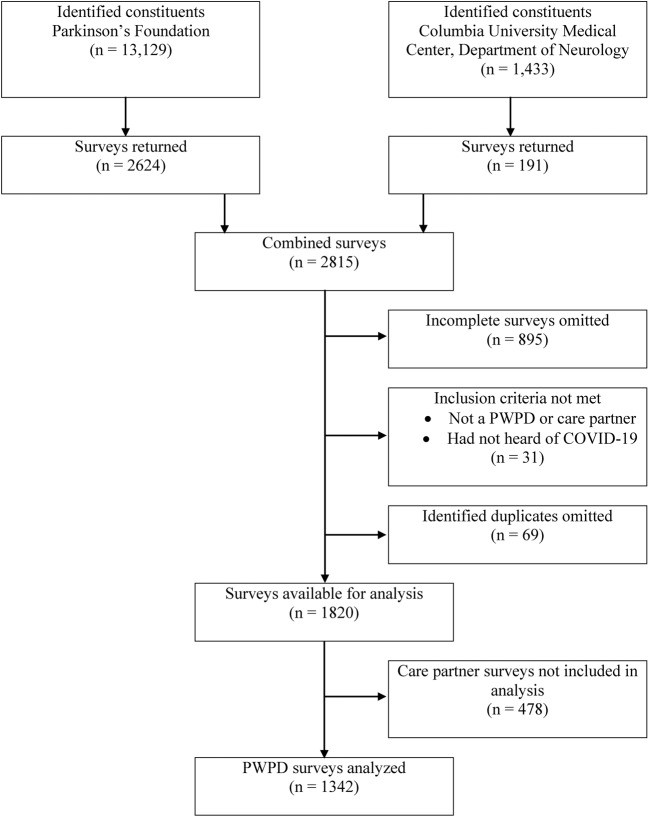
As the COVID-19 pandemic continues to affect the international community, very little is known about its impact on the health and day-to-day activities of people with Parkinson's disease (PwPD). To better understand the emotional and behavioral consequences of the public health policies implemented to mitigate the spread of SARS-CoV-2 in PwPD, and to explore the factors contributing to accessing alternative health care mechanisms, such as telehealth, we administered an anonymous knowledge, attitude, and practice survey to PwPD and care partners, via the mailing lists of the Parkinson's Foundation and Columbia University Parkinson's Disease Center of Excellence with an average response rate of 19.3%. Sufficient information was provided by 1,342 PwPD to be included in the final analysis. Approximately half of respondents reported a negative change in PD symptoms, with 45-66% reporting mood disturbances. Telehealth use increased from 9.7% prior to the pandemic to 63.5% during the pandemic. Higher income and higher education were associated with telehealth use. Services were more often used for doctor's appointment than physical, occupational, speech, or mental health therapies. Almost half (46%) of PwPD preferred to continue using telehealth always or sometimes after the coronavirus outbreak had ended. Having received support/instruction for telehealth and having a care partner, friend, or family member to help them with the telehealth visit increased the likelihood of continuous use of telehealth after the pandemic ended. Taken together, PD symptoms and management practices were markedly affected by COVID-19. Given the observed demographic limitations of telehealth, expanding its implementation to include additional physical, occupational, psychological, and speech therapies, increasing support for telehealth, as well as reaching underserved (low income) populations is urgently required.
随着新冠疫情持续影响国际社会,人们对其对帕金森病患者(PwPD)健康及日常活动的影响知之甚少。为了更好地理解为减缓SARS-CoV-2传播而实施的公共卫生政策对PwPD的情绪和行为影响,并探索有助于使用远程医疗等替代医疗机制的因素,我们通过帕金森基金会和哥伦比亚大学帕金森病卓越中心的邮件列表,对PwPD及其护理伙伴进行了一项匿名的知识、态度和实践调查,平均回复率为19.3%。1342名PwPD提供了足够信息以纳入最终分析。约一半受访者报告帕金森病症状出现负面变化,45%-66%报告有情绪障碍。远程医疗的使用从疫情前的9.7%增至疫情期间的63.5%。高收入和高学历与远程医疗的使用相关。远程医疗服务更多用于预约医生,而非物理治疗、职业治疗、言语治疗或心理健康治疗。近一半(46%)的PwPD表示在新冠疫情结束后仍希望经常或偶尔继续使用远程医疗。接受过远程医疗支持/指导以及有护理伙伴、朋友或家庭成员帮助进行远程医疗就诊,增加了疫情结束后持续使用远程医疗的可能性。总体而言,新冠疫情对帕金森病症状及管理措施产生了显著影响。鉴于观察到的远程医疗在人口统计学方面的局限性,迫切需要扩大其应用范围,纳入更多物理治疗、职业治疗、心理治疗和言语治疗,增加对远程医疗的支持,并覆盖服务不足(低收入)人群。