Department of Neuroradiology, Bonn University Hospital, Venusberg-Campus 1, 53127, Bonn, Germany.
Facoltà di Medicina e Chirurgia, Università Politecnica delle Marche, Via Tronto 10, 60126, Ancona, Italy.
Eur Radiol. 2021 Aug;31(8):6334-6341. doi: 10.1007/s00330-020-07582-2. Epub 2021 Jan 22.
Quantitative MRI (qMRI) methods provide versatile neuroradiological applications and are a hot topic in research. The degree of their clinical implementation is however barely known. This survey was created to illuminate which and how qMRI techniques are currently applied across Europe.
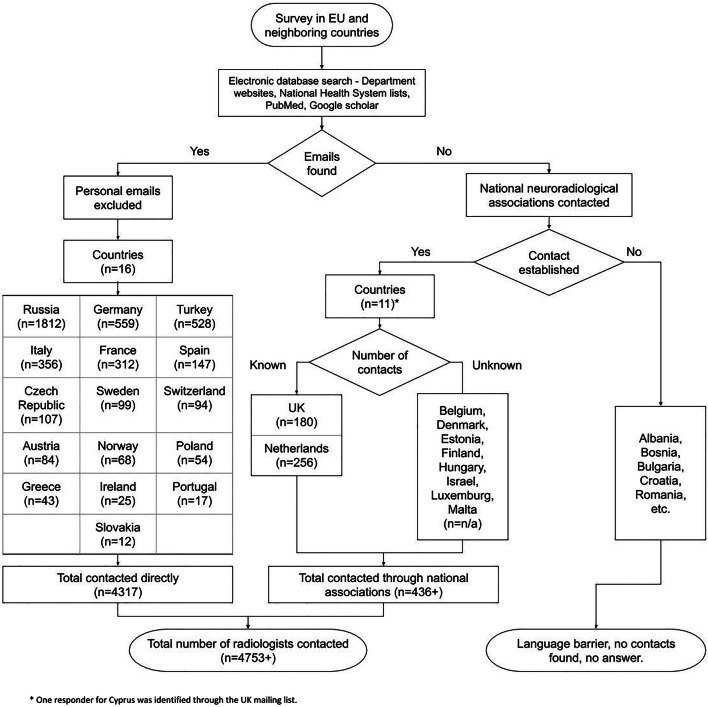
In total, 4753 neuroradiologists from 27 countries received an online questionnaire. Demographic and professional data, experience with qMRI techniques in the brain and head and neck, usage, reasons for/against application, and knowledge of the QIBA and EIBALL initiatives were assessed.
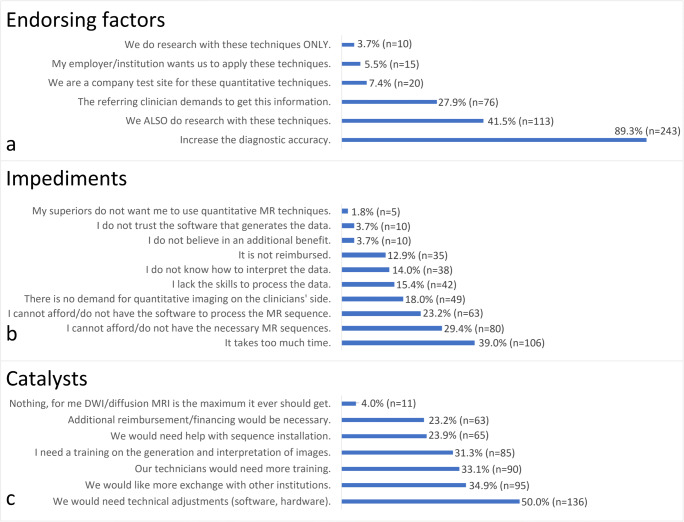
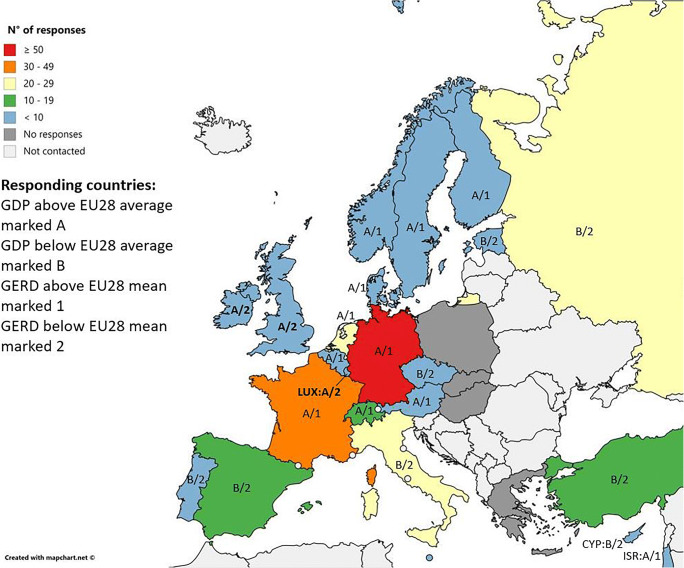
Two hundred seventy-two responders in 23 countries used the following techniques clinically (mean values in %): DWI (82.0%, n = 223), DSC (67.3%, n = 183), MRS (64.3%, n = 175), DCE (43.4%, n = 118), BOLD-fMRI (42.6%, n = 116), ASL (37.5%, n = 102), fat quantification (25.0%, n = 68), T2 mapping (16.9%, n = 46), T1 mapping (15.1%, n = 41), PET-MRI (11.8%, n = 32), IVIM (5.5%, n = 15), APT-CEST (4.8%, n = 13), and DKI (3.3%, n = 9). The most frequent usage indications for any qMRI technique were tissue differentiation (82.4%, n = 224) and oncological monitoring (72.8%, n = 198). Usage differed between countries, e.g. ASL: Germany (n = 13/63; 20.6%) vs. France (n = 31/40; 77.5%). Neuroradiologists endorsed the use of qMRI because of an improved diagnostic accuracy (89.3%, n = 243), but 50.0% (n = 136) are in need of better technology, 34.9% (n = 95) wish for more communication, and 31.3% need help with result interpretation/generation (n = 85). QIBA and EIBALL were not well known (12.5%, n = 34, and 11.0%, n = 30).
The clinical implementation of qMRI methods is highly variable. Beyond the aspect of readiness for clinical use, better availability of support and a wider dissemination of guidelines could catalyse a broader implementation.
• Neuroradiologists endorse the use of qMRI techniques as they subjectively improve diagnostic accuracy. • Clinical implementation is highly variable between countries, techniques, and indications. • The use of advanced imaging could be promoted through an increase in technical support and training of both doctors and technicians.
定量磁共振成像(qMRI)方法提供了多种神经影像学应用,是研究的热点。然而,其临床应用的程度却鲜为人知。本调查旨在阐明 qMRI 技术目前在欧洲的哪些领域以及如何得到应用。
共向来自 27 个国家的 4753 名神经放射科医生发送了在线问卷。评估了他们的人口统计学和专业数据、在脑和头颈部使用 qMRI 技术的经验、使用情况、应用的原因/反对意见,以及对 QIBA 和 EIBALL 倡议的了解。
来自 23 个国家的 272 名应答者在临床上使用了以下技术(平均值,%):DWI(82.0%,n=223)、DSC(67.3%,n=183)、MRS(64.3%,n=175)、DCE(43.4%,n=118)、BOLD-fMRI(42.6%,n=116)、ASL(37.5%,n=102)、脂肪定量(25.0%,n=68)、T2 映射(16.9%,n=46)、T1 映射(15.1%,n=41)、PET-MRI(11.8%,n=32)、IVIM(5.5%,n=15)、APT-CEST(4.8%,n=13)和 DKI(3.3%,n=9)。任何 qMRI 技术最常见的使用指征是组织分化(82.4%,n=224)和肿瘤监测(72.8%,n=198)。不同国家的使用情况存在差异,例如 ASL:德国(n=13/63;20.6%)与法国(n=31/40;77.5%)。神经放射科医生赞成使用 qMRI,因为它可以提高诊断准确性(89.3%,n=243),但 50.0%(n=136)需要更好的技术,34.9%(n=95)希望有更多的交流,31.3%需要帮助解读/生成结果(n=85)。QIBA 和 EIBALL 的知名度不高(分别为 12.5%,n=34 和 11.0%,n=30)。
qMRI 方法的临床应用具有很大的差异。除了临床应用的准备情况外,更好的技术支持可用性和更广泛的指南传播可以促进更广泛的应用。
神经放射科医生赞成使用 qMRI 技术,因为它们可以主观地提高诊断准确性。
各国、各技术和各适应证之间的临床应用存在很大差异。
通过增加医生和技术人员的技术支持和培训,可以促进高级成像的应用。