Division of Cardiovascular Medicine, University of Oxford, L6, West Wing, Oxford OX3 9DU, UK.
Department of Physiology, Anatomy and Genetics, University of Oxford, Oxford, UK.
Cardiovasc Res. 2021 Sep 28;117(11):2354-2364. doi: 10.1093/cvr/cvab019.
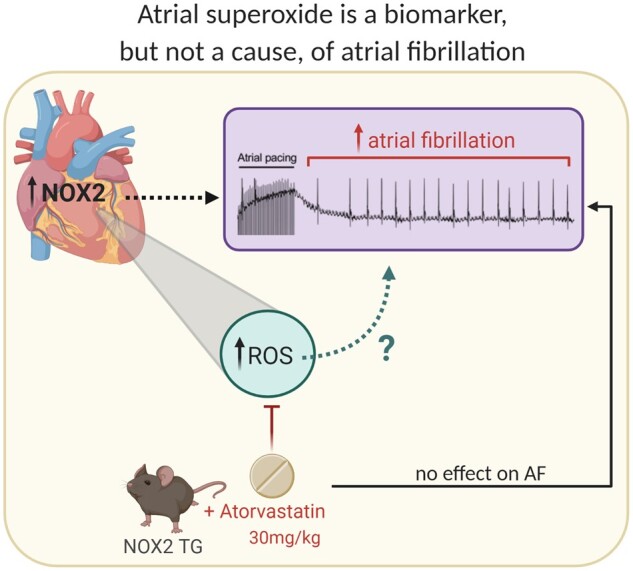
Gp91-containing NADPH oxidases (NOX2) are a significant source of myocardial superoxide production. An increase in NOX2 activity accompanies atrial fibrillation (AF) induction and electrical remodelling in animal models and predicts incident AF in humans; however, a direct causal role for NOX2 in AF has not been demonstrated. Accordingly, we investigated whether myocardial NOX2 overexpression in mice (NOX2-Tg) is sufficient to generate a favourable substrate for AF and further assessed the effects of atorvastatin, an inhibitor of NOX2, on atrial superoxide production and AF susceptibility.
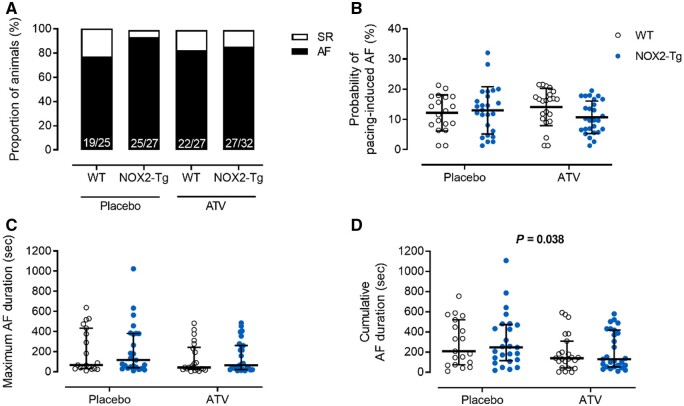
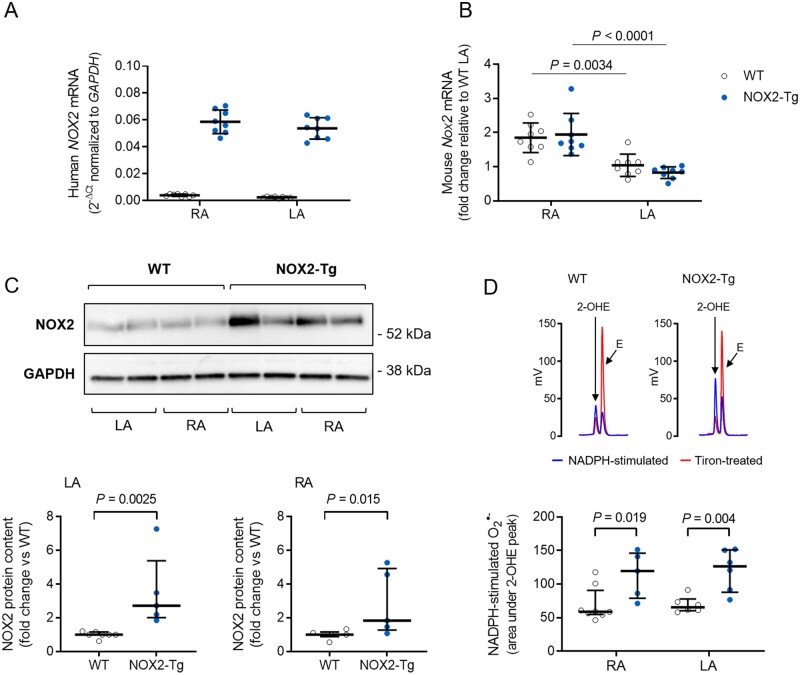
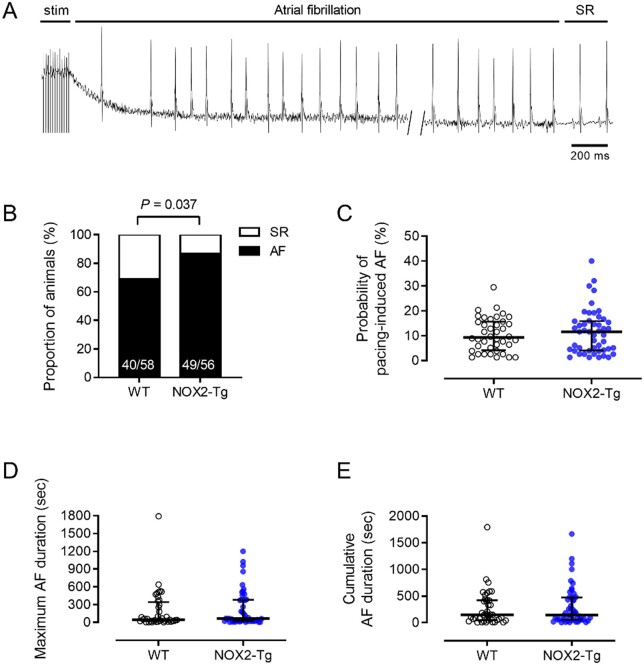
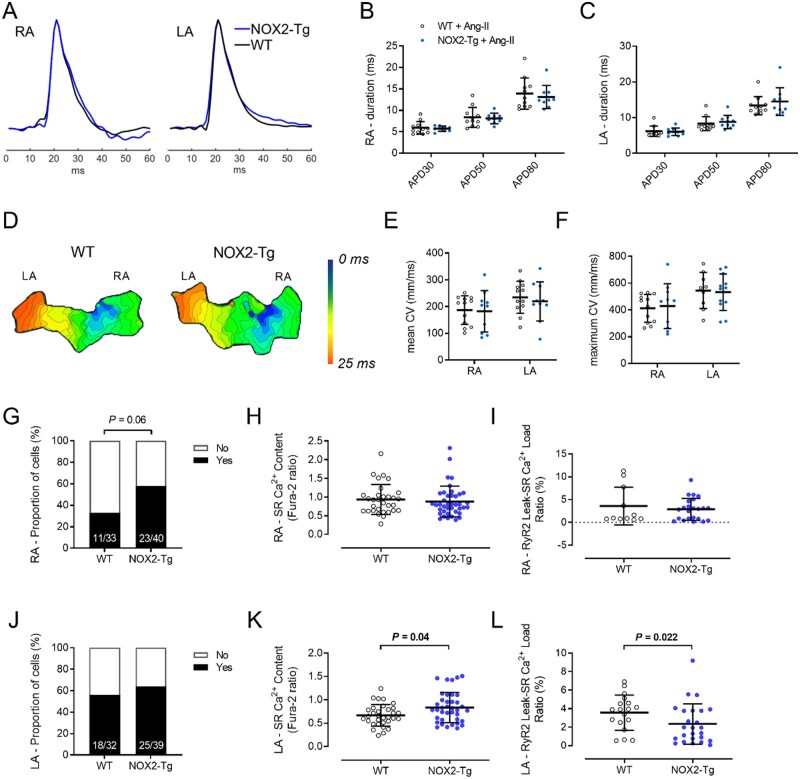
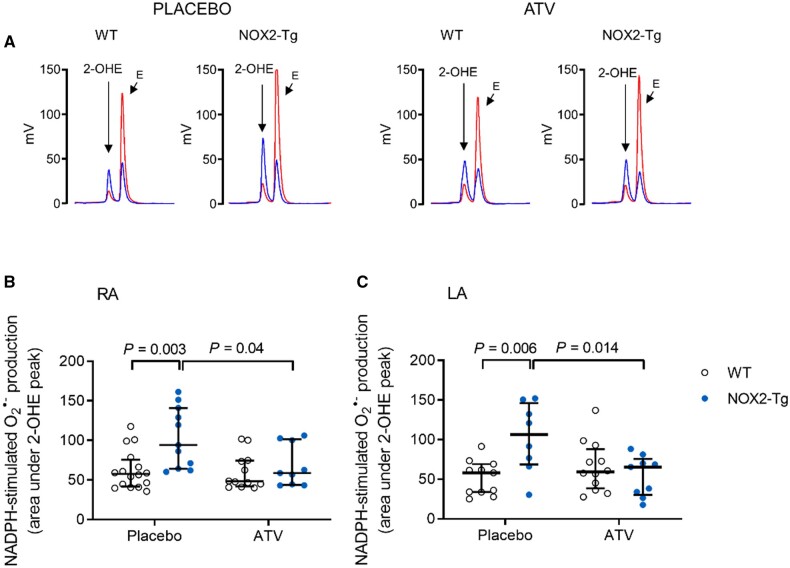
NOX2-Tg mice showed a 2- to 2.5-fold higher atrial protein content of NOX2 compared with wild-type (WT) controls, which was associated with a significant (twofold) increase in NADPH-stimulated superoxide production (2-hydroxyethidium by HPLC) in left and right atrial tissue homogenates (P = 0.004 and P = 0.019, respectively). AF susceptibility assessed in vivo by transoesophageal atrial burst stimulation was modestly increased in NOX2-Tg compared with WT (probability of AF induction: 88% vs. 69%, respectively; P = 0.037), in the absence of significant alterations in AF duration, surface ECG parameters, and LV mass or function. Mechanistic studies did not support a role for NOX2 in promoting electrical or structural remodelling, as high-resolution optical mapping of atrial tissues showed no differences in action potential duration and conduction velocity between genotypes. In addition, we did not observe any genotype difference in markers of fibrosis and inflammation, including atrial collagen content and Col1a1, Il-1β, Il-6, and Mcp-1 mRNA. Similarly, NOX2 overexpression did not have consistent effects on RyR2 Ca2+ leak nor did it affect PKA or CaMKII-mediated RyR2 phosphorylation. Finally, treatment with atorvastatin significantly inhibited atrial superoxide production in NOX2-Tg but had no effect on AF induction in either genotype.
Together, these data indicate that while atrial NOX2 overexpression may contribute to atrial arrhythmogenesis, NOX2-derived superoxide production does not affect the electrical and structural properties of the atrial myocardium.
含有 Gp91 的 NADPH 氧化酶(NOX2)是心肌超氧化物产生的重要来源。在动物模型中,NOX2 活性的增加伴随着心房颤动(AF)的诱导和电重构,并且预测人类发生 AF;然而,NOX2 在 AF 中的直接因果作用尚未得到证明。因此,我们研究了在小鼠中过度表达心肌 NOX2(NOX2-Tg)是否足以产生有利于 AF 的底物,并进一步评估了 NOX2 抑制剂阿托伐他汀对心房超氧化物产生和 AF 易感性的影响。
NOX2-Tg 小鼠的心房蛋白中 NOX2 的含量比野生型(WT)对照高 2 到 2.5 倍,这与左、右心房组织匀浆中 NADPH 刺激的超氧化物产生(通过 HPLC 测定 2-羟乙基啶)显著增加(分别为 P=0.004 和 P=0.019)有关。通过经食管心房爆发刺激在体内评估的 AF 易感性在 NOX2-Tg 中比 WT 略有增加(AF 诱导的概率:分别为 88%和 69%;P=0.037),而 AF 持续时间、体表心电图参数、LV 质量或功能没有明显变化。机制研究不支持 NOX2 在促进电或结构重构中的作用,因为心房组织的高分辨率光学图谱显示两种基因型之间动作电位持续时间和传导速度没有差异。此外,我们在纤维化和炎症标志物(包括心房胶原含量和 Col1a1、Il-1β、Il-6 和 Mcp-1 mRNA)中也没有观察到任何基因型差异。同样,NOX2 过表达也没有对 RyR2 Ca2+ 渗漏产生一致的影响,也没有影响 PKA 或 CaMKII 介导的 RyR2 磷酸化。最后,阿托伐他汀治疗显著抑制了 NOX2-Tg 的心房超氧化物产生,但对两种基因型的 AF 诱导均无影响。
综上所述,这些数据表明,尽管心房 NOX2 过表达可能有助于心房心律失常的发生,但 NOX2 衍生的超氧化物产生不会影响心房心肌的电和结构特性。