Fang Xi, Kruger Uwe, Homayounieh Fatemeh, Chao Hanqing, Zhang Jiajin, Digumarthy Subba R, Arru Chiara D, Kalra Mannudeep K, Yan Pingkun
Department of Biomedical Engineering, Center for Biotechnology and Interdisciplinary Studies, Rensselaer Polytechnic Institute, Troy, NY, 12180, USA.
Department of Radiology, Massachusetts General Hospitals, Harvard Medical School, Boston, MA, 02114, USA.
Int J Comput Assist Radiol Surg. 2021 Mar;16(3):435-445. doi: 10.1007/s11548-020-02299-5. Epub 2021 Jan 23.
Severity scoring is a key step in managing patients with COVID-19 pneumonia. However, manual quantitative analysis by radiologists is a time-consuming task, while qualitative evaluation may be fast but highly subjective. This study aims to develop artificial intelligence (AI)-based methods to quantify disease severity and predict COVID-19 patient outcome.
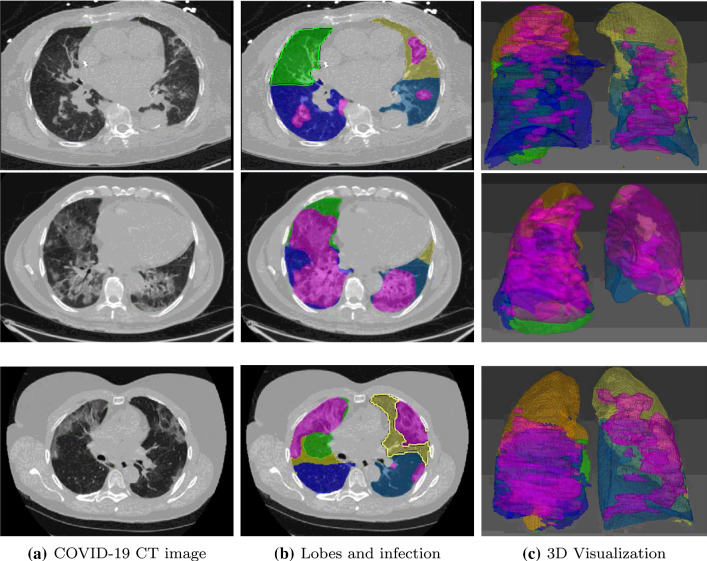
We develop an AI-based framework that employs deep neural networks to efficiently segment lung lobes and pulmonary opacities. The volume ratio of pulmonary opacities inside each lung lobe gives the severity scores of the lobes, which are then used to predict ICU admission and mortality with three different machine learning methods. The developed methods were evaluated on datasets from two hospitals (site A: Firoozgar Hospital, Iran, 105 patients; site B: Massachusetts General Hospital, USA, 88 patients).
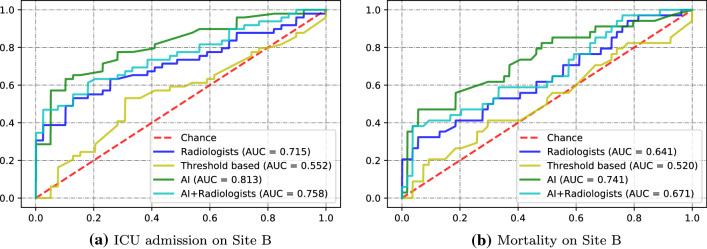
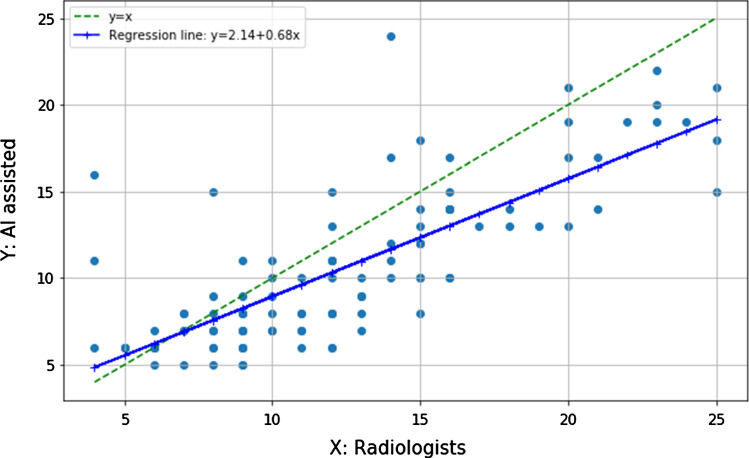
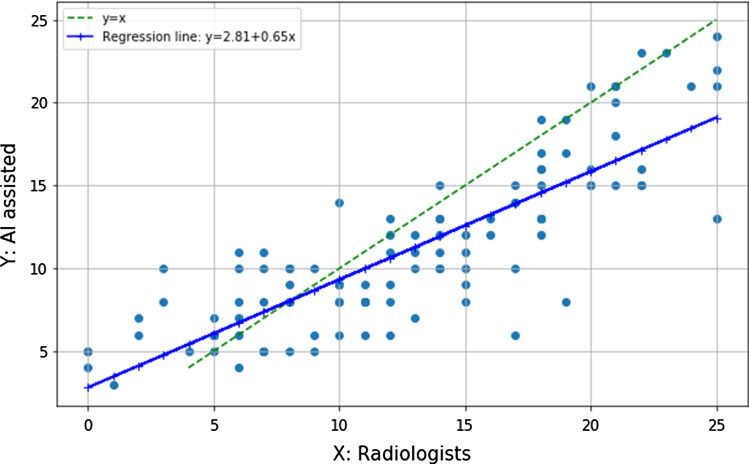
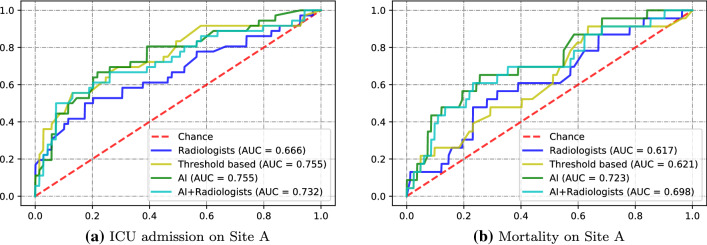
AI-based severity scores are strongly associated with those evaluated by radiologists (Spearman's rank correlation 0.837, [Formula: see text]). Using AI-based scores produced significantly higher ([Formula: see text]) area under the ROC curve (AUC) values. The developed AI method achieved the best performance of AUC = 0.813 (95% CI [0.729, 0.886]) in predicting ICU admission and AUC = 0.741 (95% CI [0.640, 0.837]) in mortality estimation on the two datasets.
Accurate severity scores can be obtained using the developed AI methods over chest CT images. The computed severity scores achieved better performance than radiologists in predicting COVID-19 patient outcome by consistently quantifying image features. Such developed techniques of severity assessment may be extended to other lung diseases beyond the current pandemic.
严重程度评分是管理新冠肺炎肺炎患者的关键步骤。然而,放射科医生进行的手动定量分析是一项耗时的任务,而定性评估可能很快但主观性很强。本研究旨在开发基于人工智能(AI)的方法来量化疾病严重程度并预测新冠肺炎患者的预后。
我们开发了一个基于AI的框架,该框架采用深度神经网络来有效地分割肺叶和肺内混浊区域。每个肺叶内肺内混浊区域的体积比给出了各肺叶的严重程度评分,然后使用三种不同的机器学习方法来预测入住重症监护病房(ICU)情况和死亡率。所开发的方法在来自两家医院的数据集上进行了评估(地点A:伊朗菲罗兹加尔医院,105例患者;地点B:美国马萨诸塞州总医院,88例患者)。
基于AI的严重程度评分与放射科医生评估的评分密切相关(斯皮尔曼等级相关系数为0.837,[公式:见原文])。使用基于AI的评分在ROC曲线下面积(AUC)值上显著更高([公式:见原文])。所开发的AI方法在预测ICU入住情况时,在两个数据集上的AUC = 0.813(95%可信区间[0.729, 0.886]),在死亡率估计方面AUC = 0.741(95%可信区间[0.640, 0.837]),表现最佳。
通过所开发的AI方法可以在胸部CT图像上获得准确的严重程度评分。通过持续量化图像特征,计算得到的严重程度评分在预测新冠肺炎患者预后方面比放射科医生表现更好。这种所开发的严重程度评估技术可能会扩展到当前大流行之外的其他肺部疾病。