Qureshi Onaiza, Endale Tarik, Ryan Grace, Miguel-Esponda Georgina, Iyer Srividya N, Eaton Julian, De Silva Mary, Murphy Jill
Global Mental Health, London School of Hygiene and Tropical Medicine, Keppel St, Bloomsbury, London, WC1E 7HT, UK.
Department of Counseling and Clinical Psychology, Teachers College, Colombia University, 525 W 120th St, New York, NY, 10027, USA.
Int J Ment Health Syst. 2021 Jan 24;15(1):14. doi: 10.1186/s13033-020-00427-x.
Research in global mental health (GMH) has previously documented how contextual factors like political instability, poverty and poorly-funded health infrastructure continue to compromise effective and equitable mental health service delivery. There is a need to develop more feasible and evidence-based solutions through implementation research. This paper, one in a series pertaining to implementation in GMH projects worldwide, focuses on implementation factors influencing mental health service delivery.
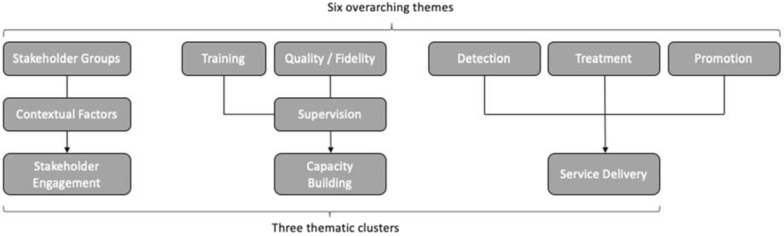
This is a qualitative study carried out as part of a Theory of Change-driven evaluation of Grand Challenges Canada's (GCC's) Global Mental Health portfolio. Purposive sampling was used to recruit twenty-nine GCC grantees for interviews. A semi-structured interview schedule was used to guide the interviews which were recorded and subsequently transcribed. Transcripts were double-coded and analyzed in NVivo 11 using framework analysis. This paper reports results related to detection and treatment of mental illness, mental health promotion and prevention of mental illness.
Key barriers included: lack of appropriate human resources and expertise for service delivery; lack of culturally appropriate screening tools and interventions; and difficulties integrating services with the existing mental health system. Formative research was a key driver facilitating the cultural adaptation of mental health detection, treatment, promotion and preventative approaches. Recruiting local providers and utilizing mHealth for improving screening, monitoring and data management were also found to be successful approaches in reducing workforce burden, improving sustainability, mental health literacy, participant engagement and uptake.
The study identifies a number of key barriers to and drivers of successful service delivery from the perspective of grantees implementing GMH projects. Findings highlight several opportunities to mitigate common challenges, providing recommendations for strengthening systems- and project-level approaches for delivering mental health services. Further, more inclusive research is required to inform guidance around service delivery for successful implementation, better utilization of funding and improving mental health outcomes among vulnerable populations in low-resource settings.
全球精神卫生(GMH)研究先前已记录了诸如政治不稳定、贫困和资金不足的卫生基础设施等背景因素如何持续损害有效且公平的精神卫生服务提供。需要通过实施研究来制定更可行且基于证据的解决方案。本文是关于全球GMH项目实施的系列文章之一,重点关注影响精神卫生服务提供的实施因素。
这是一项定性研究,作为对加拿大重大挑战组织(GCC)全球精神卫生投资组合的变革理论驱动评估的一部分进行。采用目的抽样法招募了29名GCC受资助者进行访谈。使用半结构化访谈提纲指导访谈,访谈进行录音并随后转录。转录本进行双重编码,并在NVivo 11中使用框架分析法进行分析。本文报告了与精神疾病的检测与治疗、精神卫生促进以及精神疾病预防相关的结果。
主要障碍包括:缺乏提供服务所需的适当人力资源和专业知识;缺乏文化上合适的筛查工具和干预措施;以及难以将服务与现有的精神卫生系统整合。形成性研究是促进精神卫生检测、治疗、促进和预防方法文化适应的关键驱动力。还发现招募当地提供者并利用移动健康技术来改善筛查、监测和数据管理是减轻劳动力负担、提高可持续性、精神卫生素养、参与者参与度和接受度的成功方法。
该研究从实施GMH项目的受资助者角度确定了成功服务提供的一些关键障碍和驱动因素。研究结果突出了减轻常见挑战的若干机会,为加强提供精神卫生服务的系统和项目层面方法提供了建议。此外,需要进行更具包容性的研究,为成功实施的服务提供指导、更好地利用资金以及改善资源匮乏环境中弱势群体的精神卫生结果提供信息。