Section of General Pathology, Clinics and Oncology, Department of Biomedical and Biotechnological Sciences, University of Catania, I‑95123 Catania, Italy.
Epidemiology Unit, IRCCS Istituto Nazionale Tumori 'Fondazione G. Pascale', I‑80131 Naples, Italy.
Int J Oncol. 2021 Feb;58(2):145-157. doi: 10.3892/ijo.2020.5159. Epub 2020 Dec 14.
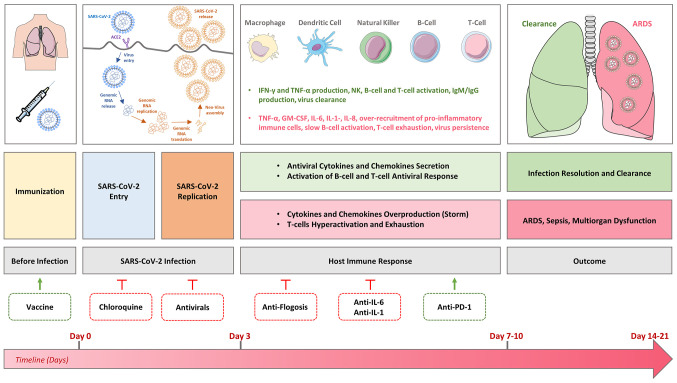
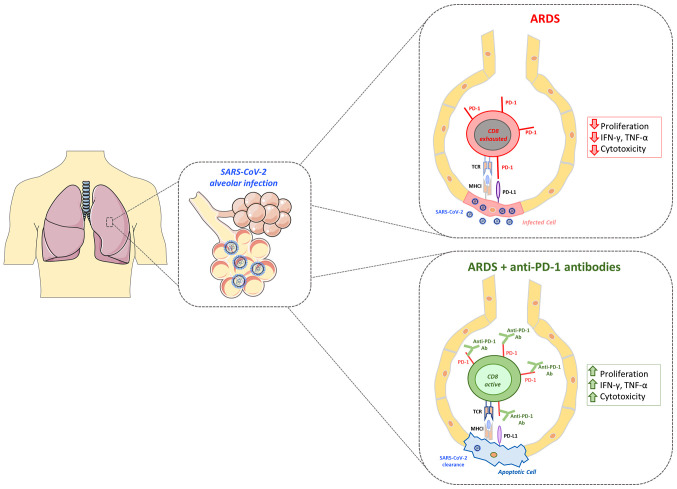
The severe acute respiratory syndrome associated coronavirus‑2 (SARS‑CoV‑2) poses a threat to human life worldwide. Since early March, 2020, coronavirus disease 2019 (COVID‑19), characterized by an acute and often severe form of pneumonia, has been declared a pandemic. This has led to a boom in biomedical research studies at all stages of the pipeline, from the in vitro to the clinical phase. In line with this global effort, known drugs, currently used for the treatment of other pathologies, including antivirals, immunomodulating compounds and antibodies, are currently used off‑label for the treatment of COVID‑19, in association with the supportive standard care. Yet, no effective treatments have been identified. A new hope stems from medical oncology and relies on the use of immune‑checkpoint inhibitors (ICIs). In particular, amongst the ICIs, antibodies able to block the programmed death‑1 (PD‑1)/PD ligand-1 (PD‑L1) pathway have revealed a hidden potential. In fact, patients with severe and critical COVID‑19, even prior to the appearance of acute respiratory distress syndrome, exhibit lymphocytopenia and suffer from T‑cell exhaustion, which may lead to viral sepsis and an increased mortality rate. It has been observed that cancer patients, who usually are immunocompromised, may restore their anti‑tumoral immune response when treated with ICIs. Moreover, viral-infected mice and humans, exhibit a T‑cell exhaustion, which is also observed following SARS‑CoV‑2 infection. Importantly, when treated with anti‑PD‑1 and anti‑PD‑L1 antibodies, they restore their T‑cell competence and efficiently counteract the viral infection. Based on these observations, four clinical trials are currently open, to examine the efficacy of anti‑PD‑1 antibody administration to both cancer and non‑cancer individuals affected by COVID‑19. The results may prove the hypothesis that restoring exhausted T‑cells may be a winning strategy to beat SARS‑CoV‑2 infection.
严重急性呼吸综合征相关冠状病毒 2(SARS-CoV-2)对全球人类的生命构成威胁。自 2020 年 3 月初以来,以急性和常伴有严重肺炎为特征的 2019 年冠状病毒病(COVID-19)已被宣布为大流行。这导致了从体外到临床阶段的整个管道各个阶段的生物医学研究的繁荣。为了响应这一全球努力,目前用于治疗其他疾病(包括抗病毒药物、免疫调节化合物和抗体)的已知药物目前被用于 COVID-19 的治疗,与支持性标准护理联合使用。然而,尚未确定有效的治疗方法。新的希望来自肿瘤医学,并依赖于免疫检查点抑制剂(ICIs)的使用。特别是在 ICIs 中,能够阻断程序性死亡 1(PD-1)/PD 配体 1(PD-L1)途径的抗体显示出了隐藏的潜力。事实上,患有严重和危重症 COVID-19 的患者,甚至在出现急性呼吸窘迫综合征之前,就表现出淋巴细胞减少和 T 细胞耗竭,这可能导致病毒败血症和死亡率增加。已经观察到患有癌症的患者通常免疫功能低下,当用 ICIs 治疗时,可能会恢复其抗肿瘤免疫反应。此外,感染病毒的小鼠和人类表现出 T 细胞耗竭,在 SARS-CoV-2 感染后也观察到这种现象。重要的是,当用抗 PD-1 和抗 PD-L1 抗体治疗时,它们恢复了 T 细胞的功能并有效地对抗了病毒感染。基于这些观察,目前有四项临床试验正在进行,以检查抗 PD-1 抗体在患有 COVID-19 的癌症和非癌症个体中的疗效。结果可能证明了这样一个假设,即恢复耗竭的 T 细胞可能是对抗 SARS-CoV-2 感染的制胜策略。