Department of Epidemiology and Preventive Medicine, University of Regensburg, Regensburg, Germany.
Department of Gynaecology and Obstetrics, University of Regensburg, Regensburg, Germany.
Eur J Epidemiol. 2021 Aug;36(8):769-780. doi: 10.1007/s10654-020-00712-6. Epub 2021 Jan 25.
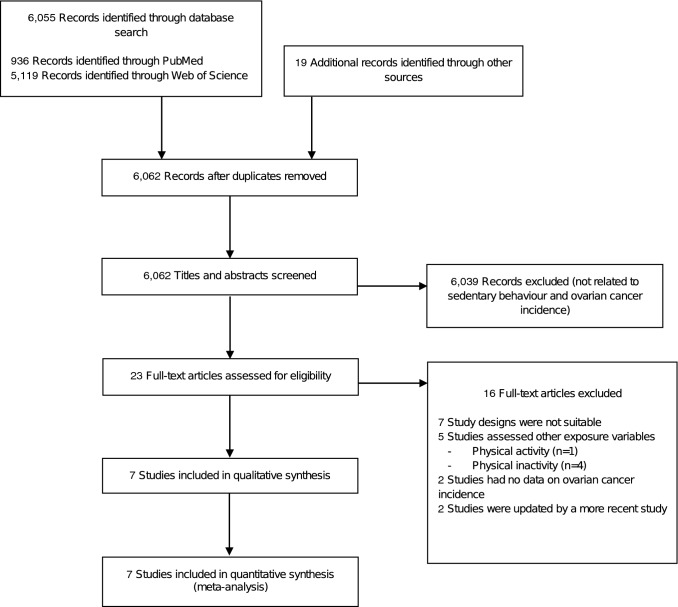
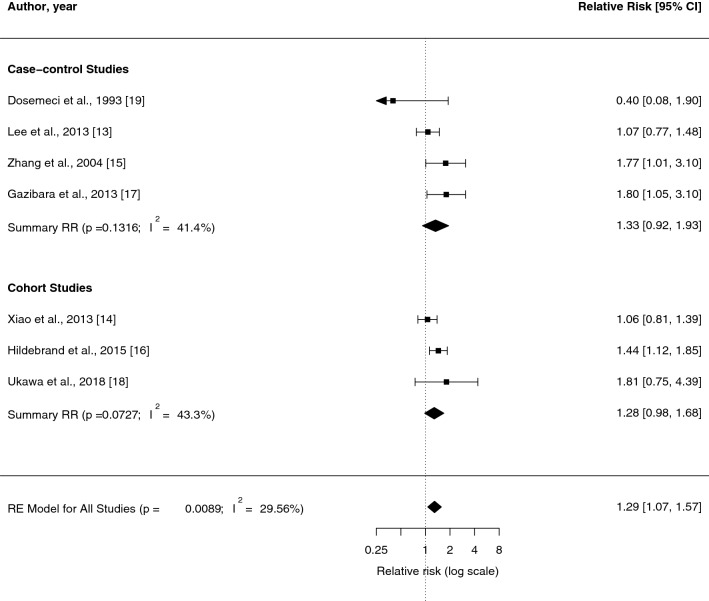
Sedentary behaviour is an emerging risk factor for several site-specific cancers. Ovarian cancers are often detected at late disease stages and the role of sedentary behaviour as a modifiable risk factor potentially contributing to ovarian cancer risk has not been extensively examined. We systematically searched relevant databases from inception to February 2020 for eligible publications dealing with sedentary behaviour in relation to ovarian cancer risk. We conducted a systematic review and meta-analysis, calculating summary relative risks (RR) and 95% confidence intervals (CI) using a random-effects model. We calculated the E-Value, a sensitivity analysis for unmeasured confounding. We tested for publication bias and heterogeneity. Seven studies (three prospective cohort studies and four case-control studies) including 2060 ovarian cancer cases were analysed. Comparing highest versus lowest levels of sedentary behaviour, the data indicated a statistically significant increase in the risk of ovarian cancer in relation to prolonged sitting time (RR = 1.29, 95% CI = 1.07-1.57). Sub-analyses of prospective cohort studies (RR = 1.33, 95% CI = 0.92-1.93) and case-control studies (RR = 1.28, 95% CI = 0.98-1.68) showed statistically non-significant results. Sensitivity analysis showed that an unmeasured confounder would need to be related to sedentary behaviour and ovarian cancer with a RR of 1.90 to fully explain away the observed RR of 1.29. Our analyses showed a statistically significant positive association between sedentary behaviour and ovarian cancer risk.
久坐行为是多种特定部位癌症的新兴风险因素。卵巢癌通常在疾病晚期才被发现,而久坐行为作为一个潜在可改变的风险因素,可能会增加卵巢癌的发病风险,但这一作用尚未得到广泛研究。我们系统地检索了从建库至 2020 年 2 月期间相关数据库中与久坐行为与卵巢癌风险相关的文献。我们进行了系统综述和荟萃分析,使用随机效应模型计算了汇总相对风险(RR)和 95%置信区间(CI)。我们计算了 E 值,这是一种针对未测量混杂因素的敏感性分析。我们还对发表偏倚和异质性进行了检验。纳入了 7 项研究(3 项前瞻性队列研究和 4 项病例对照研究),共包含 2060 例卵巢癌病例。与最低久坐行为水平相比,最高久坐行为水平与卵巢癌风险增加具有统计学意义(RR=1.29,95%CI=1.07-1.57)。前瞻性队列研究(RR=1.33,95%CI=0.92-1.93)和病例对照研究(RR=1.28,95%CI=0.98-1.68)的亚组分析结果无统计学意义。敏感性分析显示,一个未被测量的混杂因素需要与久坐行为和卵巢癌相关,其 RR 为 1.90,才能完全解释观察到的 RR 为 1.29。我们的分析表明,久坐行为与卵巢癌风险之间存在统计学上显著的正相关关系。