Department of Clinical Sciences and Community Health, University of Milan, Milan, Italy.
Audiology Unit, Department of Specialist Surgical Sciences, Fondazione IRCCS Ca' Granda Ospedale Maggiore Policlinico, Milan, Italy.
Otolaryngol Head Neck Surg. 2021 Nov;165(5):710-715. doi: 10.1177/0194599820987458. Epub 2021 Jan 26.
To evaluate the role of social isolation during the lockdown due to the SARS-CoV-2 outbreak (severe acute respiratory syndrome coronavirus 2) in modifying the prevalence of otitis media with effusion (OME) and the natural history of chronic OME.
Retrospective study.
Tertiary level referral audiologic center.
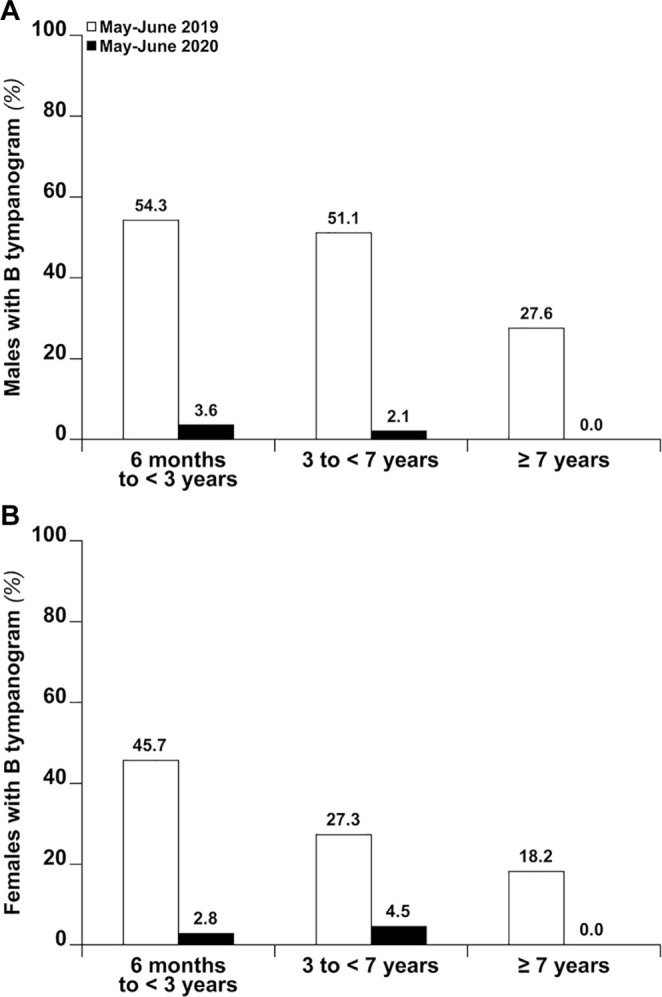
We assessed the prevalence of OME among children aged 6 months to 12 years who attended the outpatient clinic for hearing or vestibular disorders during 2 periods before the lockdown, May-June 2019 (n = 350) and January-February 2020 (n = 366), and the period immediately after the lockdown, May-June 2020 (n = 216). We also compared the disease resolution rates between a subgroup of children with chronic OME (n = 30) who were diagnosed in summer 2019 and reevaluated in May-June 2020 and a similar subgroup (n = 29) assessed in 2018-2019.
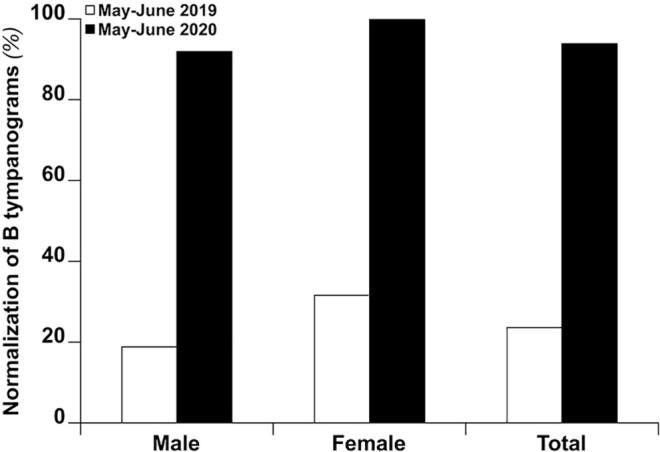
The prevalence of OME in this clinic population was 40.6% in May-June 2019, 52.2% in January-February 2020, and 2.3% in May-June 2020. Children with chronic OME had a higher rate of disease resolution in May-June 2020 (93.3%) than those examined in May-June 2019 (20.7%, < .001).
Closure of schools and the physical distancing rules were correlated with a reduction in the prevalence of OME and favored the resolution of its chronic forms among children who attended the outpatient clinic. These data could suggest that in the presence of chronic OME, keeping young children out of group care settings for a period might be beneficial to allow for OME resolution.
评估由于 SARS-CoV-2 爆发(严重急性呼吸系统综合征冠状病毒 2)而导致的封锁期间的社会隔离对分泌性中耳炎(OME)患病率和慢性 OME 自然史的影响。
回顾性研究。
三级转诊听力中心。
我们评估了在封锁前的两个时期,即 2019 年 5-6 月(n = 350)和 2020 年 1-2 月(n = 366),以及封锁后立即的 2020 年 5-6 月(n = 216)期间,6 个月至 12 岁的儿童在门诊就诊时 OME 的患病率。我们还比较了在 2019 年夏季诊断出的慢性 OME 儿童(n = 30)的疾病缓解率,并在 2020 年 5-6 月重新评估,以及类似的亚组(n = 29)在 2018-2019 年评估。
该诊所人群中,2019 年 5-6 月 OME 患病率为 40.6%,2020 年 1-2 月为 52.2%,2020 年 5-6 月为 2.3%。慢性 OME 患儿在 2020 年 5-6 月的疾病缓解率(93.3%)高于 2019 年 5-6 月的缓解率(20.7%,<0.001)。
学校关闭和社交距离规则与 OME 患病率降低有关,并有利于在门诊就诊的儿童中慢性 OME 形式的缓解。这些数据表明,在存在慢性 OME 的情况下,让幼儿离开集体护理环境一段时间可能有利于 OME 的缓解。