• 文献检索
  • 文档翻译
  • 深度研究
  • 学术资讯
  • Suppr Zotero 插件Zotero 插件
  • 邀请有礼
  • 套餐&价格
  • 历史记录
应用&插件
Suppr Zotero 插件Zotero 插件浏览器插件Mac 客户端Windows 客户端微信小程序
定价
高级版会员购买积分包购买API积分包
服务
文献检索文档翻译深度研究API 文档MCP 服务
关于我们
关于 Suppr公司介绍联系我们用户协议隐私条款
关注我们

Suppr 超能文献

核心技术专利:CN118964589B侵权必究
粤ICP备2023148730 号-1Suppr @ 2026

文献检索

告别复杂PubMed语法,用中文像聊天一样搜索,搜遍4000万医学文献。AI智能推荐,让科研检索更轻松。

立即免费搜索

文件翻译

保留排版,准确专业,支持PDF/Word/PPT等文件格式,支持 12+语言互译。

免费翻译文档

深度研究

AI帮你快速写综述,25分钟生成高质量综述,智能提取关键信息,辅助科研写作。

立即免费体验

严重急性呼吸综合征冠状病毒 2 抗体在孕妇及其新生儿中的水平。

Severe acute respiratory syndrome coronavirus 2 serology levels in pregnant women and their neonates.

机构信息

Department of Pathology and Laboratory Medicine, Weill Cornell Medicine, New York, NY; New York-Presbyterian Hospital, Weill Cornell Medicine, New York, NY.

Laboratory of Molecular Neuro-Oncology, The Rockefeller University, New York, NY.

出版信息

Am J Obstet Gynecol. 2021 Jul;225(1):73.e1-73.e7. doi: 10.1016/j.ajog.2021.01.016. Epub 2021 Jan 23.

DOI:10.1016/j.ajog.2021.01.016
PMID:33497654
原文链接:https://pmc.ncbi.nlm.nih.gov/articles/PMC7825873/
Abstract

BACKGROUND

Pregnant women and their neonates represent 2 vulnerable populations with an interdependent immune system that are highly susceptible to viral infections. The immune response of pregnant women to severe acute respiratory syndrome coronavirus 2 and the interplay of how the maternal immune response affects the neonatal passive immunity have not been studied systematically.

OBJECTIVE

We characterized the serologic response in pregnant women and studied how this serologic response correlates with the maternal clinical presentation and with the rate and level of passive immunity that the neonate received from the mother.

STUDY DESIGN

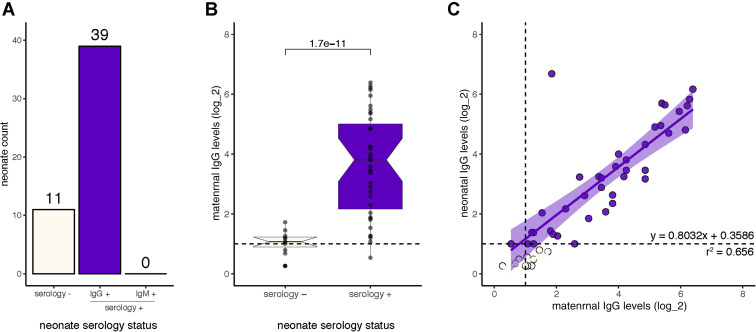
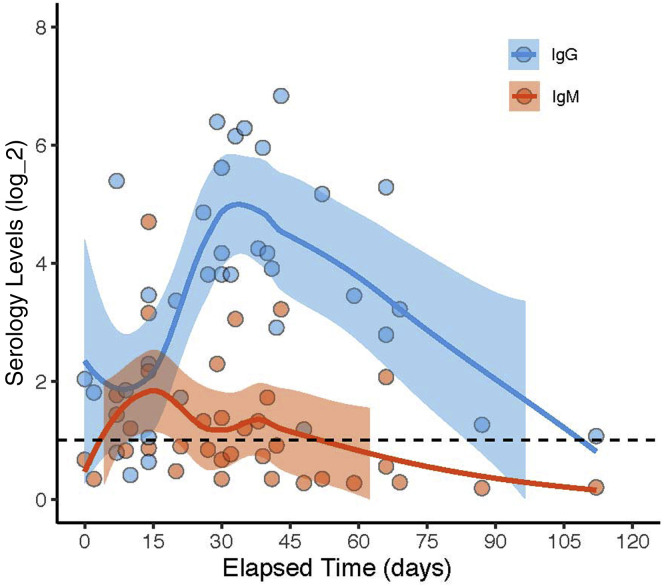
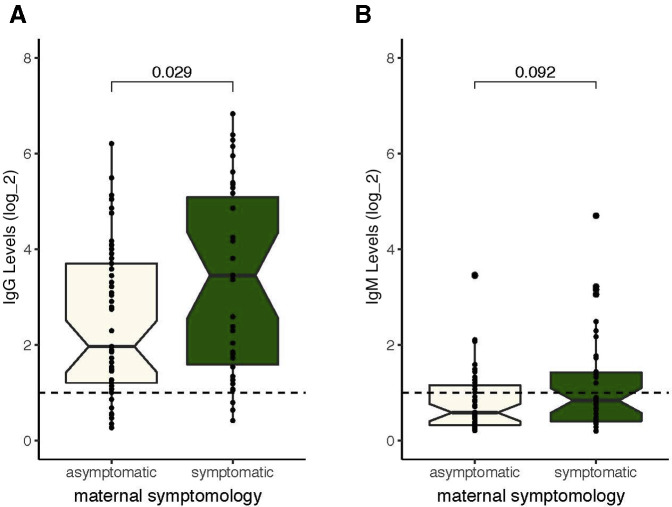
Women who gave birth and who tested positive for immunoglobulin M or immunoglobulin G against severe acute respiratory syndrome coronavirus 2 using semiquantitative detection in a New York City hospital between March 22, 2020, and May 31, 2020, were included in this study. A retrospective chart review of the cases that met the inclusion criteria was conducted to determine the presence of coronavirus disease 2019 symptoms and the use of oxygen support. Serology levels were compared between the symptomatic and asymptomatic patients using a Welch 2 sample t test. Further chart review of the same patient cohort was conducted to identify the dates of self-reported onset of coronavirus disease 2019 symptoms and the timing of the peak immunoglobulin M and immunoglobulin G antibody levels after symptom onset was visualized using local polynomial regression smoothing on log-scaled serologic values. To study the neonatal serology response, umbilical cord blood samples of the neonates born to the subset of serology positive pregnant women were tested for serologic antibody responses. The maternal antibody levels of serology positive vs the maternal antibody levels of serology negative neonates were compared using the Welch 2 sample t test. The relationship between the quantitative maternal and quantitative neonatal serologic data was studied using a Pearson correlation and linear regression. A multiple linear regression analysis was conducted using maternal symptoms, maternal serology levels, and maternal use of oxygen support to determine the predictors of neonatal immunoglobulin G levels.

RESULTS

A total of 88 serology positive pregnant women were included in this study. The antibody levels were higher in symptomatic pregnant women than in asymptomatic pregnant women. Serology studies in 34 women with symptom onset data revealed that the maternal immunoglobulin M and immunoglobulin G levels peak around 15 and 30 days after the onset of coronavirus disease 2019 symptoms, respectively. Furthermore, studies of 50 neonates born to this subset of serology positive women showed that passive immunity in the form of immunoglobulin G is conferred in 78% of all neonates. The presence of passive immunity is dependent on the maternal antibody levels, and the levels of neonatal immunoglobulin G correlate with maternal immunoglobulin G levels. The maternal immunoglobulin G levels and maternal use of oxygen support were predictive of the neonatal immunoglobulin G levels.

CONCLUSION

We demonstrated that maternal serologies correlate with symptomatic maternal infection, and higher levels of maternal antibodies are associated with passive neonatal immunity. The maternal immunoglobulin G levels and maternal use of oxygen support, a marker of disease severity, predicted the neonatal immunoglobulin G levels. These data will further guide the screening for this uniquely linked population of mothers and their neonates and can aid in developing maternal vaccination strategies.

摘要

背景

孕妇及其新生儿代表了两个易受病毒感染的脆弱群体,他们的免疫系统相互依存。孕妇对严重急性呼吸综合征冠状病毒 2 的免疫反应以及母体免疫反应如何影响新生儿被动免疫的相互作用尚未得到系统研究。

目的

我们描述了孕妇的血清学反应,并研究了这种血清学反应与母体临床表现以及新生儿从母体获得的被动免疫的速度和水平如何相关。

研究设计

本研究纳入了 2020 年 3 月 22 日至 2020 年 5 月 31 日期间在纽约市一家医院使用半定量检测方法检测到针对严重急性呼吸综合征冠状病毒 2 的免疫球蛋白 M 或免疫球蛋白 G 呈阳性的分娩妇女。通过回顾病历确定符合纳入标准的病例中是否存在 2019 年冠状病毒病的症状和使用氧气支持的情况。使用 Welch 2 样本 t 检验比较有症状和无症状患者的血清学水平。对同一患者队列进行进一步的病历回顾,以确定自我报告的 2019 年冠状病毒病症状出现日期以及症状出现后免疫球蛋白 M 和免疫球蛋白 G 抗体水平的峰值,通过对对数标度的血清学值进行局部多项式回归平滑来可视化。为了研究新生儿的血清学反应,对血清学阳性孕妇中部分新生儿的脐带血样本进行了血清学抗体反应检测。使用 Welch 2 样本 t 检验比较了血清学阳性母亲的抗体水平与血清学阴性母亲的抗体水平。使用 Pearson 相关和线性回归研究了定量母体和定量新生儿血清学数据之间的关系。使用多元线性回归分析,考虑了母体症状、母体血清学水平和母体使用氧气支持等因素,以确定新生儿免疫球蛋白 G 水平的预测因素。

结果

本研究共纳入 88 例血清学阳性孕妇。有症状孕妇的抗体水平高于无症状孕妇。对有症状出现数据的 34 名妇女进行的血清学研究表明,母体免疫球蛋白 M 和免疫球蛋白 G 水平分别在冠状病毒病 2019 症状出现后约 15 天和 30 天达到峰值。此外,对这部分血清学阳性妇女的 50 名新生儿进行的研究表明,以免疫球蛋白 G 形式存在的被动免疫在所有新生儿中占 78%。被动免疫的存在取决于母体抗体水平,新生儿免疫球蛋白 G 水平与母体免疫球蛋白 G 水平相关。母体免疫球蛋白 G 水平和母体使用氧气支持是新生儿免疫球蛋白 G 水平的预测因素。

结论

我们证明了母体血清学与有症状的母体感染相关,较高的母体抗体水平与新生儿被动免疫相关。母体免疫球蛋白 G 水平和母体使用氧气支持(疾病严重程度的标志物)可预测新生儿免疫球蛋白 G 水平。这些数据将进一步指导对这一独特的母婴群体的筛查,并有助于制定母体疫苗接种策略。
https://cdn.ncbi.nlm.nih.gov/pmc/blobs/5898/7825873/39148805e60f/gr3_lrg.jpg
https://cdn.ncbi.nlm.nih.gov/pmc/blobs/5898/7825873/573967e81104/gr1_lrg.jpg
https://cdn.ncbi.nlm.nih.gov/pmc/blobs/5898/7825873/3162c7ce0abf/gr2_lrg.jpg
https://cdn.ncbi.nlm.nih.gov/pmc/blobs/5898/7825873/39148805e60f/gr3_lrg.jpg
https://cdn.ncbi.nlm.nih.gov/pmc/blobs/5898/7825873/573967e81104/gr1_lrg.jpg
https://cdn.ncbi.nlm.nih.gov/pmc/blobs/5898/7825873/3162c7ce0abf/gr2_lrg.jpg
https://cdn.ncbi.nlm.nih.gov/pmc/blobs/5898/7825873/39148805e60f/gr3_lrg.jpg

相似文献

1
Severe acute respiratory syndrome coronavirus 2 serology levels in pregnant women and their neonates.严重急性呼吸综合征冠状病毒 2 抗体在孕妇及其新生儿中的水平。
Am J Obstet Gynecol. 2021 Jul;225(1):73.e1-73.e7. doi: 10.1016/j.ajog.2021.01.016. Epub 2021 Jan 23.
2
Assessment of Maternal and Neonatal SARS-CoV-2 Viral Load, Transplacental Antibody Transfer, and Placental Pathology in Pregnancies During the COVID-19 Pandemic.评估 COVID-19 大流行期间孕妇的母婴 SARS-CoV-2 病毒载量、胎盘抗体转移和胎盘病理学。
JAMA Netw Open. 2020 Dec 1;3(12):e2030455. doi: 10.1001/jamanetworkopen.2020.30455.
3
Relationship between viral load, infection-to-delivery interval and mother-to-child transfer of anti-SARS-CoV-2 antibodies.病毒载量、感染至分娩间隔与抗 SARS-CoV-2 抗体母婴传播的关系。
Ultrasound Obstet Gynecol. 2021 Jun;57(6):974-978. doi: 10.1002/uog.23639.
4
Maternal and Neonatal Severe Acute Respiratory Syndrome Coronavirus 2 (SARS-CoV-2) Immunoglobulin G Levels After the Pfizer-BioNTech Booster Dose for Coronavirus Disease 2019 (COVID-19) Vaccination During the Second Trimester of Pregnancy.母体和新生儿 2019 年冠状病毒病(COVID-19)疫苗接种第二孕期接种辉瑞-生物技术公司 COVID-19 疫苗加强针后严重急性呼吸综合征冠状病毒 2(SARS-CoV-2)免疫球蛋白 G 水平。
Obstet Gynecol. 2022 Aug 1;140(2):187-193. doi: 10.1097/AOG.0000000000004867. Epub 2022 May 27.
5
Association of Gestational Age at Coronavirus Disease 2019 (COVID-19) Vaccination, History of Severe Acute Respiratory Syndrome Coronavirus 2 (SARS-CoV-2) Infection, and a Vaccine Booster Dose With Maternal and Umbilical Cord Antibody Levels at Delivery.妊娠期 2019 年冠状病毒病(COVID-19)疫苗接种、严重急性呼吸综合征冠状病毒 2(SARS-CoV-2)感染史和疫苗加强剂与分娩时母婴抗体水平的关系。
Obstet Gynecol. 2022 Mar 1;139(3):373-380. doi: 10.1097/AOG.0000000000004693.
6
Maternal-Fetal Immunologic Response to SARS-CoV-2 Infection in a Symptomatic Vulnerable Population: A Prospective Cohort.母体-胎儿对有症状的脆弱人群中 SARS-CoV-2 感染的免疫反应:一项前瞻性队列研究。
J Infect Dis. 2022 Mar 2;225(5):800-809. doi: 10.1093/infdis/jiab591.
7
Pregnancy alters interleukin-1 beta expression and antiviral antibody responses during severe acute respiratory syndrome coronavirus 2 infection.妊娠改变严重急性呼吸综合征冠状病毒 2 感染期间白细胞介素-1β表达和抗病毒抗体反应。
Am J Obstet Gynecol. 2021 Sep;225(3):301.e1-301.e14. doi: 10.1016/j.ajog.2021.03.028. Epub 2021 Mar 30.
8
The rate of SARS-CoV-2 among asymptomatic non-immunised low-risk parturient women between the two waves.两波疫情期间无症状未免疫低危产妇人群中的 SARS-CoV-2 流行率。
J Obstet Gynaecol. 2022 Aug;42(6):1868-1873. doi: 10.1080/01443615.2022.2049720. Epub 2022 Apr 29.
9
Assessment of Maternal and Neonatal Cord Blood SARS-CoV-2 Antibodies and Placental Transfer Ratios.评估母体和新生儿脐血 SARS-CoV-2 抗体和胎盘转移率。
JAMA Pediatr. 2021 Jun 1;175(6):594-600. doi: 10.1001/jamapediatrics.2021.0038.
10
Longitudinal antibody response kinetics following SARS-CoV-2 messenger RNA vaccination in pregnant and nonpregnant persons.SARS-CoV-2 信使 RNA 疫苗接种后孕妇和非孕妇的纵向抗体反应动力学。
Am J Obstet Gynecol MFM. 2023 Feb;5(2):100796. doi: 10.1016/j.ajogmf.2022.100796. Epub 2022 Nov 2.

引用本文的文献

1
Maternal IBD-related antibodies are associated with early life gut inflammatory status and microbiota composition: insights from cord blood.母体炎症性肠病相关抗体与早期肠道炎症状态及微生物群组成有关:来自脐带血的见解
bioRxiv. 2025 Aug 6:2025.08.04.668517. doi: 10.1101/2025.08.04.668517.
2
Maternal and Placental Antibody Responses in SARS-CoV-2 Vaccination and Natural Infection During Pregnancy.孕期接种 SARS-CoV-2 疫苗及自然感染后的母体和胎盘抗体反应
Pediatr Infect Dis J. 2025 Feb 1;44(2S):S32-S37. doi: 10.1097/INF.0000000000004704. Epub 2025 Feb 14.
3
ICOS-ICOSL pathway enhances NKT-like cell antiviral function in pregnant women with COVID-19.
ICOS-ICOSL通路增强COVID-19孕妇中NKT样细胞的抗病毒功能。
Int J Med Sci. 2024 Jul 16;21(10):1890-1902. doi: 10.7150/ijms.95952. eCollection 2024.
4
Immune Response to Respiratory Viral Infections.呼吸道病毒感染的免疫反应。
Int J Mol Sci. 2024 Jun 4;25(11):6178. doi: 10.3390/ijms25116178.
5
Seroprevalence and placental transfer of SARS-CoV-2 antibodies in unvaccinated pregnant women.未接种疫苗孕妇的 SARS-CoV-2 抗体血清阳性率与胎盘转移。
BMC Infect Dis. 2024 May 21;24(1):509. doi: 10.1186/s12879-024-09399-6.
6
Vertical transmission and maternal passive immunity post-SARS-CoV-2.新型冠状病毒感染后的垂直传播及母体被动免疫
Future Virol. 2023 Aug. doi: 10.2217/fvl-2023-0089. Epub 2023 Oct 4.
7
Serologic evolution and follow-up to IgG antibodies of infants born to mothers with gestational COVID.母亲妊娠期感染 COVID 后所生婴儿 IgG 抗体的血清学演变及随访。
BMC Pregnancy Childbirth. 2023 Aug 30;23(1):623. doi: 10.1186/s12884-023-05926-6.
8
SARS-CoV-2 vaccination, booster, and infection in pregnant population enhances passive immunity in neonates.SARS-CoV-2 疫苗接种、加强针和孕妇感染可增强新生儿的被动免疫。
Nat Commun. 2023 Aug 10;14(1):4598. doi: 10.1038/s41467-023-39989-y.
9
Transplacental Transfer of SARS-CoV-2 Receptor-Binding Domain IgG Antibodies from Mothers to Neonates in a Cohort of Pakistani Unvaccinated Mothers.巴基斯坦未接种疫苗母亲队列中SARS-CoV-2受体结合域IgG抗体从母亲到新生儿的胎盘转移
Biomedicines. 2023 Jun 6;11(6):1651. doi: 10.3390/biomedicines11061651.
10
Immunology of Multisystem Inflammatory Syndrome after COVID-19 in Children: A Review of the Current Evidence.儿童 COVID-19 后多系统炎症综合征的免疫学:当前证据综述。
Int J Mol Sci. 2023 Mar 16;24(6):5711. doi: 10.3390/ijms24065711.