Ripellino Paolo, Pianezzi Enea, Martinetti Gladys, Zehnder Cinzia, Mathis Barbara, Giannini Petra, Forrer Nicola, Merlani Giorgio, Dalton Harry R, Petrini Orlando, Bihl Florian, Fontana Stefano, Gobbi Claudio
Neurocenter of Southern Switzerland, 6900 Lugano, Switzerland.
Laboratory of Microbiology, Ente Ospedaliero Cantonale, 6500 Bellinzona, Switzerland.
Pathogens. 2021 Jan 22;10(2):107. doi: 10.3390/pathogens10020107.
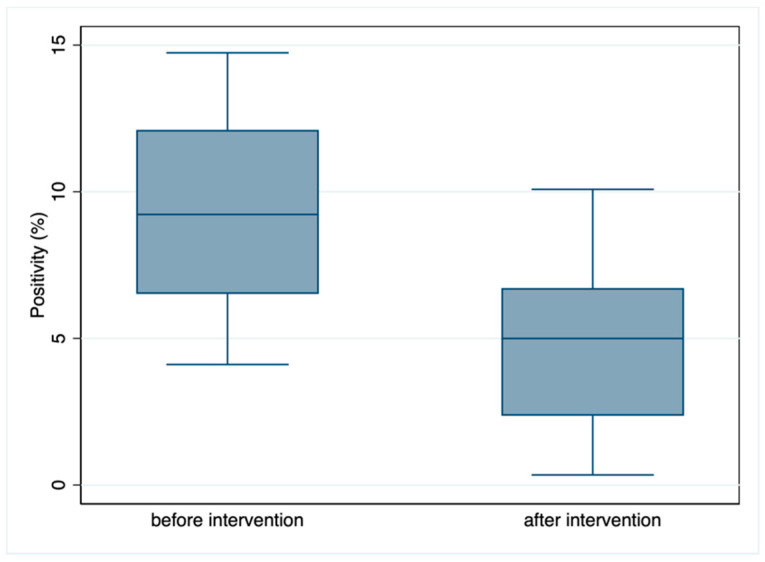
After an acute hepatitis E (HEV) outbreak in Southern Switzerland, in January 2017 the local public health authorities started an active program of food chain control and public education. In this retrospective study, we analysed all laboratory-confirmed acute cases of HEV infection diagnosed between 2014 and 2020. In the period before the public health intervention, the number of cases increased steadily from 2014 (4 of 40 tests, 10%) reaching a peak in the last quarter of 2016 (42 of 285 tests, 14.7 %). Afterwards, the number of positive cases decreased steadily, reaching its lowest value (0.3%) in the second quarter of 2019. There was a statistically significant difference between the frequency of positive cases and period of testing, i.e., before and after the introduction of the public health interventions. Our study shows that active public health measures to control sausages containing raw pork liver can reduce the prevalence of HEV infection.
在瑞士南部发生急性戊型肝炎(HEV)疫情后,当地公共卫生当局于2017年1月启动了一项积极的食物链控制和公众教育计划。在这项回顾性研究中,我们分析了2014年至2020年期间所有实验室确诊的急性戊型肝炎感染病例。在公共卫生干预之前,病例数从2014年开始稳步增加(40次检测中有4例,10%),在2016年最后一个季度达到峰值(285次检测中有42例,14.7%)。此后,阳性病例数稳步下降,在2019年第二季度达到最低值(0.3%)。阳性病例频率与检测时期(即公共卫生干预措施实施前后)之间存在统计学显著差异。我们的研究表明,对含有生猪肝的香肠采取积极的公共卫生措施可以降低戊型肝炎感染的患病率。