Patuzzi Ilaria, Orsini Massimiliano, Cibin Veronica, Petrin Sara, Mastrorilli Eleonora, Tiengo Alessia, Gobbo Federica, Catania Salvatore, Barco Lisa, Ricci Antonia, Losasso Carmen
Microbial Ecology and Genomics Laboratory, Istituto Zooprofilattico Sperimentale delle Venezie, Viale dell'Università 10, 35120 Legnaro, Italy.
National Reference Laboratory for Salmonella, Istituto Zooprofilattico Sperimentale delle Venezie, Viale dell'Università 10, 35120 Legnaro, Italy.
Microorganisms. 2021 Jan 22;9(2):221. doi: 10.3390/microorganisms9020221.
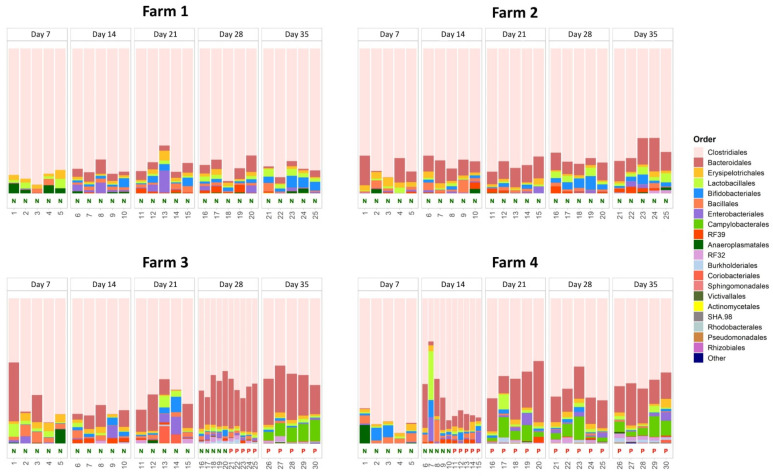
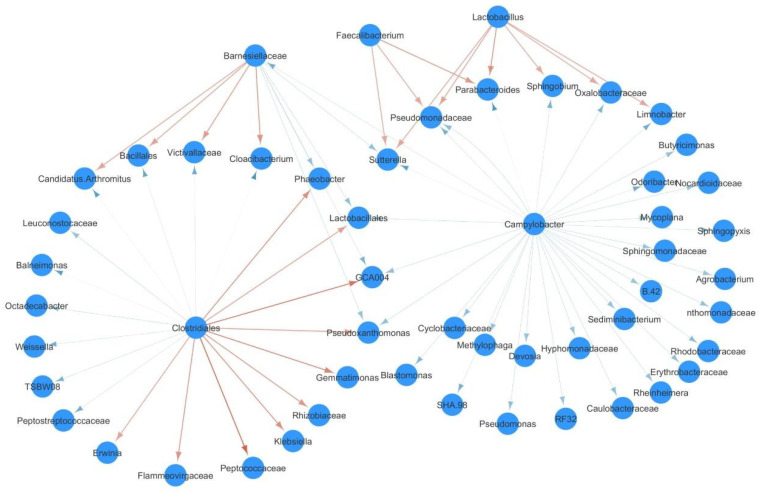
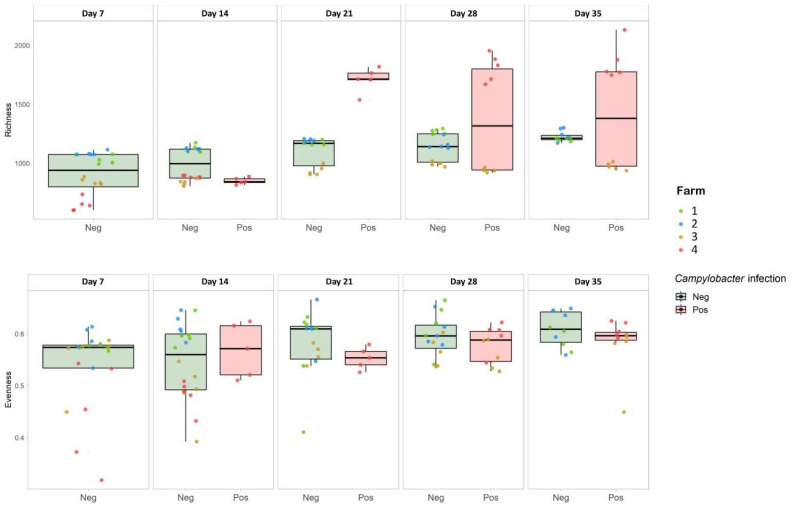
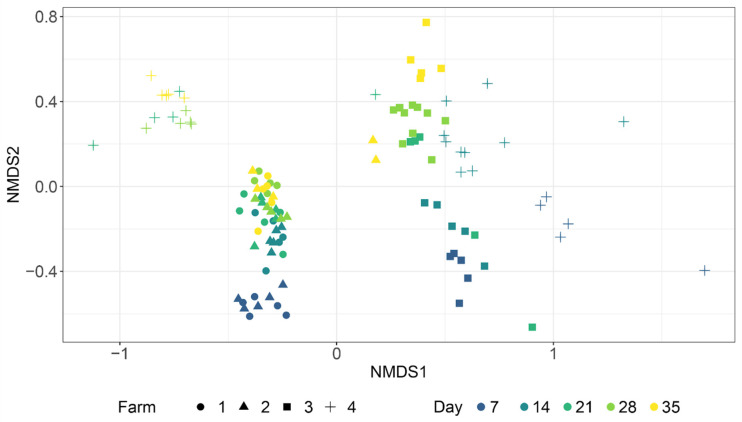
is the most frequent foodborne zoonotic bacteria worldwide, with chicken meat being overwhelmingly the most important reservoir for human infections. Control measures implemented at the farm level (i.e., biosecurity or vaccination), which have been successfully applied to limit other pathogens, such as , have not been effective in reducing occurrence. Thus, new approaches are needed to fully understand the ecological interactions of with host animals to effectively comprehend its epidemiology. The objective of this study was to analyse longitudinally the gut microbiota composition of -infected and non-infected farms to identify any difference that could potentially be indicative of gut colonization by spp. Differences in the colonization rate and timing were observed at the farms that became positive for over the investigated time points, even though in positive tests, the occurrence of gut colonization was not observed before the second week of the life of the birds. Significant differences were observed in the abundances of specific bacterial taxa between the microbiota of individuals belonging to farms that became positive during the study and those who remained negative with particular reference to and , respectively. Moreover, colonization dramatically influenced the microbiota richness, although to a different extent depending on the infection timing. Finally, a key role of and genera on the microbial network was observed. Understanding the ecology of the interaction with host microbiota during infection could support novel approaches for broiler microbial barrier restoration. Therefore, evidence obtained through this study can be used to identify options to reduce the incidence of infection at a primary production level based on the targeted influence of the intestinal microbiota, thus helping develop new control strategies in order to mitigate the risk of human exposure to by chicken meat consumption.
是全球最常见的食源性人畜共患病细菌,鸡肉是人类感染最重要的宿主。在农场层面实施的控制措施(即生物安全或疫苗接种),已成功应用于限制其他病原体,如 ,但在减少 的发生方面并不有效。因此,需要新的方法来全面了解 与宿主动物的生态相互作用,以有效理解其流行病学。本研究的目的是纵向分析感染 和未感染 的农场的肠道微生物群组成,以确定任何可能表明 菌属肠道定植的差异。在调查时间点检测呈阳性的农场中,观察到定植率和时间的差异,尽管在阳性检测中,在鸡生命的第二周之前未观察到 肠道定植的发生。在研究期间检测呈阳性的农场个体的微生物群与仍为阴性的农场个体的微生物群之间,在特定细菌类群的丰度上分别观察到了显著差异,特别是在 和 方面。此外, 定植显著影响了微生物群的丰富度,尽管程度因感染时间而异。最后,观察到 和 属在 微生物网络中的关键作用。了解感染期间 与宿主微生物群相互作用的生态学可以支持恢复肉鸡微生物屏障的新方法。因此,通过本研究获得的证据可用于确定基于肠道微生物群的靶向影响来降低初级生产水平感染发生率的选项,从而有助于制定新的控制策略,以降低人类通过食用鸡肉接触 的风险。