Ultrasound Department, Institute of Fundamental Technological Research, Polish Academy of Sciences, Pawińskiego 5B, 02-106, Warsaw, Poland.
Radiology Department II, Maria Sklodowska-Curie National Research Institute of Oncology, 15 Wawelska St., 02-034, Warsaw, Poland.
Sci Rep. 2021 Jan 28;11(1):2501. doi: 10.1038/s41598-021-82141-3.
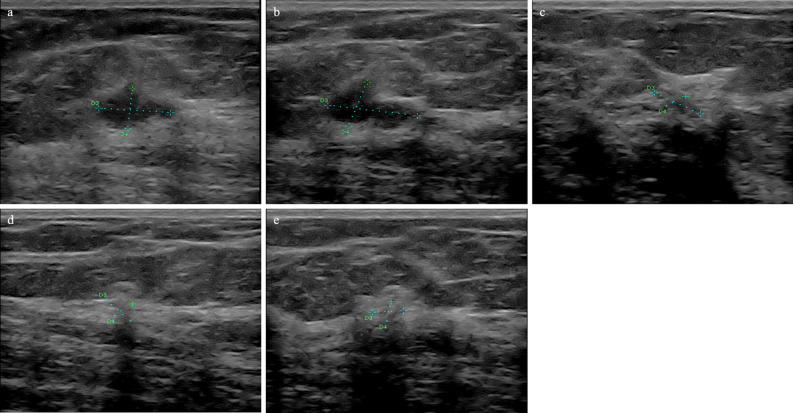
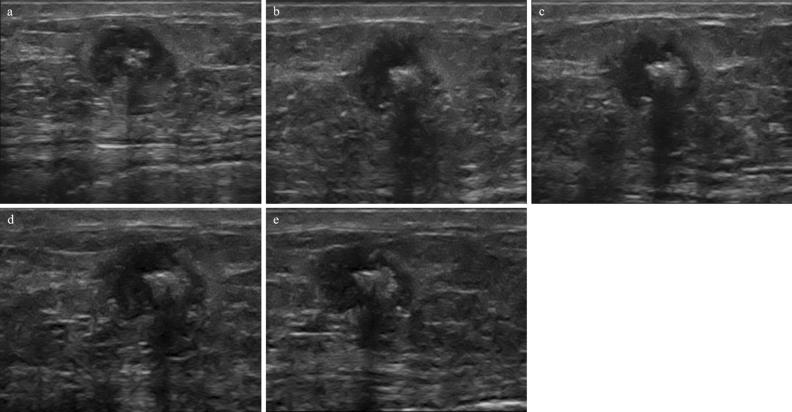
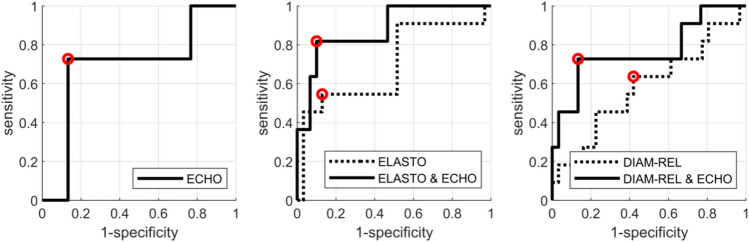
To investigate the performance of multiparametric ultrasound for the evaluation of treatment response in breast cancer patients undergoing neoadjuvant chemotherapy (NAC). The IRB approved this prospective study. Breast cancer patients who were scheduled to undergo NAC were invited to participate in this study. Changes in tumour echogenicity, stiffness, maximum diameter, vascularity and integrated backscatter coefficient (IBC) were assessed prior to treatment and 7 days after four consecutive NAC cycles. Residual malignant cell (RMC) measurement at surgery was considered as standard of reference. RMC < 30% was considered a good response and > 70% a poor response. The correlation coefficients of these parameters were compared with RMC from post-operative histology. Linear Discriminant Analysis (LDA), cross-validation and Receiver Operating Characteristic curve (ROC) analysis were performed. Thirty patients (mean age 56.4 year) with 42 lesions were included. There was a significant correlation between RMC and echogenicity and tumour diameter after the 3rd course of NAC and average stiffness after the 2nd course. The correlation coefficient for IBC and echogenicity calculated after the first four doses of NAC were 0.27, 0.35, 0.41 and 0.30, respectively. Multivariate analysis of the echogenicity and stiffness after the third NAC revealed a sensitivity of 82%, specificity of 90%, PPV = 75%, NPV = 93%, accuracy = 88% and AUC of 0.88 for non-responding tumours (RMC > 70%). High tumour stiffness and persistent hypoechogenicity after the third NAC course allowed to accurately predict a group of non-responding tumours. A correlation between echogenicity and IBC was demonstrated as well.
为了研究多参数超声在评估接受新辅助化疗(NAC)的乳腺癌患者治疗反应中的性能。IRB 批准了这项前瞻性研究。邀请计划接受 NAC 的乳腺癌患者参加这项研究。在治疗前和连续 4 个 NAC 周期后 7 天评估肿瘤回声、硬度、最大直径、血管生成和背向散射积分(IBC)的变化。手术时的残留恶性细胞(RMC)测量被认为是参考标准。RMC<30%被认为是良好反应,RMC>70%是不良反应。将这些参数的相关系数与术后组织学的 RMC 进行比较。进行了线性判别分析(LDA)、交叉验证和接收器操作特性曲线(ROC)分析。30 例(平均年龄 56.4 岁)患者共 42 个病灶。在 NAC 第 3 疗程后,RMC 与回声强度和肿瘤直径之间存在显著相关性,在 NAC 第 2 疗程后平均硬度之间存在显著相关性。在 NAC 前 4 剂后计算的 IBC 与回声强度的相关系数分别为 0.27、0.35、0.41 和 0.30。在第 3 个 NAC 后分析回声和硬度的多变量分析显示,对 RMC>70%的无反应肿瘤的敏感性为 82%,特异性为 90%,阳性预测值(PPV)为 75%,阴性预测值(NPV)为 93%,准确率为 88%,AUC 为 0.88。第 3 个 NAC 疗程后肿瘤硬度高且回声持续低回声,可准确预测一组无反应的肿瘤。还证明了回声和 IBC 之间存在相关性。