Department of Radiology, University of Cambridge, Cambridge, United Kingdom.
Memorial Sloan-Kettering Cancer Center, Department of Radiology, Molecular Imaging and Therapy Service, New York, NY.
Invest Radiol. 2019 May;54(5):257-264. doi: 10.1097/RLI.0000000000000543.
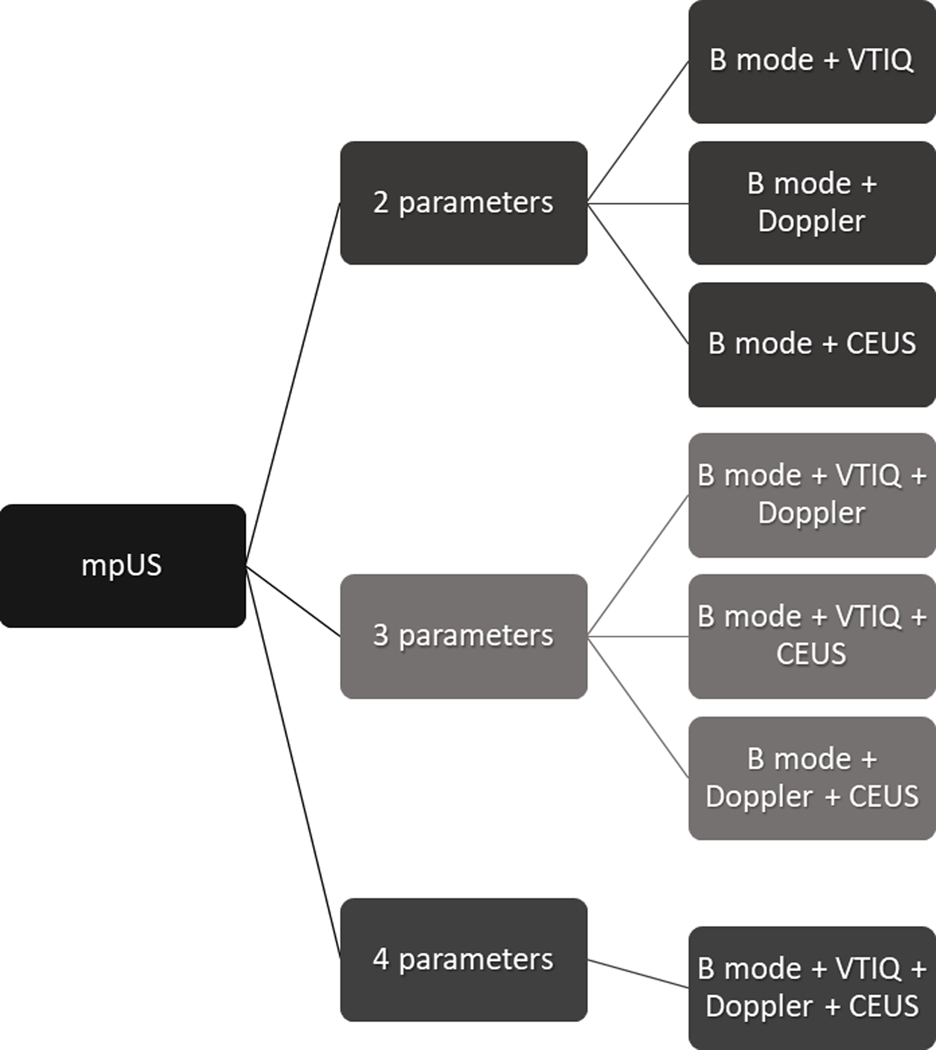
The aim of this study was to evaluate breast multiparametric ultrasound (mpUS) and its potential to reduce unnecessary breast biopsies with 1, 2, or 3 additional quantitative parameters (Doppler, elastography, and contrast-enhanced ultrasound [CEUS]) to B-mode and investigate possible variations with different reader experience.
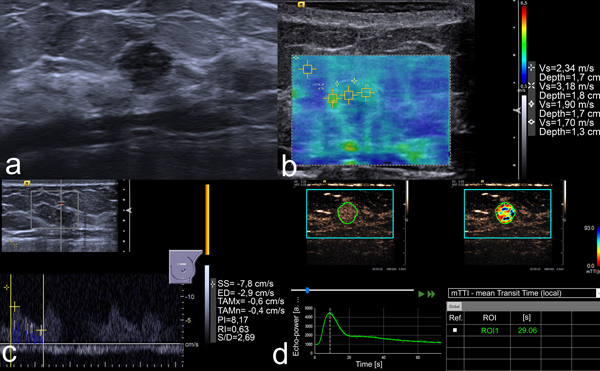
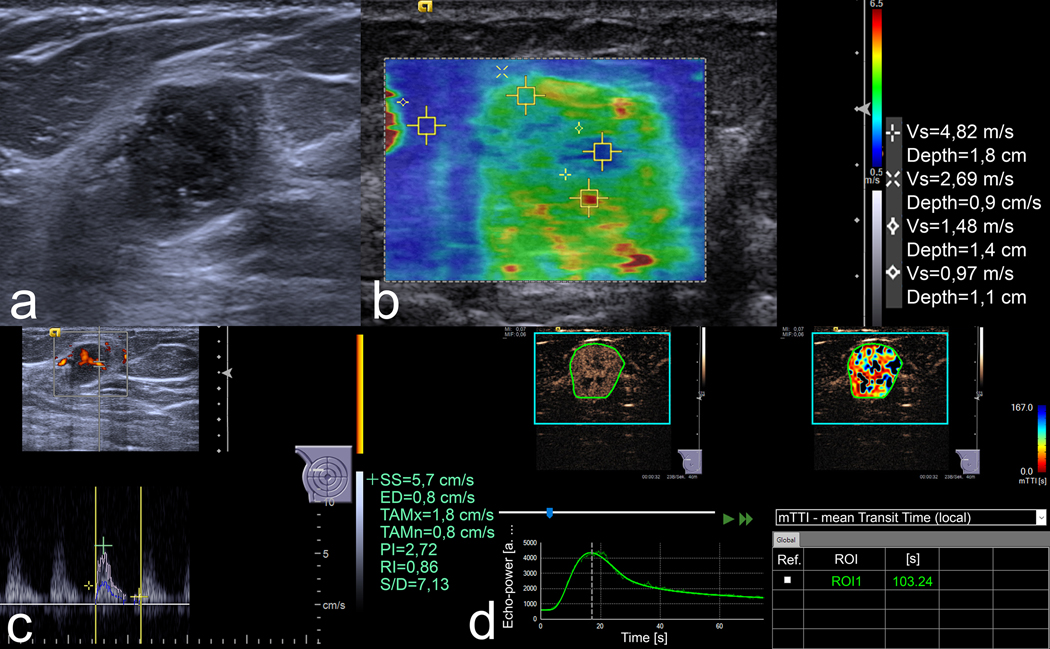
This prospective study included 124 women (age range, 18-82 years; mean, 52 years), each with 1 new breast lesion, scheduled for ultrasound-guided biopsy between October 2015 and September 2016. Each lesion was examined with B-mode, elastography (Virtual Touch IQ [VTIQ]), Doppler, and CEUS, and different quantitative parameters were recorded for each modality. Four readers (2 experienced breast radiologists and 2 in-training) independently evaluated B-mode images of each lesion and assigned a BI-RADS (Breast Imaging Reporting and Data System) score. Using the area under the receiver operating characteristic curve (AUC), the most accurate quantitative parameter for each modality was chosen. These were then combined with the BI-RADS scores of all readers. Descriptive statistics and AUC were used to evaluate the diagnostic performance of mpUS.
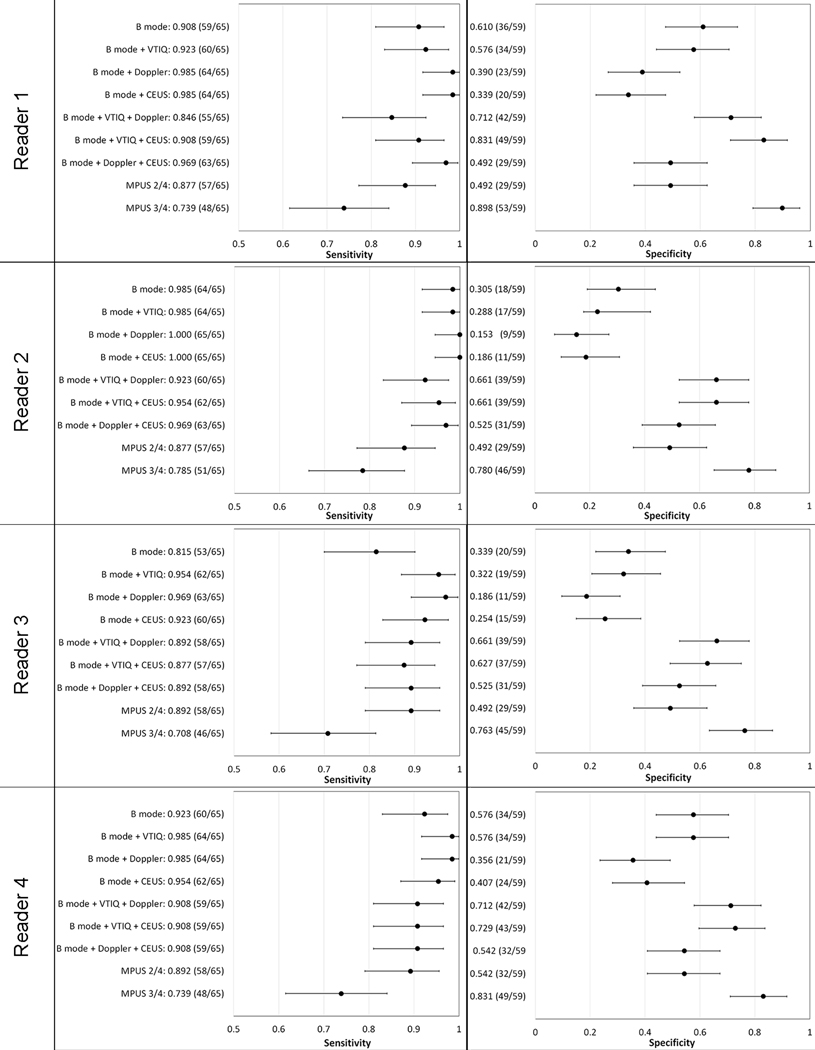
Sixty-five lesions were malignant. MpUS with B-mode and 2 additional quantitative parameters (VTIQ and CEUS or Doppler) showed the highest diagnostic performance for all readers (averaged AUCs, 0.812-0.789 respectively vs 0.683 for B-mode, P = 0.0001). Both combinations significantly reduced the number of false-positive findings up to 46.9% (P < 0.0001).
Quantitative mpUS with 2 different triple assessment modalities (B-mode, VTIQ elastography, CEUS, or Doppler) shows the best diagnostic performance for breast cancer diagnosis and leads to a significant reduction of false-positive biopsy recommendations, for both experienced and inexperienced readers.
本研究旨在评估乳腺多参数超声(mpUS)及其通过增加 1、2 或 3 个额外的定量参数(多普勒、弹性成像和对比增强超声[CEUS])来减少不必要的乳腺活检的潜力,同时研究不同经验的读者之间可能存在的差异。
本前瞻性研究纳入了 124 名年龄在 18-82 岁之间(平均年龄 52 岁)的女性,每位女性均有 1 个新的乳腺病灶,计划在 2015 年 10 月至 2016 年 9 月期间进行超声引导活检。每个病灶均通过 B 模式、弹性成像(虚拟触摸 IQ[VTIQ])、多普勒和 CEUS 进行检查,并记录每种模式的不同定量参数。4 位读者(2 位有经验的乳腺放射科医生和 2 位在培训中的医生)分别独立评估每个病灶的 B 模式图像,并分配 BI-RADS(乳腺成像报告和数据系统)评分。通过接受者操作特征曲线(ROC)下面积(AUC),选择每种模式最准确的定量参数。然后将这些参数与所有读者的 BI-RADS 评分相结合。使用描述性统计和 AUC 来评估 mpUS 的诊断性能。
65 个病灶为恶性。对于所有读者,B 模式和 2 个额外的定量参数(VTIQ 和 CEUS 或多普勒)的 mpUS 显示出最高的诊断性能(平均 AUC 分别为 0.812-0.789,而 B 模式为 0.683,P=0.0001)。两种组合均显著减少了 46.9%的假阳性发现(P<0.0001)。
具有 2 种不同三重评估模式(B 模式、VTIQ 弹性成像、CEUS 或多普勒)的定量 mpUS 对乳腺癌诊断具有最佳的诊断性能,并可显著减少经验丰富和经验不足的读者的假阳性活检建议。