Estudillo Alejandro J, Wong Hoo Keat
Department of Psychology, Bournemouth University, Bournemouth, UK.
School of Psychology, University of Nottingham-Malaysia Campus, Semenyih, Selangor, Malaysia.
PeerJ. 2021 Jan 11;9:e10629. doi: 10.7717/peerj.10629. eCollection 2021.
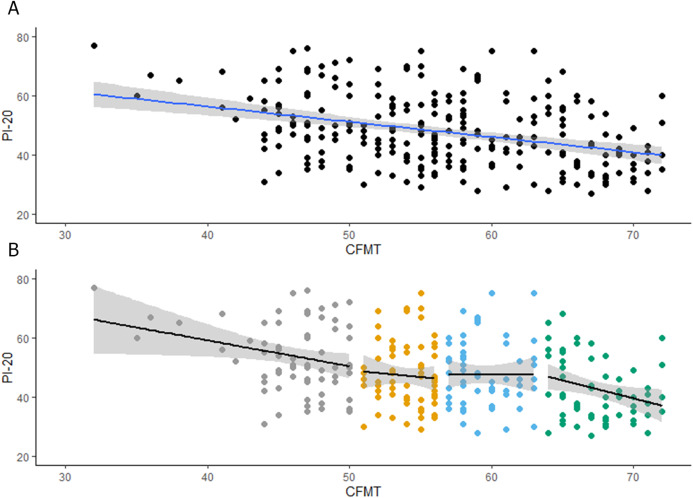
The 20-Item Prosopagnosia Items (PI-20) was recently introduced as a self-report measure of face recognition abilities and as an instrument to help the diagnosis of prosopagnosia. In general, studies using this questionnaire have shown that observers have moderate to strong insights into their face recognition abilities. However, it remains unknown whether these insights are equivalent for the whole range of face recognition abilities. The present study investigates this issue using the Mandarin version of the PI-20 and the Cambridge Face Memory Test Chinese (CFMT-Chinese). Our results showed a moderate negative association between the PI-20 and the CFMT-Chinese. However, this association was driven by people with low and high face recognition ability, but absent in people within the typical range of face recognition performance. The implications of these results for the study of individual differences and the diagnosis of prosopagnosia are discussed.
20项面孔失认症条目(PI - 20)最近被引入,作为一种对面部识别能力的自我报告测量方法,以及一种有助于面孔失认症诊断的工具。总体而言,使用该问卷的研究表明,观察者对自己的面部识别能力有中度到强烈的洞察。然而,这些洞察对于整个面部识别能力范围是否等同仍不清楚。本研究使用PI - 20的中文版和剑桥面部记忆测试中文版(CFMT - 中文)来调查这个问题。我们的结果显示PI - 20与CFMT - 中文之间存在中度负相关。然而,这种关联是由面部识别能力低和高的人驱动的,而在面部识别表现处于典型范围内的人中不存在。讨论了这些结果对个体差异研究和面孔失认症诊断的意义。