Di Fiore Riccardo, Suleiman Sherif, Ellul Bridget, O'Toole Sharon A, Savona-Ventura Charles, Felix Ana, Napolioni Valerio, Conlon Neil T, Kahramanoglu Ilker, Azzopardi Miriam J, Dalmas Miriam, Calleja Neville, Brincat Mark R, Muscat-Baron Yves, Sabol Maja, Dimitrievska Vera, Yordanov Angel, Vasileva-Slaveva Mariela, von Brockdorff Kristelle, Micallef Rachel A, Kubelac Paul, Achimaș-Cadariu Patriciu, Vlad Catalin, Tzortzatou Olga, Poka Robert, Giordano Antonio, Felice Alex, Reed Nicholas, Herrington C Simon, Faraggi David, Calleja-Agius Jean
Department of Anatomy, Faculty of Medicine and Surgery, University of Malta, MSD 2080 Msida, Malta.
Center for Biotechnology, Sbarro Institute for Cancer Research and Molecular Medicine, College of Science and Technology, Temple University, Philadelphia, PA 19122, USA.
Cancers (Basel). 2021 Jan 27;13(3):493. doi: 10.3390/cancers13030493.
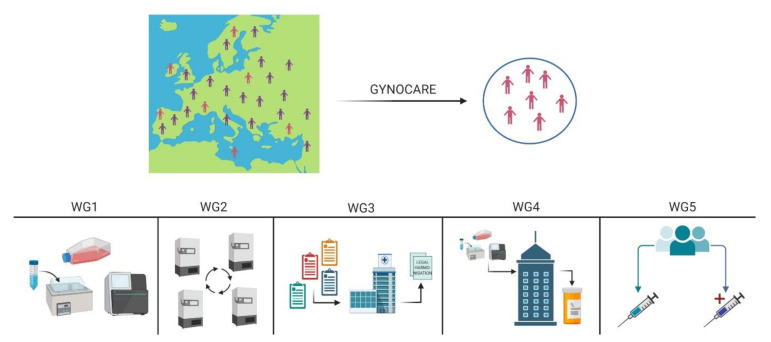
More than 50% of all gynecologic tumors can be classified as rare (defined as an incidence of ≤6 per 100,000 women) and usually have a poor prognosis owing to delayed diagnosis and treatment. In contrast to almost all other common solid tumors, the treatment of rare gynecologic tumors (RGT) is often based on expert opinion, retrospective studies, or extrapolation from other tumor sites with similar histology, leading to difficulty in developing guidelines for clinical practice. Currently, gynecologic cancer research, due to distinct scientific and technological challenges, is lagging behind. Moreover, the overall efforts for addressing these challenges are fragmented across different European countries and indeed, worldwide. The GYNOCARE, COST Action CA18117 (European Network for Gynecological Rare Cancer Research) programme aims to address these challenges through the creation of a unique network between key stakeholders covering distinct domains from concept to cure: basic research on RGT, biobanking, bridging with industry, and setting up the legal and regulatory requirements for international innovative clinical trials. On this basis, members of this COST Action, (Working Group 1, “Basic and Translational Research on Rare Gynecological Cancer”) have decided to focus their future efforts on the development of new approaches to improve the diagnosis and treatment of RGT. Here, we provide a brief overview of the current state-of-the-art and describe the goals of this COST Action and its future challenges with the aim to stimulate discussion and promote synergy across scientists engaged in the fight against this rare cancer worldwide.
超过50%的妇科肿瘤可归类为罕见肿瘤(定义为每10万名女性中发病率≤6例),由于诊断和治疗延迟,其预后通常较差。与几乎所有其他常见实体瘤不同,罕见妇科肿瘤(RGT)的治疗往往基于专家意见、回顾性研究或从其他具有相似组织学的肿瘤部位推断而来,这导致制定临床实践指南存在困难。目前,由于独特的科学和技术挑战,妇科癌症研究滞后。此外,应对这些挑战的整体努力在不同欧洲国家乃至全球范围内都较为分散。GYNOCARE,即COST行动CA18117(欧洲妇科罕见癌症研究网络)项目旨在通过在关键利益相关者之间建立一个独特的网络来应对这些挑战,该网络涵盖从概念到治愈的不同领域:RGT的基础研究、生物样本库、与行业的对接以及为国际创新临床试验设定法律和监管要求。在此基础上,该COST行动的成员(第一工作组,“罕见妇科癌症的基础与转化研究”)决定将未来的努力重点放在开发新方法以改善RGT的诊断和治疗上。在此,我们简要概述当前的技术水平,并描述该COST行动的目标及其未来挑战,旨在激发讨论并促进全球致力于对抗这种罕见癌症的科学家之间的协同合作。