Institute of Computational Biology, Helmholtz Zentrum München - German Research Center for Environmental Health, 85764, Neuherberg, Germany.
Center for Mathematics, Technische Universität München, 85748, Garching, Germany.
Sci Rep. 2021 Jan 29;11(1):2696. doi: 10.1038/s41598-021-82196-2.
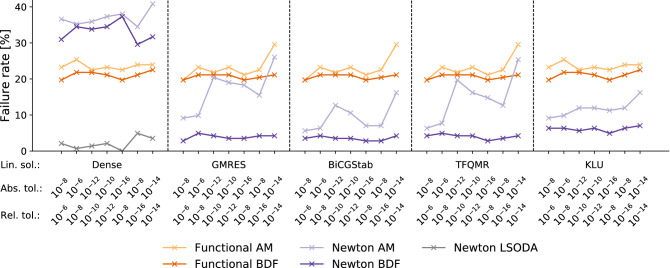
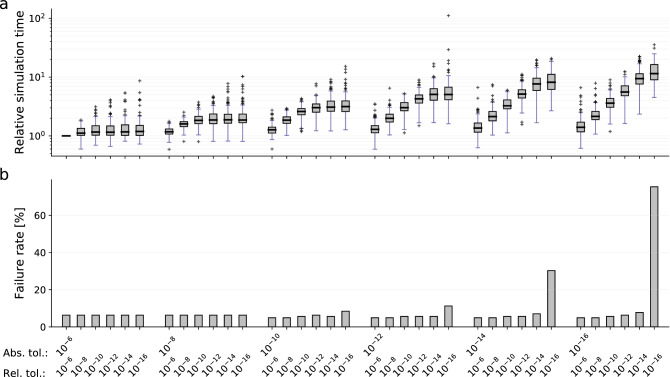
Ordinary differential equation (ODE) models are a key tool to understand complex mechanisms in systems biology. These models are studied using various approaches, including stability and bifurcation analysis, but most frequently by numerical simulations. The number of required simulations is often large, e.g., when unknown parameters need to be inferred. This renders efficient and reliable numerical integration methods essential. However, these methods depend on various hyperparameters, which strongly impact the ODE solution. Despite this, and although hundreds of published ODE models are freely available in public databases, a thorough study that quantifies the impact of hyperparameters on the ODE solver in terms of accuracy and computation time is still missing. In this manuscript, we investigate which choices of algorithms and hyperparameters are generally favorable when dealing with ODE models arising from biological processes. To ensure a representative evaluation, we considered 142 published models. Our study provides evidence that most ODEs in computational biology are stiff, and we give guidelines for the choice of algorithms and hyperparameters. We anticipate that our results will help researchers in systems biology to choose appropriate numerical methods when dealing with ODE models.
常微分方程 (ODE) 模型是理解系统生物学中复杂机制的关键工具。这些模型使用各种方法进行研究,包括稳定性和分叉分析,但最常通过数值模拟进行研究。所需模拟的数量通常很大,例如,当需要推断未知参数时。这使得高效可靠的数值积分方法变得至关重要。然而,这些方法取决于各种超参数,这些超参数对 ODE 解有很大的影响。尽管如此,尽管数百个已发表的 ODE 模型在公共数据库中免费提供,但仍缺乏针对 ODE 求解器在准确性和计算时间方面的超参数影响进行全面研究。在本文中,我们研究了当处理来自生物过程的 ODE 模型时,通常哪些算法和超参数选择是有利的。为了确保代表性评估,我们考虑了 142 个已发表的模型。我们的研究表明,计算生物学中的大多数 ODE 都是刚性的,我们为算法和超参数的选择提供了指导。我们预计,我们的研究结果将帮助系统生物学研究人员在处理 ODE 模型时选择合适的数值方法。