Zhuo Xunhui, Du Kaige, Ding Haojie, Lou Di, Zheng Bin, Lu Shaohong
Department of Immunity and Biochemistry, Institute of Parasitic Disease, Hangzhou Medical College, Hangzhou, China.
Department of Immunity and Biochemistry, Institute of Parasitic Disease, Zhejiang Academy of Medical Sciences, Hangzhou, China.
Front Microbiol. 2021 Jan 14;11:616688. doi: 10.3389/fmicb.2020.616688. eCollection 2020.
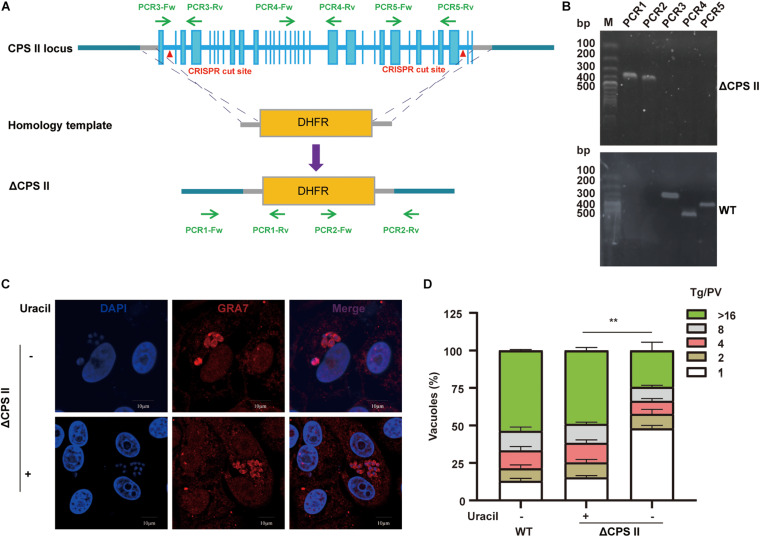
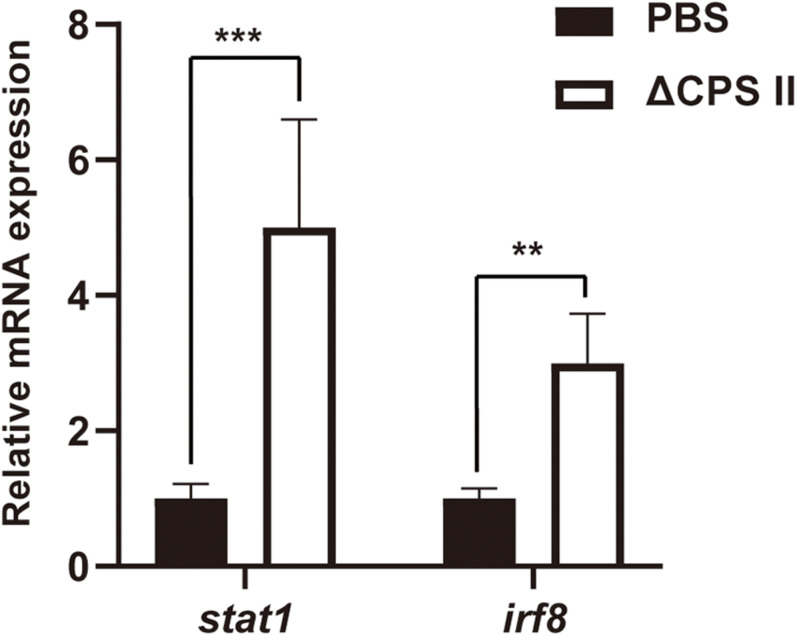
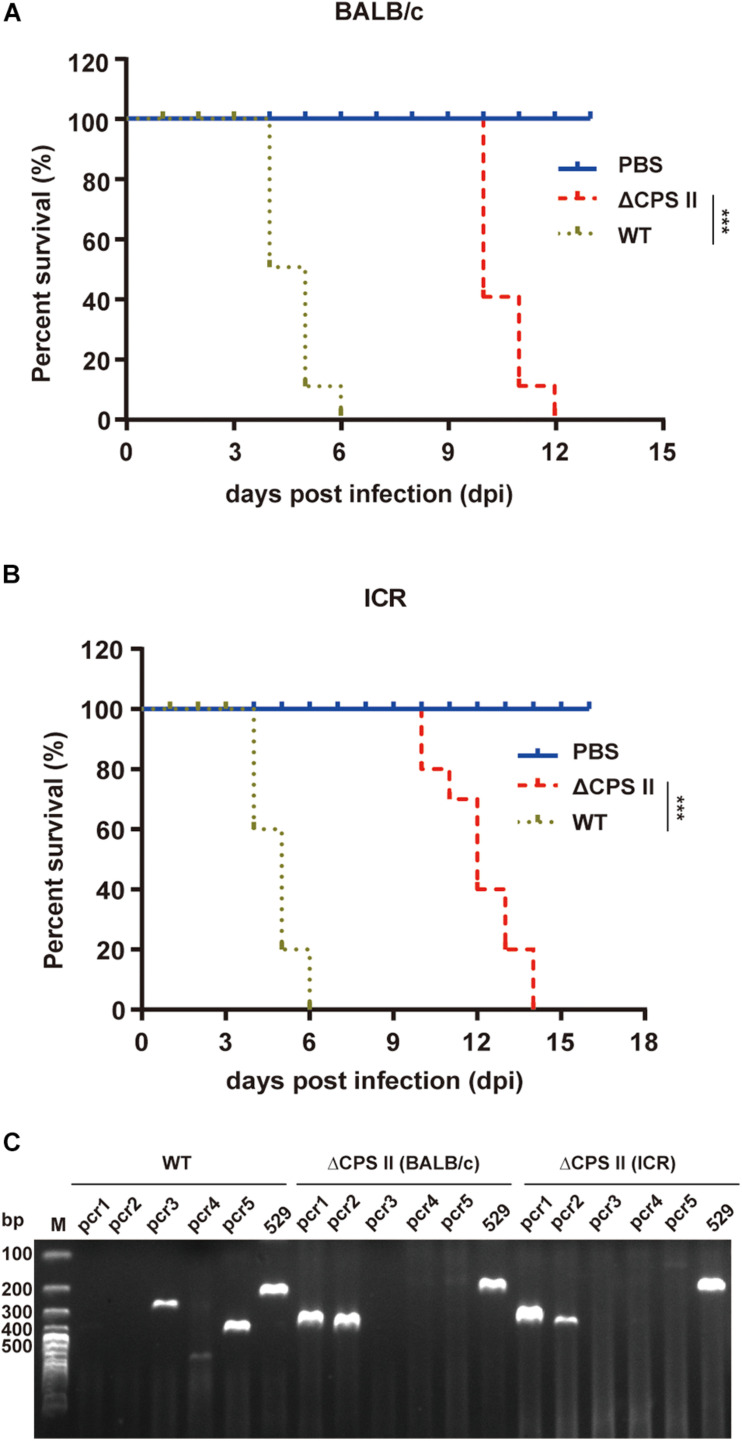
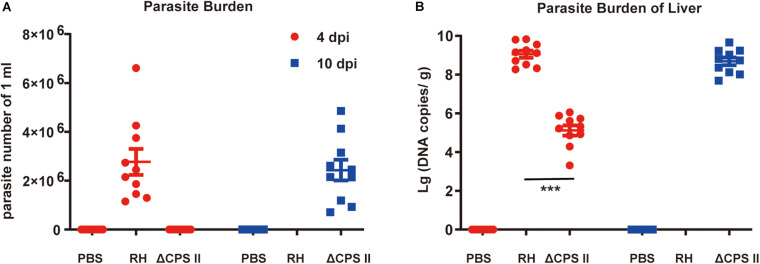
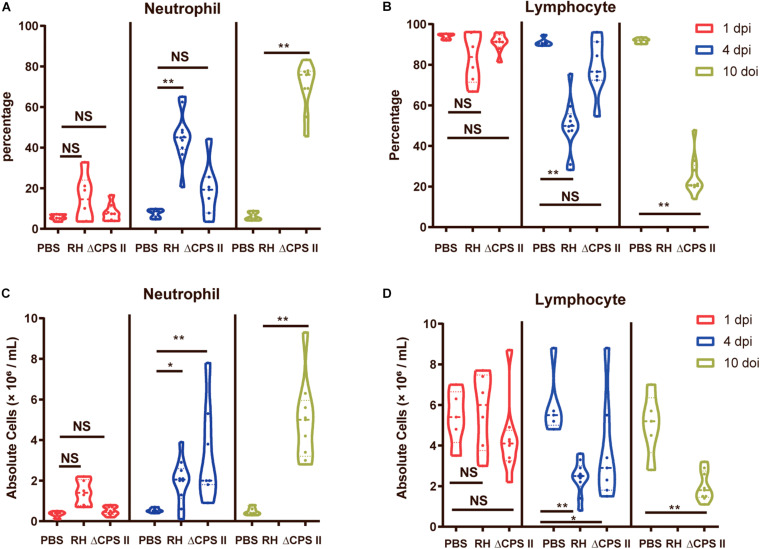
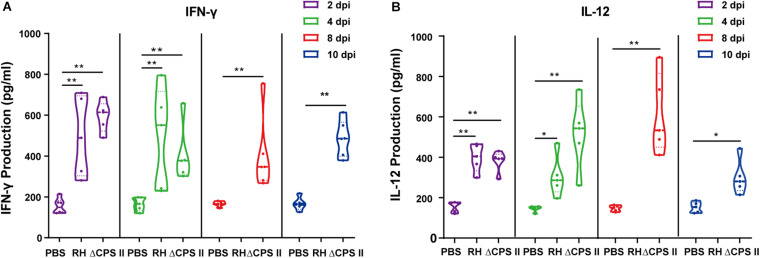
is an obligate intracellular protozoan parasite. primarily infection in pregnant women may result in fetal abortion, and infection in immunosuppressed population may result in toxoplasmosis. Carbamoyl phosphate synthetase II (CPSII) is a key enzyme in the pyrimidine-biosynthesis pathway, and has a crucial role in parasite replication. We generated a mutant with complete deletion of CPSII via clustered regularly interspaced short palindromic repeats (CRISPR)/cas9 in type-1 RH strain of . We tested the intracellular proliferation of this mutant and found that it showed significantly reduced replication , though CPSII deletion did not completely stop the parasite growth. The immune responses induced by the infection of RHΔCPSII tachyzoites in mice were evaluated. During infection in mice, the RHΔCPSII mutant displayed notable defects in replication and virulence, and significantly enhanced the survival of mice compared with survival of RH-infected mice. We tracked parasite propagation from ascitic fluid in mice infected with the RHΔCPSII mutant, and few tachyzoites were observed at early infection. We also observed that the RHΔCPSII mutant induced greater accumulation of neutrophils. The mutant induced a higher level of T-helper type-1 cytokines [interferon (IFN)-γ, interleukin (IL)-12]. The mRNA levels of signal transducer and activator of transcription cellular transcription factor 1 and IFN regulatory factor 8 were significantly higher in the RHΔCPSII mutant-infected group. Together, these data suggest that CPSII is crucial for parasite growth, and that strains lack the pyrimidine biosynthesis pathway and salvage pathway may become a promising live attenuated vaccine to prevent infection with .
是一种专性细胞内原生动物寄生虫。主要感染孕妇可能导致胎儿流产,感染免疫抑制人群可能导致弓形虫病。氨甲酰磷酸合成酶II(CPSII)是嘧啶生物合成途径中的关键酶,在寄生虫复制中起关键作用。我们通过成簇规律间隔短回文重复序列(CRISPR)/cas9在1型RH株中产生了完全缺失CPSII的突变体。我们测试了该突变体的细胞内增殖,发现其复制显著减少,尽管CPSII缺失并未完全阻止寄生虫生长。评估了RHΔCPSII速殖子感染小鼠诱导的免疫反应。在小鼠感染期间,RHΔCPSII突变体在复制和毒力方面表现出明显缺陷,与感染RH的小鼠相比,显著提高了小鼠的存活率。我们追踪了感染RHΔCPSII突变体的小鼠腹水中的寄生虫繁殖情况,在早期感染时观察到很少的速殖子。我们还观察到RHΔCPSII突变体诱导了更多中性粒细胞的积累。该突变体诱导了更高水平的1型辅助性T细胞细胞因子[干扰素(IFN)-γ、白细胞介素(IL)-12]。在RHΔCPSII突变体感染组中,信号转导和转录激活因子细胞转录因子1和IFN调节因子8的mRNA水平显著更高。总之,这些数据表明CPSII对寄生虫生长至关重要,缺乏嘧啶生物合成途径和补救途径的菌株可能成为预防感染的有前景的减毒活疫苗。