Gao Yulin, Pan Zhenghui, Sun Jianguo, Liu Zhaolin, Wang John
Department of Materials Science and Engineering, National University of Singapore, Singapore, 117574, Singapore.
ST Engineering Advanced Material Engineering Pte. Ltd., Singapore, 619523, Singapore.
Nanomicro Lett. 2022 Apr 6;14(1):94. doi: 10.1007/s40820-022-00844-2.
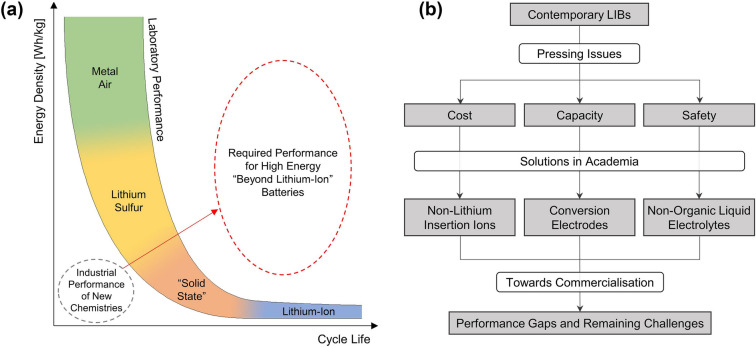
Rechargeable batteries of high energy density and overall performance are becoming a critically important technology in the rapidly changing society of the twenty-first century. While lithium-ion batteries have so far been the dominant choice, numerous emerging applications call for higher capacity, better safety and lower costs while maintaining sufficient cyclability. The design space for potentially better alternatives is extremely large, with numerous new chemistries and architectures being simultaneously explored. These include other insertion ions (e.g. sodium and numerous multivalent ions), conversion electrode materials (e.g. silicon, metallic anodes, halides and chalcogens) and aqueous and solid electrolytes. However, each of these potential "beyond lithium-ion" alternatives faces numerous challenges that often lead to very poor cyclability, especially at the commercial cell level, while lithium-ion batteries continue to improve in performance and decrease in cost. This review examines fundamental principles to rationalise these numerous developments, and in each case, a brief overview is given on the advantages, advances, remaining challenges preventing cell-level implementation and the state-of-the-art of the solutions to these challenges. Finally, research and development results obtained in academia are compared to emerging commercial examples, as a commentary on the current and near-future viability of these "beyond lithium-ion" alternatives.
在二十一世纪快速变化的社会中,高能量密度和综合性能的可充电电池正成为一项至关重要的技术。虽然锂离子电池迄今为止一直是主导选择,但众多新兴应用要求在保持足够循环寿命的同时具备更高的容量、更好的安全性和更低的成本。潜在更好替代方案的设计空间极其广阔,众多新的化学体系和结构正在同时被探索。这些包括其他嵌入离子(如钠和众多多价离子)、转换电极材料(如硅、金属负极、卤化物和硫族元素)以及水性和固体电解质。然而,这些潜在的“超越锂离子”的替代方案中的每一个都面临着众多挑战,这些挑战往往导致循环寿命非常差,尤其是在商业电池层面,而锂离子电池的性能却在不断提高,成本也在不断降低。本综述研究了使这些众多进展合理化的基本原理,并且在每种情况下,都简要概述了其优点、进展、阻碍电池层面应用的剩余挑战以及解决这些挑战的最新方案。最后,将学术界获得的研发成果与新兴的商业实例进行比较,以此作为对这些“超越锂离子”替代方案当前及近期可行性的评论。