Wu Yun-Ju, Mar Guang-Yuan, Wu Ming-Ting, Wu Fu-Zong
Department of Radiology, Kaohsiung Veterans General Hospital, Kaohsiung, Taiwan.
Department of Health Care Administration, Chang Jung Christian University, Tainan, Taiwan.
Front Cardiovasc Med. 2021 Jan 15;7:619798. doi: 10.3389/fcvm.2020.619798. eCollection 2020.
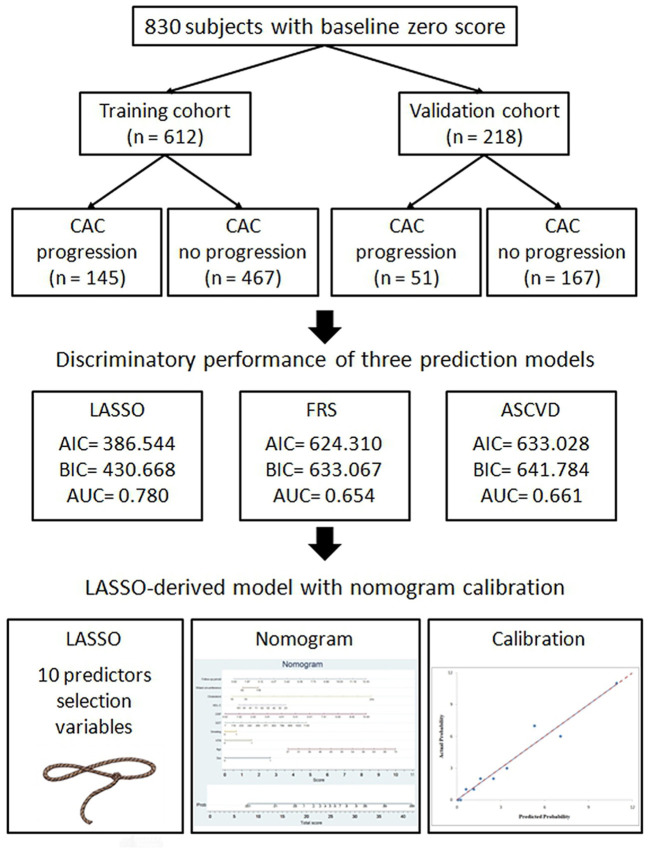
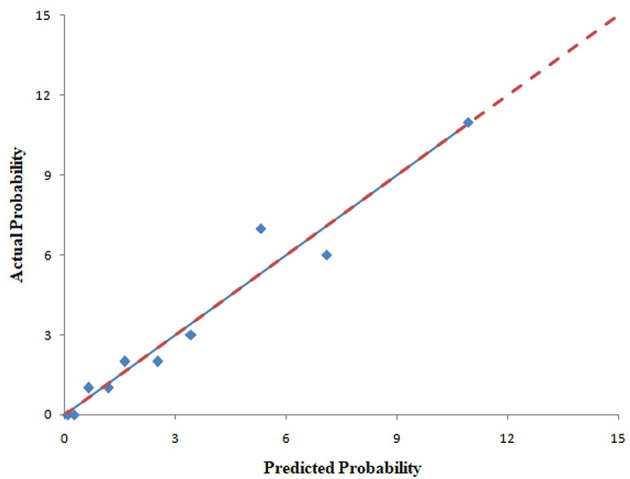
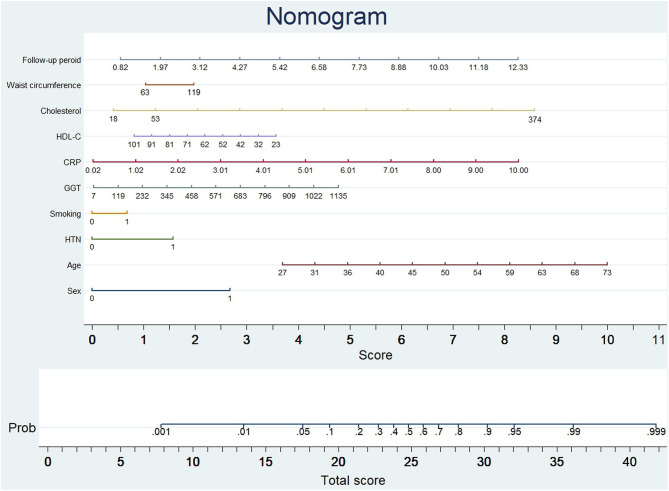
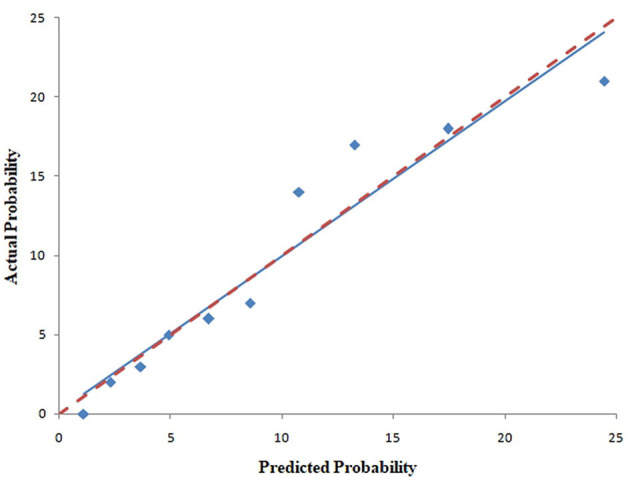
This study is aimed at developing a prediction nomogram for subclinical coronary atherosclerosis in an Asian population with baseline zero score, and to compare its discriminatory ability with Framingham risk score (FRS) and atherosclerotic cardiovascular disease (ASCVD) models. Clinical characteristics, physical examination, and laboratory profiles of 830 subjects were retrospectively reviewed. Subclinical coronary atherosclerosis in term of Coronary artery calcification (CAC) progression was the primary endpoint. A nomogram was established based on a least absolute shrinkage and selection operator (LASSO)-derived logistic model. The discrimination and calibration ability of this nomogram was evaluated by Hosmer-Lemeshow test and calibration curves in the training and validation cohort. Of the 830 subjects with baseline zero score with the average follow-up period of 4.55 ± 2.42 year in the study, these subjects were randomly placed into the training set or validation set at a ratio of 2.8:1. These study results showed in the 612 subjects with baseline zero score, 145 (23.69%) subjects developed CAC progression in the training cohort ( = 612), while in the validation cohort ( = 218), 51 (23.39%) subjects developed CAC progression. This LASSO-derived nomogram included the following 10 predictors: "sex," age," "hypertension," "smoking habit," "Gamma-Glutamyl Transferase (GGT)," "C-reactive protein (CRP)," "high-density lipoprotein cholesterol (HDL-C)," "cholesterol," "waist circumference," and "follow-up period." Compared with the FRS and ASCVD models, this LASSO-derived nomogram had higher diagnostic performance and lower Akaike information criterion (AIC) and Bayesian information criterion (BIC) value. The discriminative ability, as determined by the area under receiver operating characteristic curve was 0.780 (95% confidence interval: 0.731-0.829) in the training cohort and 0.836 (95% confidence interval: 0.761-0.911) in the validation cohort. Moreover, satisfactory calibration was confirmed by Hosmer-Lemeshow test with -values of 0.654 and 0.979 in the training cohort and validation cohort. This validated nomogram provided a useful predictive value for subclinical coronary atherosclerosis in subjects with baseline zero score, and could provide clinicians and patients with the primary preventive strategies timely in individual-based preventive cardiology.
本研究旨在为基线评分为零的亚洲人群开发一种预测亚临床冠状动脉粥样硬化的列线图,并将其鉴别能力与弗雷明汉风险评分(FRS)和动脉粥样硬化性心血管疾病(ASCVD)模型进行比较。回顾性分析了830名受试者的临床特征、体格检查和实验室检查结果。以冠状动脉钙化(CAC)进展来定义的亚临床冠状动脉粥样硬化为主要终点。基于最小绝对收缩和选择算子(LASSO)推导的逻辑模型建立了列线图。通过Hosmer-Lemeshow检验和校准曲线在训练队列和验证队列中评估该列线图的鉴别能力和校准能力。在本研究中,830名基线评分为零的受试者平均随访期为4.55±2.42年,这些受试者以2.8:1的比例随机分为训练集或验证集。这些研究结果显示,在612名基线评分为零的受试者中,训练队列(n = 612)中有145名(23.69%)受试者出现CAC进展,而在验证队列(n = 218)中,有51名(23.39%)受试者出现CAC进展。这种基于LASSO推导的列线图包括以下10个预测因子:“性别”、“年龄”、“高血压”、“吸烟习惯”、“γ-谷氨酰转移酶(GGT)”、“C反应蛋白(CRP)”、“高密度脂蛋白胆固醇(HDL-C)”、“胆固醇”、“腰围”和“随访期”。与FRS和ASCVD模型相比,这种基于LASSO推导的列线图具有更高的诊断性能以及更低的赤池信息准则(AIC)和贝叶斯信息准则(BIC)值。在训练队列中,由受试者工作特征曲线下面积确定的鉴别能力为0.780(95%置信区间:0.731 - 0.829),在验证队列中为0.836(95%置信区间:0.761 - 0.911)。此外,Hosmer-Lemeshow检验在训练队列和验证队列中的P值分别为0.654和0.979,证实了校准效果良好。这种经过验证的列线图为基线评分为零的受试者的亚临床冠状动脉粥样硬化提供了有用的预测价值,并可为临床医生和患者在基于个体的预防心脏病学中及时提供一级预防策略。