Max Planck Institute of Biochemistry, Am Klopferspitz 18, 82152 Martinsried, Germany.
Proteros biostructures GmbH, Bunsenstr 7a, 82152 Martinsried, Germany.
Sci Adv. 2021 Jan 8;7(2). doi: 10.1126/sciadv.abd4413. Print 2021 Jan.
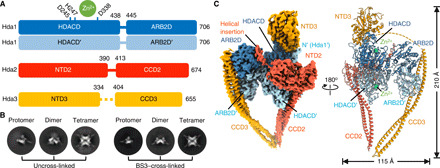
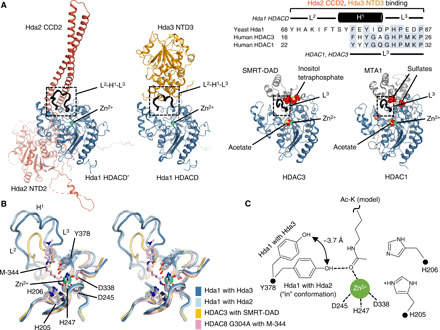
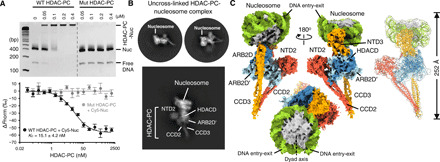
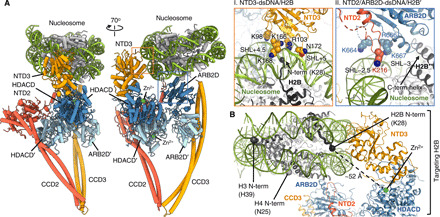
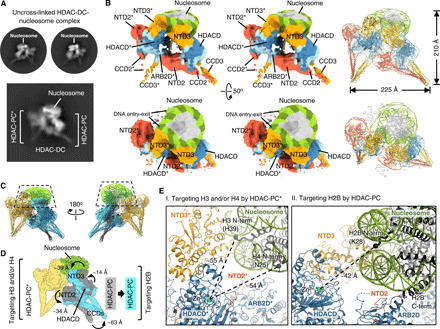
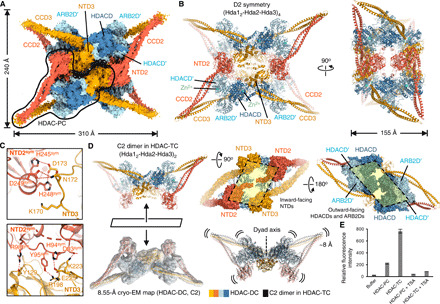
The chromatin-modifying histone deacetylases (HDACs) remove acetyl groups from acetyl-lysine residues in histone amino-terminal tails, thereby mediating transcriptional repression. Structural makeup and mechanisms by which multisubunit HDAC complexes recognize nucleosomes remain elusive. Our cryo-electron microscopy structures of the yeast class II HDAC ensembles show that the HDAC protomer comprises a triangle-shaped assembly of stoichiometry Hda1-Hda2-Hda3, in which the active sites of the Hda1 dimer are freely accessible. We also observe a tetramer of protomers, where the nucleosome binding modules are inaccessible. Structural analysis of the nucleosome-bound complexes indicates how positioning of Hda1 adjacent to histone H2B affords HDAC catalysis. Moreover, it reveals how an intricate network of multiple contacts between a dimer of protomers and the nucleosome creates a platform for expansion of the HDAC activities. Our study provides comprehensive insight into the structural plasticity of the HDAC complex and its functional mechanism of chromatin modification.
组蛋白去乙酰化酶(HDACs)是一类可以将组蛋白氨基末端尾巴上的乙酰基转移到赖氨酸残基上的酶,从而介导转录抑制。多亚基 HDAC 复合物识别核小体的结构组成和机制仍然难以捉摸。我们的酵母 II 类 HDAC 复合物的冷冻电镜结构表明,HDAC 单体由 Hda1-Hda2-Hda3 组成的三角形组装体组成,其中 Hda1 二聚体的活性位点可自由进入。我们还观察到四聚体的单体,其中核小体结合模块不可访问。对核小体结合复合物的结构分析表明,Hda1 如何定位在组蛋白 H2B 旁边以提供 HDAC 催化。此外,它揭示了两个单体之间的复杂的网络接触如何为 HDAC 活性的扩展创建一个平台。我们的研究为 HDAC 复合物的结构可塑性及其染色质修饰的功能机制提供了全面的见解。