Department of Microbial Pathogenicity Mechanisms, Leibniz Institute for Natural Product Research and Infection Biology-Hans Knoell Institute, Beutenbergstrasse 11a, 07745, Jena, Germany.
Center for Sepsis Control and Care (CSCC), Jena University Hospital, Am Klinikum 1, 07747, Jena, Germany.
FEMS Microbiol Rev. 2021 Sep 8;45(5). doi: 10.1093/femsre/fuab005.
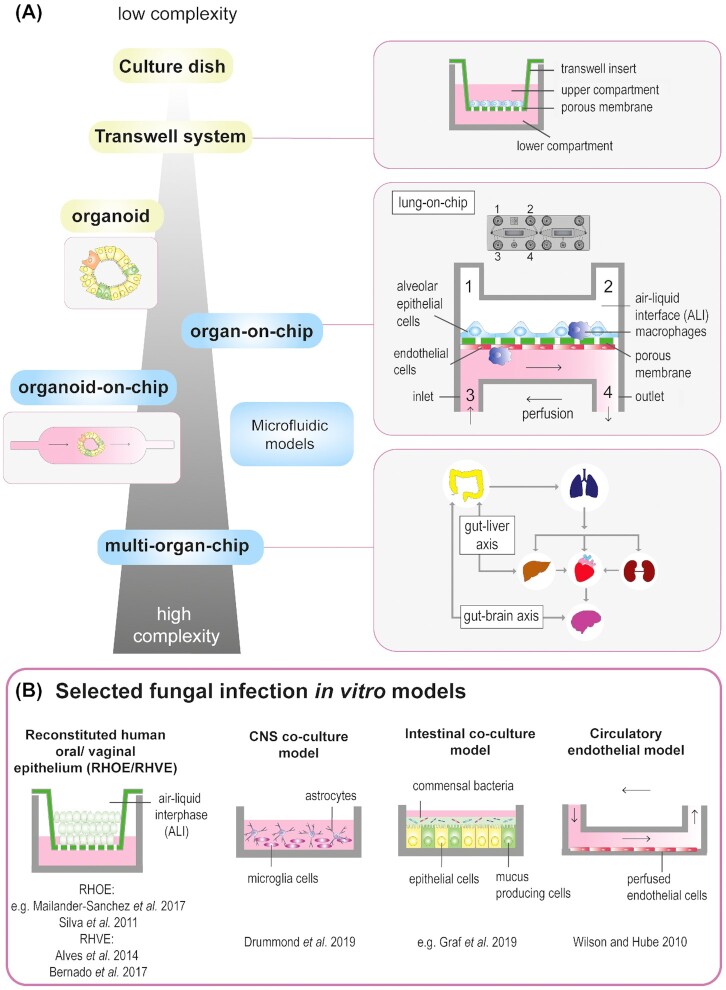
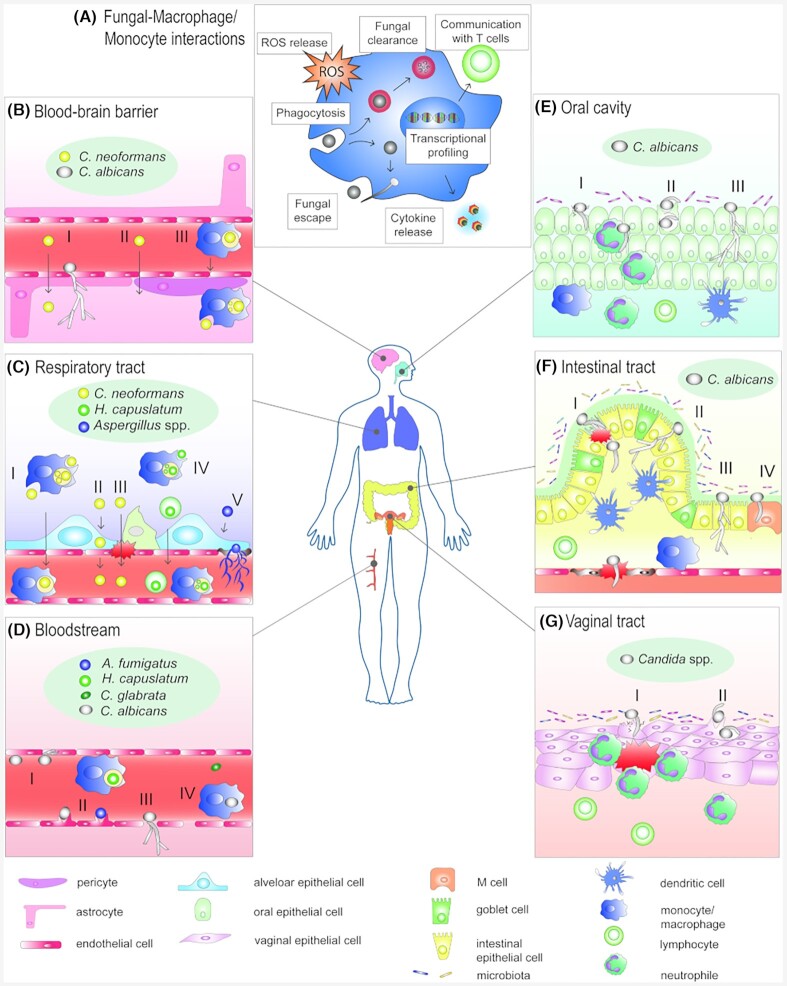
Fungal infections (mycoses) affect over a billion people per year. Approximately, two million of these infections are life-threatening, especially for patients with a compromised immune system. Fungi of the genera Aspergillus, Candida, Histoplasma and Cryptococcus are opportunistic pathogens that contribute to a substantial number of mycoses. To optimize the diagnosis and treatment of mycoses, we need to understand the complex fungal-host interplay during pathogenesis, the fungal attributes causing virulence and how the host resists infection via immunological defenses. In vitro models can be used to mimic fungal infections of various tissues and organs and the corresponding immune responses at near-physiological conditions. Furthermore, models can include fungal interactions with the host-microbiota to mimic the in vivo situation on skin and mucosal surfaces. This article reviews currently used in vitro models of fungal infections ranging from cell monolayers to microfluidic 3D organ-on-chip (OOC) platforms. We also discuss how OOC models can expand the toolbox for investigating interactions of fungi and their human hosts in the future.
真菌感染(真菌病)每年影响超过 10 亿人。其中,约有 200 万人的感染是危及生命的,尤其是对免疫系统受损的患者。曲霉属、假丝酵母属、组织胞浆菌属和隐球菌属等真菌是机会致病菌,它们导致了大量的真菌病。为了优化真菌病的诊断和治疗,我们需要了解发病机制过程中复杂的真菌-宿主相互作用、导致毒力的真菌特性以及宿主如何通过免疫防御来抵抗感染。体外模型可用于模拟各种组织和器官的真菌感染以及相应的免疫反应,接近生理条件。此外,模型还可以包括真菌与宿主微生物群的相互作用,以模拟皮肤和粘膜表面的体内情况。本文综述了目前用于真菌感染的体外模型,从单层细胞到微流控 3D 器官芯片(OOC)平台。我们还讨论了 OOC 模型如何在未来扩展研究真菌与其人类宿主相互作用的工具包。