Center for Autoimmune Diseases Research (CREA), School of Medicine and Health Sciences, Universidad del Rosario, Bogota, Colombia.
Center for Autoimmune Diseases Research (CREA), School of Medicine and Health Sciences, Universidad del Rosario, Bogota, Colombia; Clínica del Occidente, Bogota, Colombia.
J Autoimmun. 2021 Mar;118:102598. doi: 10.1016/j.jaut.2021.102598. Epub 2021 Jan 22.
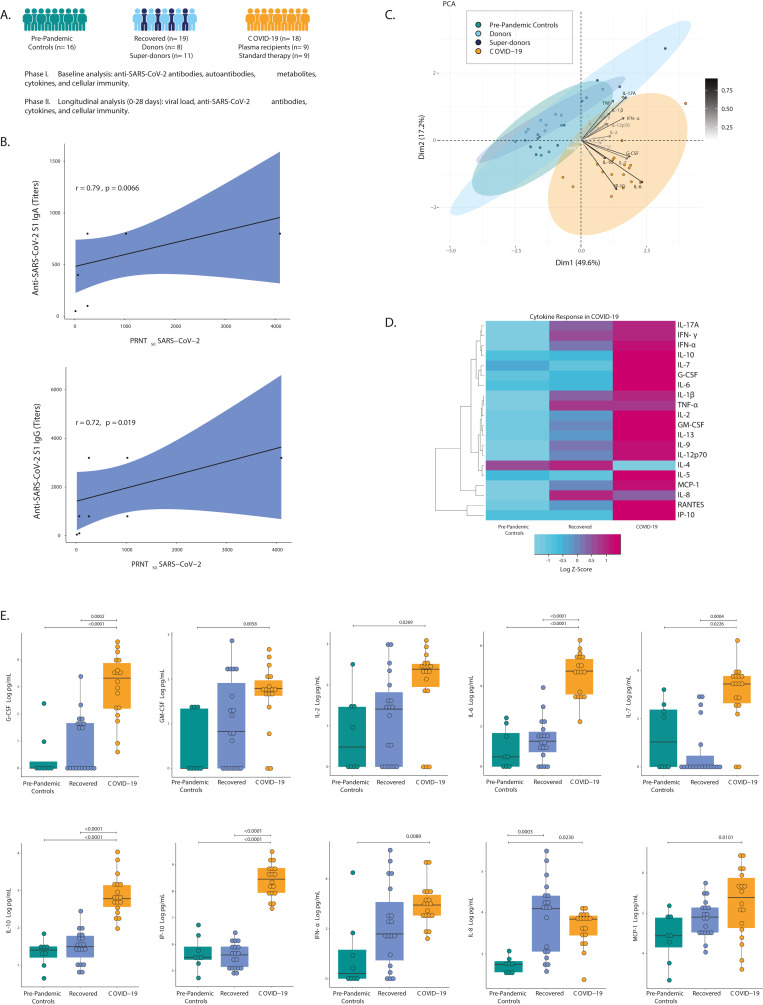
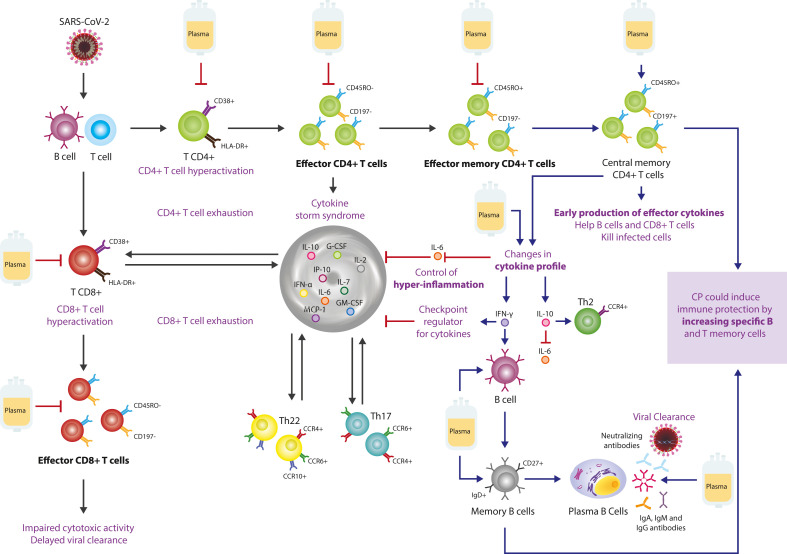
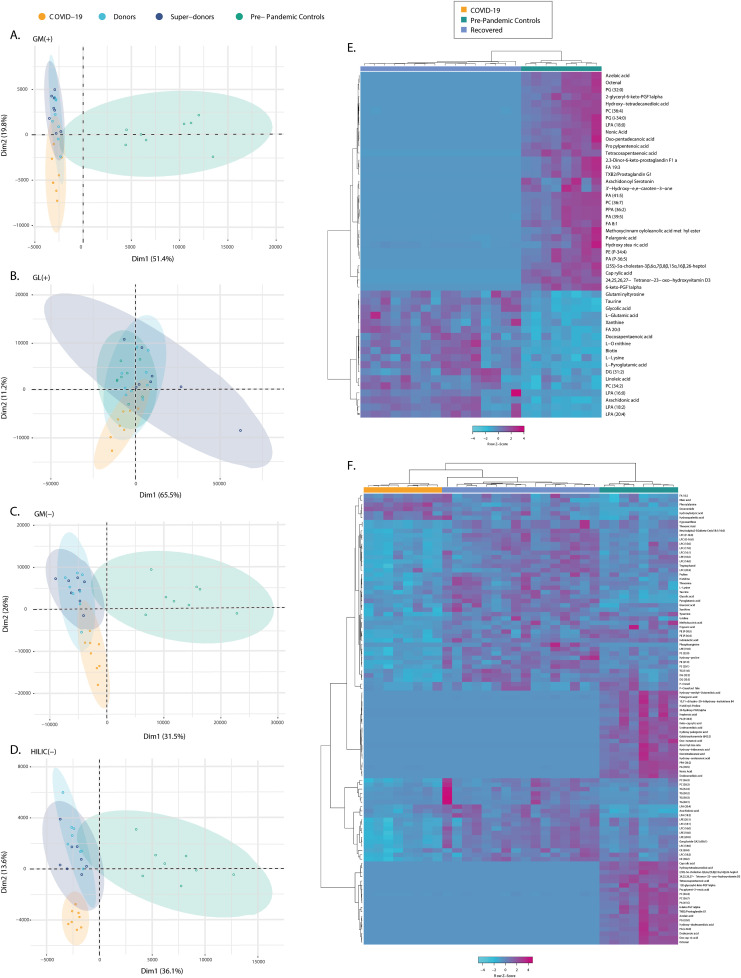
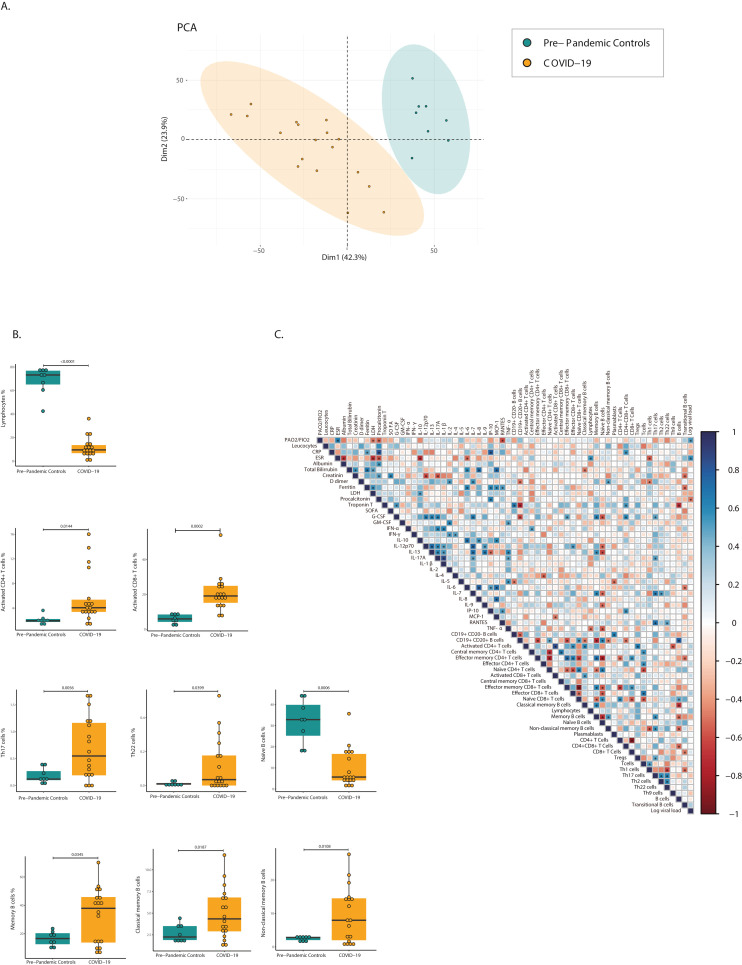
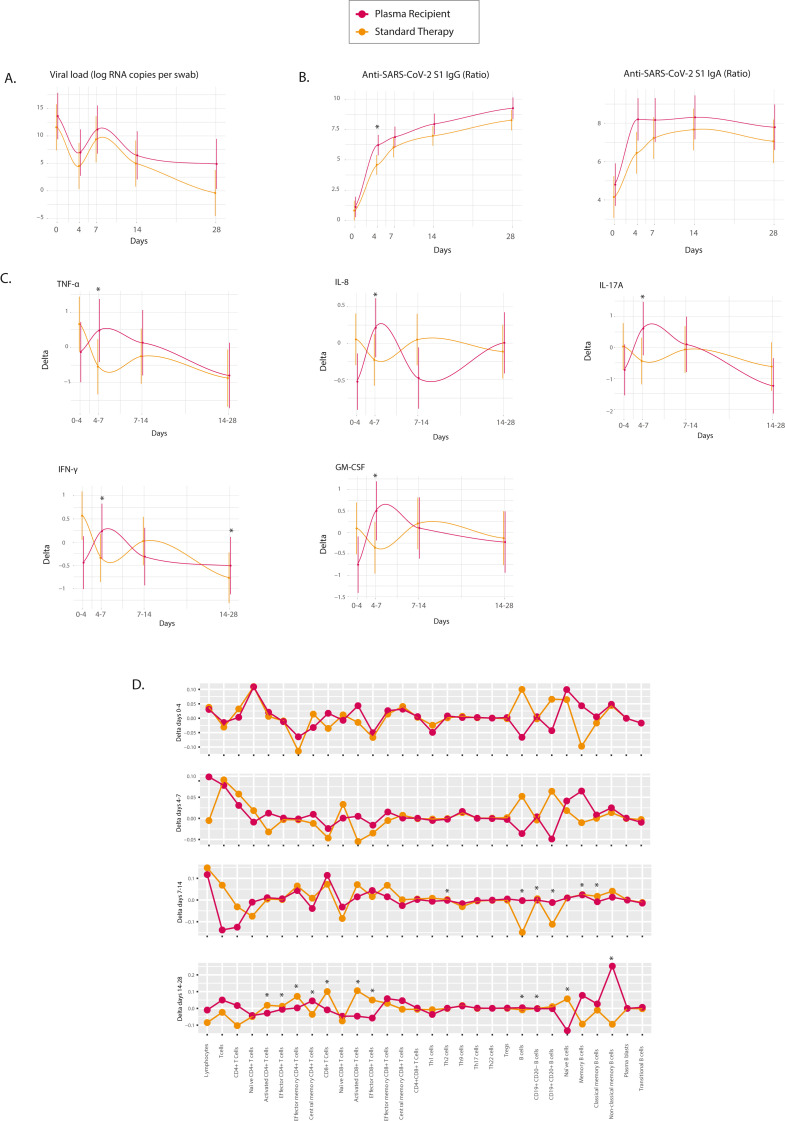
Convalescent plasma (CP) has emerged as a treatment for COVID-19. However, the composition and mechanism of action are not fully known. Therefore, we undertook a two-phase controlled study in which, first the immunological and metabolomic status of recovered and severe patients were evaluated. Secondly, the 28-day effect of CP on the immune response in severe patients was assessed. Nineteen recovered COVID-19 patients, 18 hospitalized patients with severe disease, and 16 pre-pandemic controls were included. Patients with severe disease were treated with CP transfusion and standard therapy (i.e., plasma recipients, n = 9) or standard therapy alone (n = 9). Clinical and biological assessments were done on day 0 and during follow-up on days 4, 7, 14, and 28. Clinical parameters, viral load, total immunoglobulin (Ig) G and IgA anti-S1-SARS-CoV-2 antibodies, neutralizing antibodies (NAbs), autoantibodies, cytokines, T and B cells, and metabolomic and lipidomic profiles were examined. Total IgG and IgA anti-S1-SARS-CoV-2 antibodies were key factors for CP selection and correlated with NAbs. In severe COVID-19 patients, mostly interleukin (IL)-6 (P = <0.0001), IL-10 (P = <0.0001), IP-10 (P = <0.0001), fatty acyls and glycerophospholipids were higher than in recovered patients. Latent autoimmunity and anti-IFN-α antibodies were observed in both recovered and severe patients. COVID-19 CP induced an early but transient cytokine profile modification and increases IgG anti-S1-SARS-CoV-2 antibodies. At day 28 post-transfusion, a decrease in activated, effector and effector memory CD4 (P < 0.05) and activated and effector CD8 (P < 0.01) T cells and naïve B cells (P = 0.001), and an increase in non-classical memory B cells (P=<0.0001) and central memory CD4 T cells (P = 0.0252) were observed. Moreover, IL-6/IFN-γ (P = 0.0089) and IL-6/IL-10 (P = 0.0180) ratios decreased in plasma recipients compared to those who received standard therapy alone. These results may have therapeutic implications and justify further post-COVID-19 studies.
恢复期血浆(CP)已成为治疗 COVID-19 的一种方法。然而,其组成和作用机制尚不完全清楚。因此,我们进行了一项两阶段对照研究,首先评估了康复患者和重症患者的免疫和代谢组学状况。其次,评估 CP 对重症患者免疫反应的 28 天影响。纳入了 19 名康复的 COVID-19 患者、18 名住院的重症患者和 16 名大流行前的对照者。重症患者接受 CP 输血和标准治疗(即血浆接受者,n=9)或单独标准治疗(n=9)。在第 0 天和随后的第 4、7、14 和 28 天进行临床和生物学评估。检查了临床参数、病毒载量、总免疫球蛋白(Ig)G 和 IgA 抗-S1-SARS-CoV-2 抗体、中和抗体(NAb)、自身抗体、细胞因子、T 和 B 细胞以及代谢组学和脂质组学特征。CP 选择的关键因素是总 IgG 和 IgA 抗-S1-SARS-CoV-2 抗体,与 NAb 相关。在重症 COVID-19 患者中,白细胞介素(IL)-6(P<0.0001)、IL-10(P<0.0001)、IP-10(P<0.0001)、脂肪酸和甘油磷脂的水平高于康复患者。潜伏自身免疫和抗 IFN-α 抗体在康复和重症患者中均有观察到。COVID-19 CP 诱导了早期但短暂的细胞因子谱修饰,并增加了 IgG 抗-S1-SARS-CoV-2 抗体。在输血后第 28 天,观察到活化、效应和效应记忆 CD4(P<0.05)和活化及效应 CD8(P<0.01)T 细胞以及幼稚 B 细胞(P=0.001)减少,而非经典记忆 B 细胞(P<0.0001)和中央记忆 CD4 T 细胞(P=0.0252)增加。此外,与单独接受标准治疗的患者相比,血浆接受者的 IL-6/IFN-γ(P=0.0089)和 IL-6/IL-10(P=0.0180)比值降低。这些结果可能具有治疗意义,并证明了 COVID-19 后进一步研究的合理性。