Korea Institute of Brain Science, Seoul 06022, Korea.
Department of Integrative Health Care, University of Brain Education, Cheonan 31228, Korea.
Int J Mol Sci. 2021 Jan 28;22(3):1317. doi: 10.3390/ijms22031317.
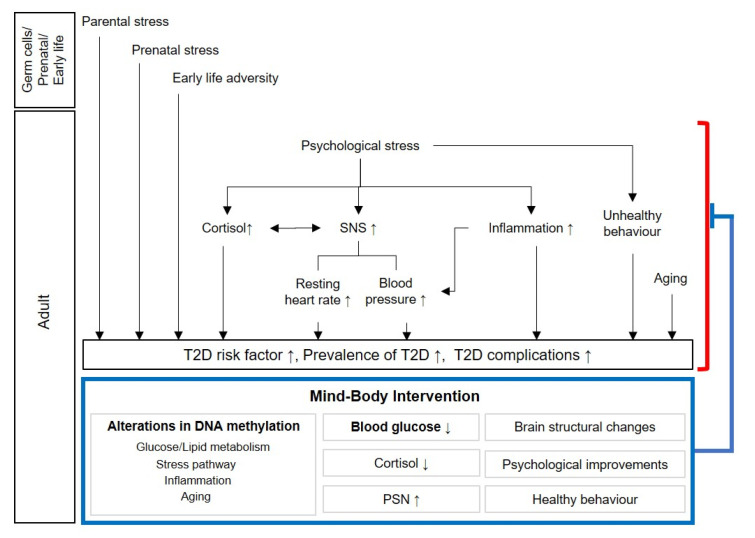
Studies have evidenced that epigenetic marks associated with type 2 diabetes (T2D) can be inherited from parents or acquired through fetal and early-life events, as well as through lifelong environments or lifestyles, which can increase the risk of diabetes in adulthood. However, epigenetic modifications are reversible, and can be altered through proper intervention, thus mitigating the risk factors of T2D. Mind-body intervention (MBI) refers to interventions like meditation, yoga, and qigong, which deal with both physical and mental well-being. MBI not only induces psychological changes, such as alleviation of depression, anxiety, and stress, but also physiological changes like parasympathetic activation, lower cortisol secretion, reduced inflammation, and aging rate delay, which are all risk factors for T2D. Notably, MBI has been reported to reduce blood glucose in patients with T2D. Herein, based on recent findings, we review the effects of MBI on diabetes and the mechanisms involved, including epigenetic modifications.
研究表明,与 2 型糖尿病(T2D)相关的表观遗传标记可以通过父母遗传或通过胎儿和生命早期事件以及通过终身环境或生活方式获得,这会增加成年后患糖尿病的风险。然而,表观遗传修饰是可逆的,可以通过适当的干预来改变,从而减轻 T2D 的危险因素。身心干预(MBI)是指冥想、瑜伽和气功等干预措施,同时涉及身心健康。MBI 不仅会引起心理变化,如减轻抑郁、焦虑和压力,还会引起生理变化,如副交感神经激活、皮质醇分泌减少、炎症减轻和衰老速度减缓,这些都是 T2D 的危险因素。值得注意的是,有报道称 MBI 可降低 T2D 患者的血糖。在此,基于最近的研究结果,我们综述了 MBI 对糖尿病的影响及其涉及的机制,包括表观遗传修饰。