Howard Hughes Medical Institute, Robin Chemers Neustein Laboratory of Mammalian Cell Biology and Development, The Rockefeller University, New York, New York 10065, USA.
Genes Dev. 2021 Feb 1;35(3-4):199-211. doi: 10.1101/gad.346973.120.
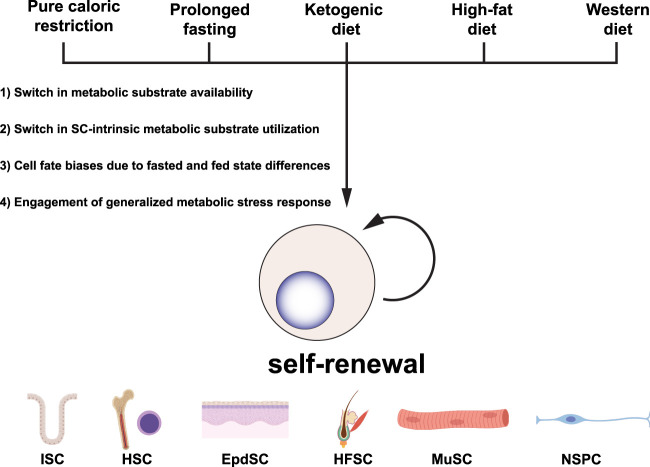
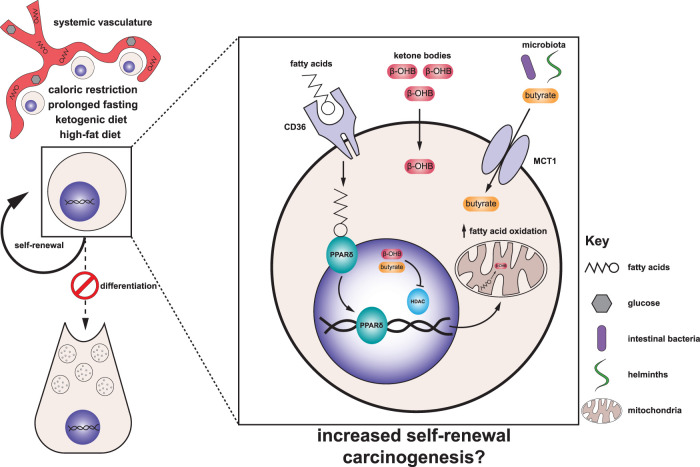
Stem cells maintain tissues by balancing self-renewal with differentiation. A stem cell's local microenvironment, or niche, informs stem cell behavior and receives inputs at multiple levels. Increasingly, it is becoming clear that the overall metabolic status of an organism or metabolites themselves can function as integral members of the niche to alter stem cell fate. Macroscopic dietary interventions such as caloric restriction, the ketogenic diet, and a high-fat diet systemically alter an organism's metabolic state in different ways. Intriguingly, however, they all converge on a propensity to enhance self-renewal. Here, we highlight our current knowledge on how dietary changes feed into stem cell behavior across a wide variety of tissues and illuminate possible explanations for why diverse interventions can result in similar stem cell phenotypes. In so doing, we hope to inspire new avenues of inquiry into the importance of metabolism in stem cell homeostasis and disease.
干细胞通过自我更新与分化之间的平衡来维持组织。干细胞的局部微环境或龛位,为干细胞的行为提供信息,并在多个层面接收输入。越来越明显的是,生物体的整体代谢状态或代谢物本身可以作为龛位的组成部分,改变干细胞的命运。宏观的饮食干预,如热量限制、生酮饮食和高脂肪饮食,以不同的方式系统性地改变生物体的代谢状态。然而,有趣的是,它们都倾向于增强自我更新。在这里,我们强调了我们目前对饮食变化如何影响各种组织中的干细胞行为的了解,并阐明了为什么不同的干预措施可以导致相似的干细胞表型的可能解释。通过这样做,我们希望激发对代谢在干细胞稳态和疾病中的重要性的新研究途径。